
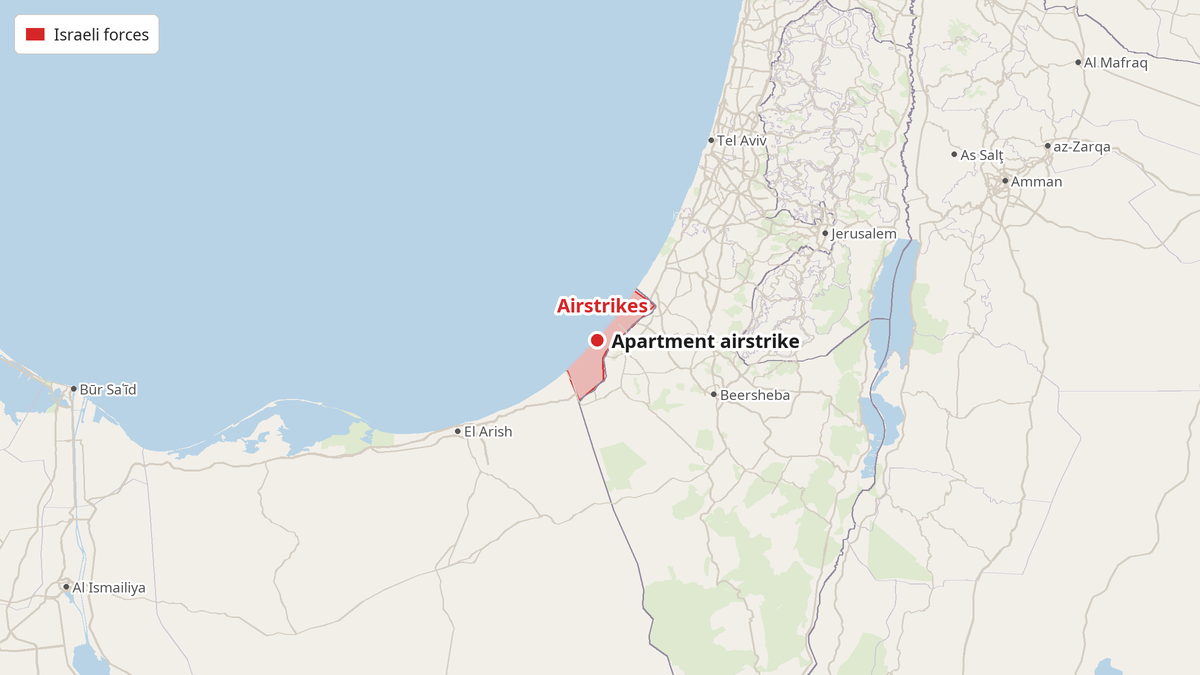
The IDF and Shin Bet confirmed they killed senior Hamas political bureau official Khaled Abu Nada in a strike in Deir al-Balah, while Israeli strikes continued for a third consecutive night during a year-old ceasefire. Hamas leader Khalil al-Hayya said the group was consulting other Palestinian factions about a response. The civilians living under both armed authorities remain inside the equation, though the statements from those authorities leave them largely outside it.
A ceasefire with strikes
Abu Nada headed Hamas's Economic Department and served as the terrorist organization's education minister. The military said he managed Hamas's banking and investment systems, directed funds toward terrorist activities and helped rehabilitate its military capabilities. Those are the IDF and Shin Bet's stated grounds for the killing; the strike itself was confirmed by the two agencies.
Prime Minister Benjamin Netanyahu and Defense Minister Israel Katz said in a joint statement on Thursday: "No terrorist is immune, and no one in the Hamas leadership will manage to evade us." The language is blunt: Israeli state power claims the right to reach Hamas leaders wherever they are in Gaza, despite the ceasefire agreement.
Al-Hayya framed Hamas's position around the same agreement. "The equation of continued killing and siege under an agreement is unacceptable to us. We are holding discussions with the other Palestinian factions on how to respond to the daily killings directed against us," he said. He didn't specify what measures were being considered. Hamas's consultation with other factions is not, by itself, evidence of grassroots decision-making or civilian control over the response.
Competing apparatuses
On Wednesday, the IDF and Shin Bet confirmed the killing of Muhammad Majed Abu al-Ouf, head of Hamas's internal security apparatus in the northern Gaza Strip. The military said Abu al-Ouf had been involved in efforts to restore Hamas's operational capabilities and had overseen executions of Palestinians who opposed the organization's rule.
Netanyahu and Katz confirmed on Tuesday the killing of Naeem Abu Nahel, head of Hamas's internal security apparatus in the Gaza Strip. Hamas condemned his killing and called on the international community to pressure Israel to adhere to the ceasefire agreement. The stated role of Abu al-Ouf's apparatus points to another form of coercive power over Palestinians: Hamas security forces, like Israel's military, operate through command structures, while the people subject to them have no voice in these official accounts.
These forces aren't interchangeable in their actions or consequences. But the account describes two authorities wielding organized force: Israeli agencies carrying out targeted killings, and Hamas maintaining an internal security apparatus whose former head was accused by the military of overseeing executions of opponents. The dead are named. The people governed, besieged and caught under the strikes are not counted here.
A plan for disarmament and rule
International efforts were underway to advance US President Donald Trump's peace plan for Gaza, including Hamas's disarmament and the establishment of an alternative governing authority. On Monday, the Board of Peace announced that Hamas and other Palestinian factions had agreed to a disarmament roadmap involving the relinquishment of their weapons and the transfer of civilian and security responsibilities to a transitional Palestinian administration.
The board said implementation remained limited and called on Israel and Hamas to fulfill their commitments under the agreement. That is the machinery on offer: armed organizations relinquish weapons, and civilian and security powers move to a transitional administration. The announcement doesn't describe how Gaza's residents would choose that authority, oversee it or refuse its rule. It also doesn't change the immediate fact reported here: strikes continued for a third consecutive night under a ceasefire that had been in place for one year.
The base account names no aid organizations, human rights groups, grassroots networks or mutual-aid efforts, and gives no account of civilians organizing outside the armed authorities. The space left in the story is occupied by official statements, military claims and an international board's roadmap. Israel says no Hamas leader can evade it; Hamas says it is consulting factions; the Board of Peace says implementation is limited. Gaza's people remain the ones living beneath the decisions.
- gaza
- hamas
- israel defense forces
- khalil al-hayya
- targeted killings
- ceasefire agreement
- donald trump peace plan
- disarmament