
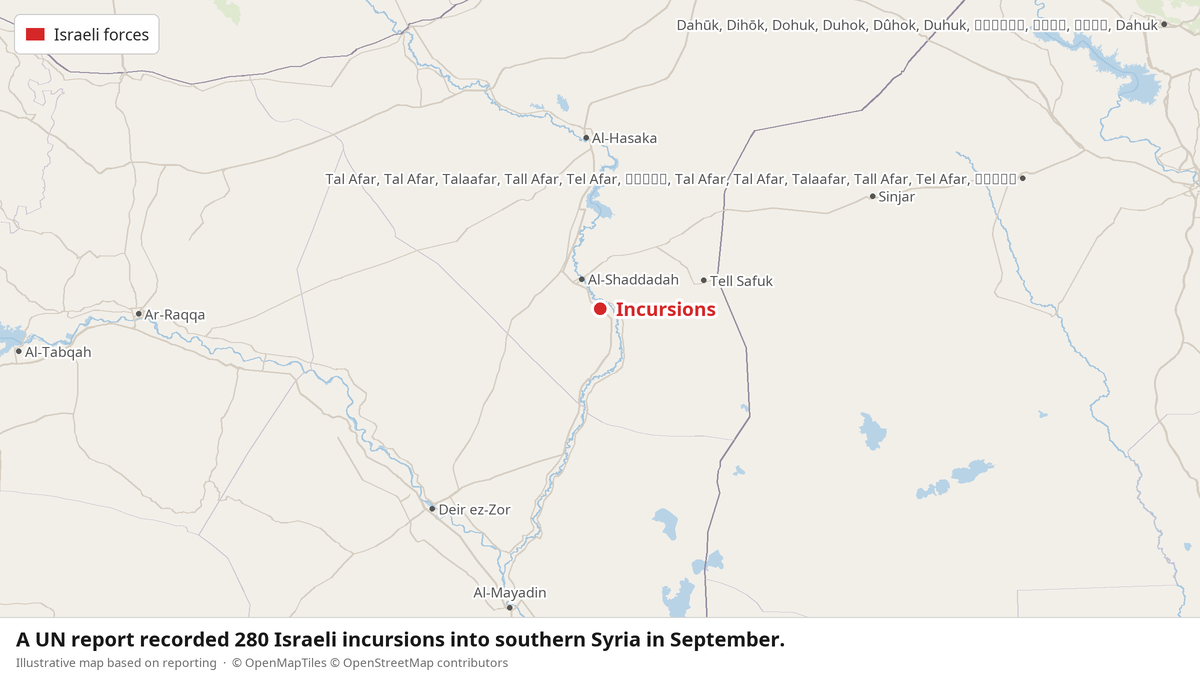
According to UN High Commissioner for Human Rights Volker Turk, Israel carried out 280 armed incursions into southern Syria in September, the highest monthly number recorded since the beginning of the year. His office also said 49 Syrians remain in Israeli detention, though it couldn't independently verify that figure.
The numbers come from a border zone whose control and character have changed in under two years. Israeli troops crossed into southern Syria and areas west of Damascus and occupied parts of those regions soon after rebel forces led by current President Ahmad Al Shara ousted Bashar Al Assad’s regime in December 2024, about one year and 10 months before today. A collapsing state on Israel’s northern frontier left a security vacuum. Israeli forces moved in.
What the UN Alleges
Turk’s office says released detainees have alleged torture and ill-treatment, including beatings, prolonged forced standing and threats against their families. Drawing on open-source monitoring, it also cited reported home raids, restrictions on movement, harassment and intimidation of civilians, arbitrary detention and destruction of livelihoods.
The office urged Israeli authorities to “cease actions that harass or intimidate civilians in Syrian villages, including raids, restrictions on freedom of movement, detention and destruction of crops.” Those are serious allegations from a UN body with a long record of heavy scrutiny of Israel. The office acknowledges that it can’t verify the detention figure, and the base reporting contains no Israeli response to the allegations or explanation of why the detentions occurred. Israel’s side of that ledger remains unreported here.
The Diplomatic Track
The more consequential story may be unfolding at the negotiating table. The US, which backs Syria’s current rulers, has supervised several meetings between Israeli and Syrian officials aimed at negotiating a peace deal. The discussions have covered halting Israeli attacks on Syria and returning Israeli forces to the 1974 armistice line adjacent to the Golan Heights. The line is 52 years old.
That’s a notable shift. Israel and Syria have no peace treaty, yet the two sides are now meeting under US supervision to discuss a possible deal. Whether the talks can produce guarantees Israel can rely on remains an open question. Damascus is led by a man whose rebel forces toppled Assad only recently, and Israeli planners have little track record to judge him by.
Fortifications and Competing Claims
Syria’s Foreign Ministry accused Israel of building major military fortifications in Syrian territory along the occupied Golan Heights. It said Israel was working to complete its “Sufa 53 Line,” in violation of previous agreements. The statement doesn’t specify which agreements. According to the reporting, areas near the Golan Heights have seen more Israeli incursions this year.
Two facts sit uneasily together. Israel is negotiating over a return to the 1974 line while Syria says it is fortifying positions beyond it. Israel hasn’t addressed the fortification claim in the available material. For Israeli security planners, the logic of a forward posture is clear enough: with the former regime gone and a new, untested government in Damascus, a buffer offers some insurance against whatever fills the void next. For Syrian villagers, the cost of that posture is what the UN describes.
Why This Matters: Israel’s northern and northeastern frontiers have never been quiet. Assad’s fall removed a hostile but predictable neighbor and replaced it with uncertainty. Israeli forces in southern Syria reflect a doctrine that doesn’t wait for threats to organize on the border. But the UN allegations, even unverified, carry diplomatic costs and complicate the US-supervised talks that could deliver a durable arrangement. From a security standpoint, the best outcome is a deal with enforceable guarantees that Syrian territory won’t become a launchpad for hostile forces. That means Israeli conduct on the ground and the credibility of the negotiations are now tied together.