
Prison terms of up to five years and fines of €20,000 for joining a protest group that 'endangers public safety'. That's the emergency package Prime Minister Giorgia Meloni's government put in place after youth clashed with police in Milan, and it was the backdrop on Friday, October 30, 2026, as tens of thousands of students and workers marched across Italy. The Independent reported the measures also make parents financially liable when their children take part in vandalism and looting, and raise penalties where faces are concealed or people are injured.
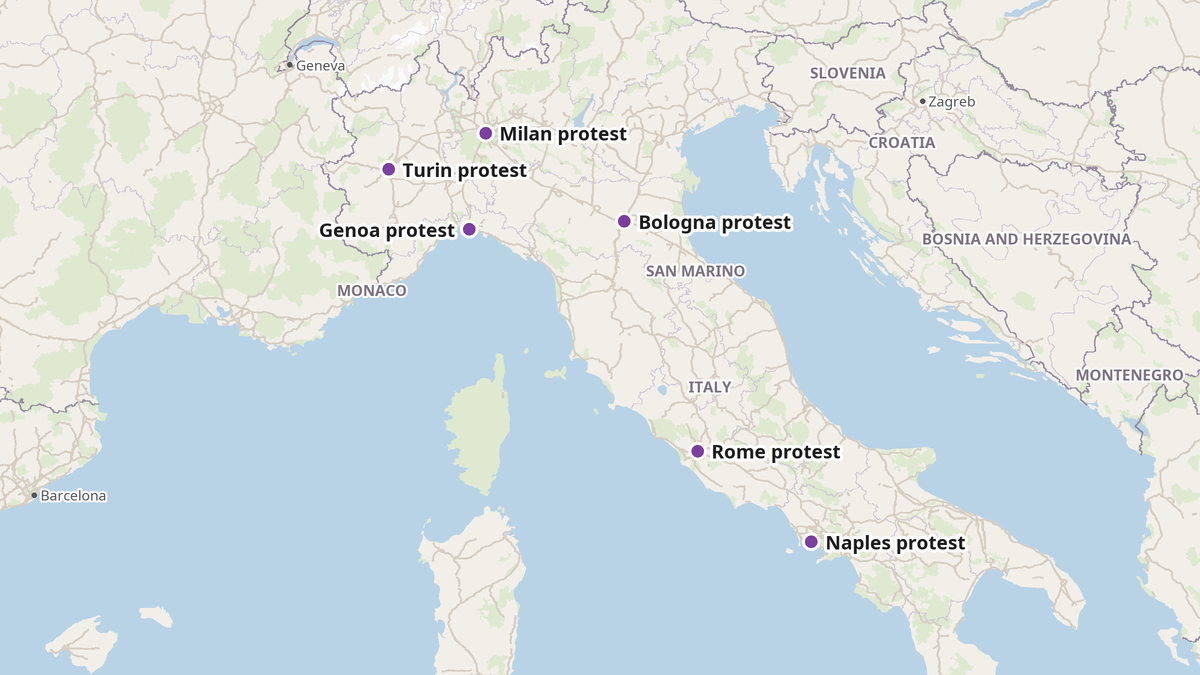
Marches ran through dozens of cities, including Rome, Milan, Turin, Bologna, Genoa and Naples. The Independent reported demonstrations scheduled in more than 50 cities. Police deployed in large numbers. Armoured vehicles stood near the Colosseum in Rome, and heavy police trucks were rallied to protect a military exhibition at the Circus Maximus.
Who Pays for the Rearmament
Demonstrators criticised the government over low wages, rising fuel prices and military spending. "We need more houses, not bombs!" one group chanted in Rome, where thousands marched from Termini station past the Colosseum, accompanied by two tractors and a taxi. Al Jazeera reported that rallies in recent weeks have demanded an end to higher fuel prices and rising defence spending.
The USB trade union called a general strike. Truck drivers, taxi drivers and farmers joined. Unions then issued a joint call with peers in France, Greece, Spain, Turkiye and Morocco demanding an end to the wars in the Middle East, including the war in Gaza, and "an end to the militarisation of ports." Their statement said: "Ports must not be used for the transport of weapons, ammunition, military equipment and troops. Dockworkers do not work for war!"
The numbers behind the anger are blunt. Prices paid in Italy for food, energy, transport and bills have risen by 68 percent since 2000, while the average wage fell by almost 5 percent.
Wages That Don't Cover Rent
Beatrice Chilelli, 21, a university student in Rome, told AFP that students were "at a breaking point." She said they "can't afford to pay exorbitant tuition fees, and rent... which weighs heavily on their parents' shoulders." Medical students in Rome told La Repubblica they were marching after years on temporary contracts and salaries of just €1,300-1,500 per month, while paying €900 in rent.
The government's answer last week was a 175 million euro aid package for truck drivers, farmers and fishermen hit by fuel prices linked to the war in the Middle East. The draft 2027 budget includes an annual bonus of 2,500 euros for workers under 30. Meloni said at a news conference on Wednesday she hoped this could provide answers for young people "who feel that the state doesn't care about them," stressing the measures were "not for those who smash windows."
One banner in the crowds read: "the problem is not the foreigner but the lack of education."
Policing the Streets
In Turin, minor scuffles broke out between demonstrators and riot police at the start of the march. The Independent reported protesters forced their way through a blockade on Via Rossini, forcing officers to retreat. In Vicenza, ANSA reported three people injured, including one hit in the head by a tear gas canister; water cannon blocked the march after protesters tried to force through a blockade. In Naples, protesters headed for the central station chanting "let's block everything," as armoured vehicles guarded the main entrance. In Bologna, student groups used dumpsters to block entrances to several high schools, and shopkeepers installed screens to protect windows. Authorities increased protection around landmarks including Rome's Colosseum and Milan's cathedral. The Colosseum was placed under lockdown after some protesters entered last Saturday.
In Milan, hundreds gathered outside Milan Polytechnic over the right to education, cost of living and rearmament. One protester said over a megaphone: "We're taking back the city. Let's make a mess. Let's make our voices heard."
A Movement Across Borders
The student protests have drawn momentum from similar movements in France and Spain. A banner in Rome read: "Spain, France, Italy. A new '68 is coming." Students were heard chanting: "Every school will be an occupation, every square will be a revolution." Teachers, retirees and other workers joined.
In France, interior minister Laurent Nuñez said the coming Saturday looked like a "very high risk" day for public order and that he would again deploy 70,000 security forces. His ministry said 410,000 people took part in marches last Saturday. Labour leaders and students have urged further protests Saturday and a nationwide strike on November 5, six days from today.
- italy protests
- student protests
- cost of living
- education funding
- general strike
- giorgia meloni
- usb union
- rome