
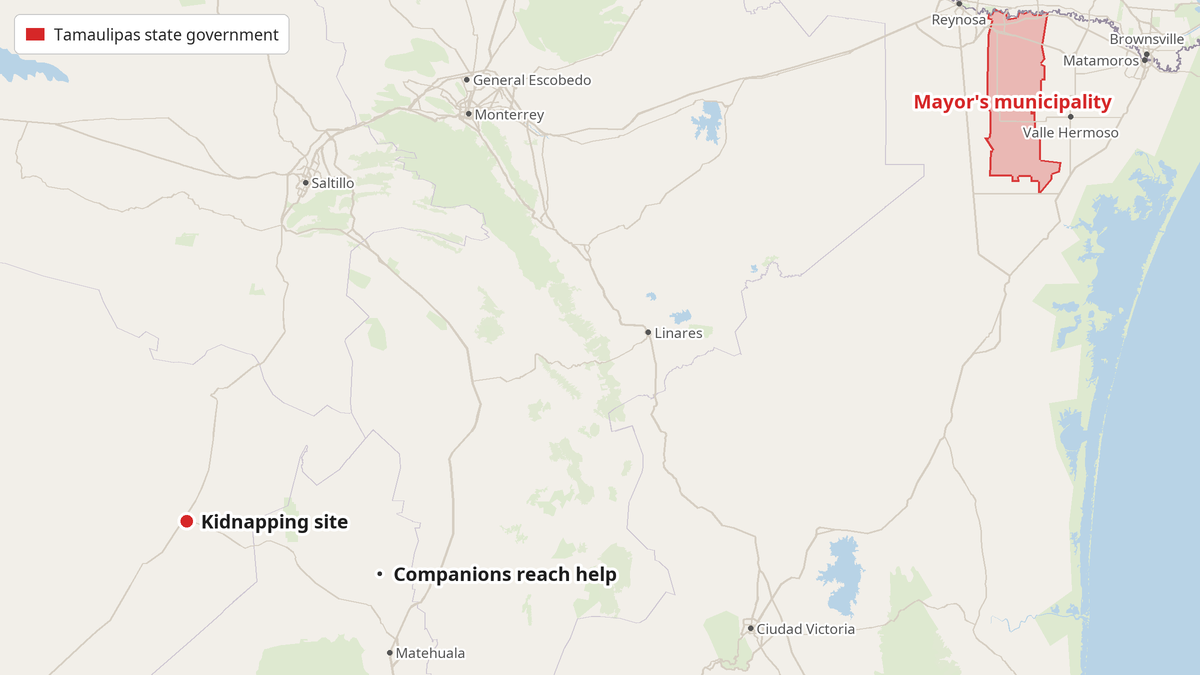
Miguel Ángel Almaraz Maldonado, the mayor of Río Bravo, Tamaulipas, was found alive Sunday after armed men snatched him on a highway in a stretch of north-central Mexico where drug gangs operate, federal officials said. He'd been missing for several hours. His companions weren't so lucky with their nerves, but they weren't harmed either.
The mayor had been traveling Saturday with family, friends and members of his team near the boundary between Zacatecas and San Luis Potosí, between the communities of San Tiburcio and Cedral, when gunmen intercepted his vehicle. They took the mayor and left the others behind. The Security Department of San Luis Potosí said the companions were abandoned at the roadside and made their way to Cedral, where they begged local authorities for help.
A Multi-State Scramble
The Tamaulipas State Attorney General's Office received a report Saturday night, 7 November, about the probable unlawful deprivation of liberty of the mayor and his companions, according to Infobae. That complaint set off a search involving state and federal forces. Coahuila's government said search protocols and information-sharing mechanisms were activated with prosecutors and security authorities in Zacatecas, San Luis Potosí and Tamaulipas, in coordination with the federal Security Cabinet. The Secretaría de Seguridad y Protección Ciudadana, the Fiscalía General de la República, the Secretaría de la Defensa Nacional and the Secretaría de Marina all took part.
Security Secretary Omar García Harfuch announced the finding Sunday morning and credited coordination among federal institutions and the governments of Zacatecas, Coahuila, San Luis Potosí and Tamaulipas. According to Infobae, he thanked governors David Monreal Ávila, Manolo Jiménez Salinas, Ricardo Gallardo Cardona and Américo Villarreal Anaya.
Competing Accounts of the Release
How Almaraz got free depends on who's telling it. Coahuila's government and State Attorney General's Office said he was rescued at a State Police checkpoint on the Coahuila-Zacatecas boundary and is under the formal protection of the Coahuila State Attorney General's Office. They said he received a medical evaluation, food, hydration and institutional accompaniment. AP, citing the security department's account of his testimony, reported something different: he was taken to the city of Zacatecas, where his captors released him, then boarded public transport on his own and headed north, where he was located on a highway near the capital of Coahuila.
Almaraz himself told yet another version, according to Infobae. He said he escaped. Held in a pasture, he said, he and other people jumped a fence when their captors left and ran for about an hour without stopping, then wandered through the night. He put the trek at about 80 kilometers. He reached a passenger bus, rode to the Coahuila-Zacatecas boundary and asked for help at a Policía de Acción y Reacción checkpoint. He said he had no blows or injuries but admitted to moments of great fear.
The differing accounts remain unreconciled in the public record.
The Governor's Pledge
Tamaulipas Governor Américo Villarreal Anaya wrote on X that Almaraz is out of danger and back in his municipality with his family. The act "will not go unpunished," he said, and he pledged to find those responsible and bring them to justice. "The full weight of the law will be applied, with strict adherence to due process," he wrote.
Authorities haven't named the perpetrators or a motive. Several drug gangs known for attacking civilians and politicians operate in the area, including the Jalisco New Generation Cartel and the Sinaloa Cartel, along with some cells of what was Los Zetas. The U.S. government has designated all of those groups as terrorist organizations. Zacatecas and San Luis Potosí sit in a north-central zone with a record of criminal violence and territorial disputes, including clashes, disappearances and attacks on civilians.
Who Is the Mayor
Río Bravo is a municipality of about 110,000 people, seven miles from the Texas border. Almaraz was imprisoned in 2009 on accusations of money laundering and stealing fuel, and he was acquitted six years later, in 2015. He belongs to the conservative National Action Party but has represented other parties, including the left-wing Party of the Democratic Revolution. The case remains under investigation.
Why This Matters: A sitting mayor of a border municipality was seized on a public highway, and the state's first line of defense was a group of frightened companions asking strangers for help. That's a stark data point about who controls the roads in parts of north-central Mexico. For the United States, the stakes are practical: Río Bravo sits seven miles from Texas, and the groups operating in the region are ones Washington has formally labeled terrorist organizations. Cross-border commerce depends on local officials who can govern without fear of abduction, and on a legal order that deters rather than merely reacts. The rescue effort drew in four federal agencies and four governors, which shows capacity when a prominent figure is taken. Whether that capacity reaches ordinary citizens, and whether prosecutors can deliver convictions with the due process the governor promised, is the real test.
- miguel angel almaraz maldonado
- rio bravo
- tamaulipas
- kidnapping
- zacatecas
- coahuila
- omar garcia harfuch
- mayor