
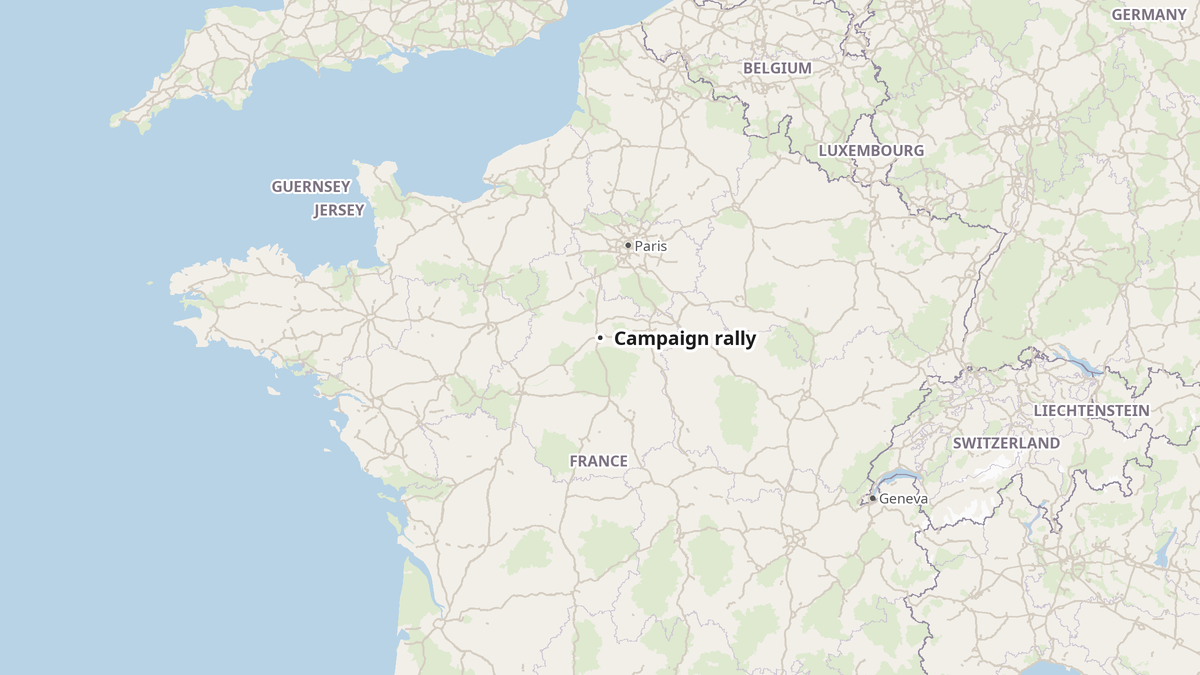
Marine Le Pen launched her presidential campaign in Orléans on Sunday, pledging to expel foreign offenders, preserve France’s cultural identity and establish what she called a “double border: French and European.” Her campaign began as protests over rising living costs again turned violent, putting public order and national authority at the centre of the contest ahead of the presidential election scheduled for April and May 2027.
Borders and national priority
Le Pen said she would pursue “national priority” if elected and promised greater security, including certainty that cases would be brought and sentences carried out. She said France’s language, traditions, values and way of life formed part of the cultural identity she wanted to preserve. The pledges place border control and the definition of national belonging among the central themes of her campaign.
At the rally, Le Pen called for “a alteration of course” that she said was “not a revolutionary act but a normal breath of democratic life.” She also said, “No one thinks we are stronger today than we were yesterday, nor that after ten years of Emmanuel Macron we are walking through a field of rose petals.” She claimed, “Everyone in France agrees with us”.
Le Pen criticised the justice system under Macron, describing it as too lax. Referring to looting and clashes on Oct. 17 during protests over rising living costs, she asked: “Who can claim there is a rule of law when hordes come to ransack and burn our buildings, or carry out real raids in front of law-enforcement officers who have been deliberately disarmed, both materially and morally?” She added: “The rule of law is not the law against the state.” She accused Macron’s government of lacking authority and “denying reality” in response to the violence.
Unrest and public order
More than 400,000 people marched in major French cities on Saturday, Oct. 24, according to the Interior Ministry. Organisers estimated nearly 800,000. Demonstrations were largely peaceful, but masked groups broke away from marches and clashes followed. Police arrested 1,314 people, 53 officers were injured, police responded to 75 fires and 24 shops were looted, the ministry said. It reported that the remainder of Saturday night after the clashes was calm, but gave no number for injured protesters.
Interior Minister Laurent Nuñez blamed much of the violence on “ultra-left” extremists. He said two protesters had been seriously injured, one in Toulouse and one in Clermont-Ferrand. The Toulouse prefecture said a 20-year-old man had a serious hand wound. A street medic who treated demonstrators told AFP anonymously that “several fingers” had been blown off his right hand. The Clermont-Ferrand prefecture said a man injured his hand but did not lose fingers. Officials said investigations had opened in at least some cases; it was not known whether the injuries reported on Saturday came from police weapons.
The protests came amid student demonstrations over the state of France’s schools and followed another weekend of protests that also descended into unrest. Unions and Yellow Vest protesters said they would continue marches in the coming weeks. The CGT union urged a strike campaign starting Nov. 5, while the Yellow Vest movement called for another protest day the following Saturday.
The election contest
Le Pen is the frontrunner in polls. An Ipsos survey published Saturday suggested she would receive 32% to 34% of first-round votes; the survey also found widespread anger over the unrest, with a majority saying the government was responsible for the crisis. Macron is reaching his two-term limit, and voters will choose his successor in April and May 2027.
Le Pen has also pledged to reduce living costs through capped household energy bills and lower taxes, and to reduce France’s contribution to the European Union. France’s debt and budget deficit were already above EU limits, while Macron’s government was struggling to pass a cost-cutting budget. Le Pen is critical of NATO and France’s support for Ukraine against Russia’s invasion. She said France “will not send” its young people “to die in reckless or irresponsible military adventures, and even less in wars that are not ours.”
Jordan Bardella, National Rally president, introduced Le Pen at the rally and said the RN “has appeared as the only option capable of restoring order and bringing back authority.” Bardella was re-elected party president with 98.98% of the vote at the RN congress held under heavy police protection the previous day. Le Pen is running for president, while Bardella is positioning himself to become her prime minister if she wins.
- marine le pen
- national rally
- france
- presidential election
- cost of living protests
- orleans
- jordan bardella
- rule of law