
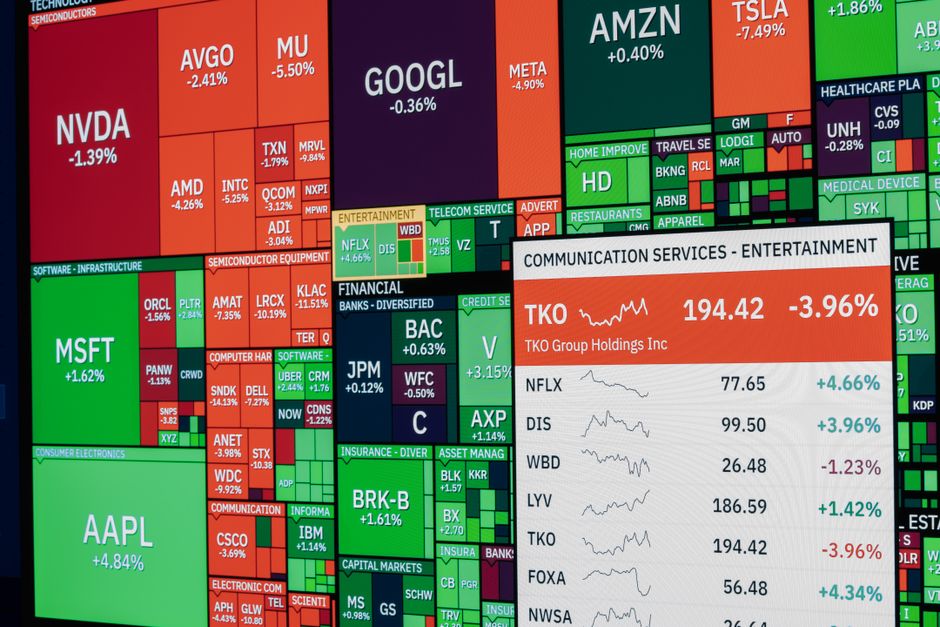
The Nasdaq Composite fell roughly 2.5% on Friday, leaving it down almost 5% for the week and on track for its worst week since June. The S&P 500 dropped 1.4%, pushing its weekly losses past 2%, also its worst week since June. For people whose retirement accounts and paychecks ride on these indexes, the numbers tell a sharp story, and it's still unfolding.
Both indexes had hit record highs just 10 days earlier. Then borrowing costs climbed, and debt-dependent corners of the AI boom started to buckle. Investors pulled back amid higher interest rates, mounting AI-related debt and risks to technology companies. The sell-off spread quickly.
The Debt Behind the Boom
The sharpest pain hit neocloud companies, which rent computing power to AI businesses. CoreWeave, a neocloud backed by Nvidia that went public in 2025, carries tens of billions of dollars of debt to finance its growth. Its bond yields recently rose to levels signaling distress or a higher risk of default.
Gil Luria, head of technology research at D.A. Davidson, didn't mince words with CNN. “It's unclear that (CoreWeave is) going to get a sufficiently good return to pay down the debt that they borrowed,” Luria said. “As people get concerned about the trajectory of the buildout, they are the subprime tranche of the AI trade, and that's why they're selling off first.”
Luria said demand for AI is real and growing. But, he argued, it collides with concerns about unsustainable financing and steep interest rates. That tension is the heart of the problem. Growth that depends on borrowed money lasts only as long as lenders keep extending it.
Nvidia CEO Jensen Huang told Bloomberg on Thursday that he was optimistic about CoreWeave, and the company's shares rallied that day. The rally didn't last. CoreWeave fell 14% on Friday, lost one-quarter of its value during the week, and sat more than 60% below a peak shortly after its March 2025 initial public offering.
Chips, China and the Cost Question
A closely watched semiconductor index fell 3.9% on Friday, its eighth straight daily decline. Investors had pushed chip stocks higher this year on expectations of a large AI buildout and shortages that could produce substantial profits. Now they're weighing higher costs and the possibility that political disputes over data centers could drag down growth forecasts.
Chinese memory-chip maker CXMT announced earlier in the week that it had made progress on advanced memory chips. Investors had counted on U.S. and South Korean chipmakers to keep their dominant market share and pricing power. They're now debating whether cheaper, efficient Chinese chips could weaken that outlook.
“The market sells first, asks questions later,” said Thomas Martin, portfolio manager at Globalt Investments.
The semiconductor index sat more than 20% below its June peak, though it remained up almost 60% year to date. South Korea's benchmark Kospi, heavily weighted toward SK Hynix and Samsung Electronics, fell 14.5% during the week, its worst weekly performance since 2008. It had risen as much as 116% year to date in June, then erased all gains from the previous six months before settling 35% higher for the year.
Semiconductor companies make up roughly one-fifth of the S&P 500's market value. That concentration means a chip slump doesn't stay in one sector. It reaches pension funds, index funds and household savings tied to them. The VIX, Wall Street's fear gauge, jumped 30% on Friday to above 20 points.
Who Pays for the Buildout
A New York Times DealBook item reported that the largest technology companies would spend around $800 billion on AI infrastructure in 2026, with consensus forecasts above $1 trillion for 2027. Goldman Sachs said that would represent a larger share of gross domestic product than any investment cycle since the railroads.
That scale should make everyone ask who carries the risk. Washington has made AI a national priority, the DealBook item noted, while raising questions about the cost of the buildout and whether companies could do it for less.
Nvidia's gross margin in the previous quarter reached 75%. Micron, which sells memory chips, reported a margin of nearly 87%. Three years ago, Micron was losing money on memory chips. The DealBook item said shortages set prices and high margins typically draw competitors. Yet competition hadn't pulled margins down in the AI buildout, a signal visible since 2023. The item cited AMD, custom silicon from Amazon and Chinese open-weight models as developments that could eventually lower costs. It also noted that relief would take time, and spending was already underway, partly backed by tax credits.
That last detail matters. When public money helps underwrite private buildouts, the public has a stake in whether profits are shared or simply concentrated.
Official Response
The Federal Reserve's chairman, Kevin Warsh, suggested he wouldn't push to raise borrowing rates that month, according to the DealBook item, though persistent inflation could force the Fed's hand. The S&P 500 appeared set to open higher on Friday, largely because of Warsh's remarks. Markets rose on his words, then fell through the day anyway.
Why This Matters:
The turmoil reaches far beyond trading desks. Borrowed money is funding a buildout that, by one estimate, could eclipse past investment cycles in its share of the economy. When companies at the riskiest edge of that buildout start to look like distressed borrowers, the damage can spread to lenders, investors and the wider economy. CoreWeave's bond yields, South Korea's worst week since 2008 and semiconductors' one-fifth share of the S&P 500 all point the same way: a great deal rides on a small group of firms. Working families whose savings sit in broad index funds have little say in how that risk is taken on. Democratic oversight of how this spending is financed, and who bears the losses if the bet sours, deserves the same scrutiny the boom itself has received.
- nasdaq composite
- s&p 500
- artificial intelligence
- coreweave
- semiconductor stocks
- nvidia
- interest rates
- ai infrastructure