
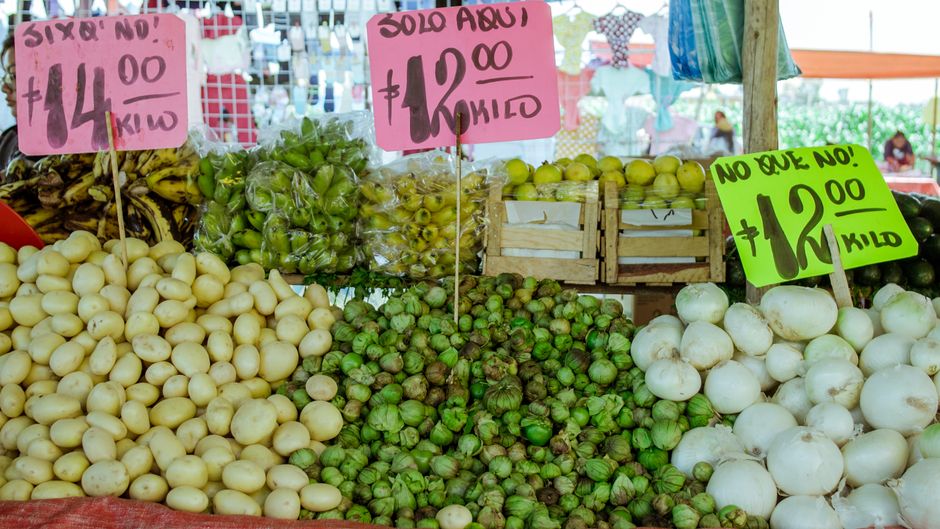
Tomatoes jumped 30.25% in September as Mexico’s annual inflation rose to 3.45%. Households faced higher prices, while the country’s central bank kept its overnight rate at 6.50%. The National Institute of Statistics and Geography (INEGI) reported consumer prices rose 0.42% from August. Core inflation eased, but the headline measure climbed for a second consecutive month.
The cost at the checkout
Fruit and vegetable prices rose 4.40% during September and 8.78% from a year earlier. Onions climbed 23.00%, while household LP gas rose 3.14%. Tomatoes and onions together added 0.20 percentage points to the monthly inflation increase—nearly half of it, Expansión reported. Potatoes fell 13.92%, avocados 8.11%, and internet, phone and pay-TV bundles 2.06%.
The figures don't explain why tomato and onion prices surged. INEGI also didn't say whether the increase would reverse in October. Households still face the costs in the meantime. A basket of 170 goods and services that tracks minimum living costs for lower-income households rose 3.29% from a year earlier.
Annual inflation stood at 3.26% in August and 3.12% in July, compared with 3.76% a year earlier. Core inflation, which excludes more volatile items, eased to 3.75% from 3.88% in August and 4.19% in May. Core prices rose 0.20% in September. Within the core index, goods inflation slowed to 3.21%, and services inflation slowed to 4.27%; restaurant and education costs still rose faster than the headline rate.
Who sets the terms
Banco de México (Banxico), the autonomous central bank, targets 3% inflation, with a tolerance range of one percentage point on either side. On 24 September, it said headline inflation would reach the target in the fourth quarter of 2027. Its board voted unanimously that day to keep the overnight rate at 6.50%, marking the third consecutive hold. The last rate cut came in May; the rate stood at 10.00% at the start of 2025.
Minutes published on Thursday showed that three of the five board members were open to cutting rates; one called it a possible one-off. The other two urged caution. One warned Banxico might otherwise have to discuss matching U.S. Federal Reserve hikes. The minutes named none of the members open to a cut, and none committed to a date. Citi-surveyed analysts, cited by Expansión, expected the rate to stay at 6.50% through December.
The Federal Reserve raised its target range by a quarter point in September, to 3.75% to 4.00%. It was the Fed’s first increase since July 2023. Banxico said Mexican monetary policy “would not have to react mechanically” to Federal Reserve moves because economic conditions differ between the two countries. The report covers central-bank decisions and forecasts. It identifies no community-led response to rising prices.
The peso and household costs
Banxico’s FIX reference rate rose from 16.98 pesos per U.S. dollar on Tuesday, 1 September, to 18.11 on Thursday, 8 October. That meant US$100 converted to about 1,811 pesos. A dollar bought 6.7% more pesos than on 1 September, but 1.3% fewer than a year earlier. Banxico listed peso depreciation as an upside risk to inflation: a weaker peso makes imported goods, including those from the United States, more expensive for Mexican buyers.
Remittances reached US$5.45 billion in August, 3.6% less than a year earlier, Banxico data showed. Producer prices rose 4.05% year over year, signaling costs for U.S. companies buying goods made in Mexico. Banxico’s next rate decision was due Thursday, 5 November, at 1 p.m. Mexico City time; INEGI was scheduled to publish October inflation on Monday, 9 November.