
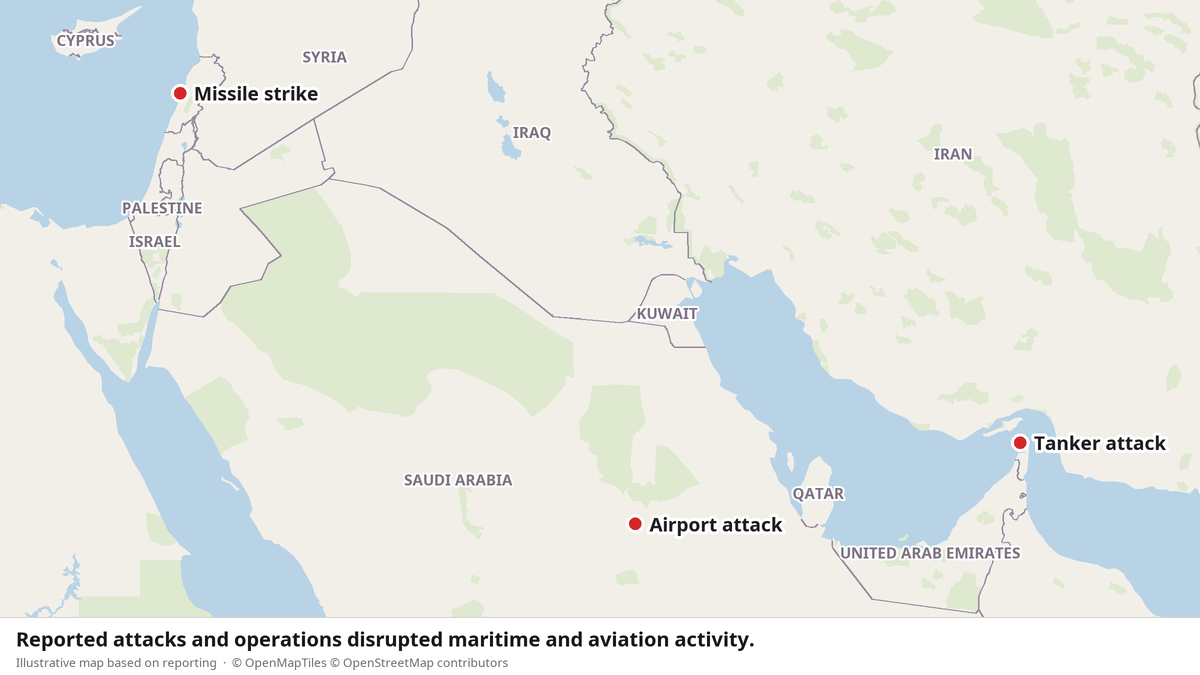
Three Saudi citizens died and several others were wounded in attacks on Riyadh airport, according to Saudi Arabia’s General Authority of Civil Aviation. The airport became a site of military attack and civilian disruption: flights were diverted, Kuwait Airways canceled flights, and Saudi Arabia urged stranded citizens to contact embassies. The institutions issuing warnings and directing operations couldn't keep ordinary travelers clear of the conflict’s consequences.
Airport Under Fire
The Associated Press reported that Houthi attacks on Thursday damaged three planes at Riyadh airport, citing two regional officials who spoke anonymously because they weren't authorized to brief the media. On Friday evening, one official said, the Houthis fired another missile at the airport, disrupting air traffic again. Flightradar24 said many flights were diverted. The National reported that a Riyadh-bound Qatar Airways flight returned to Doha after the attack.
The response brought further restrictions. The National reported that U.S. government employees needed special permission to use Riyadh airport, while U.S. and British nationals were advised to avoid it. Saudi Arabia urged citizens stranded by flight disruptions to contact embassies. Access to civilian infrastructure can hinge on decisions by armed groups and governments, while passengers bear the disruption. There's little protection for ordinary travelers.
Military Escalation, Civilian Exposure
The AP reported that fighting between the Houthis and Saudi-backed Yemeni government forces had escalated. A Saudi-led coalition provided air support for government forces seeking to reverse Houthi gains. The National listed a wide-ranging coalition operation in Yemen but gave no operational details in the extracted page content. Its update also reported that the UAE condemned the Houthi attack and that the United States stood with Saudi Arabia and Yemen against the Houthis.
President Donald Trump was evaluating whether the United States should join Saudi strikes against the Iran-backed Houthi rebels in neighboring Yemen, the AP reported. The report said Saudi-backed Yemeni government forces had launched a major military offensive. Another state could join the strikes, on top of the coalition’s existing air support, as more military power is considered in a conflict already disrupting civilian travel and killing people at an airport. That’s the stark reality.
The Tanker Claims Remain Unclear
The Islamic Revolutionary Guard Corps claimed an attack on a tanker in the Strait of Hormuz. Separately, the AP reported that the UAE national guard rescued 22 crew members after a fire aboard an oil tanker in the Persian Gulf. The crew, all of Asian nationalities, received first aid and were in stable condition, the statement said. The guard didn't identify the tanker or say where or why the fire began.
Iran’s state-run IRNA news agency cited the Revolutionary Guard Corps navy as saying an oil tanker was burning after striking a naval mine while attempting to transit the Strait of Hormuz. Whether that was the same incident remained unclear. The AP said commercial vessels transiting the strait had faced a surge in attacks during the U.S.-Iran war as Tehran sought to assert control over the waterway. The National’s extracted updates offered no further details about the tanker claim, the coalition operation, or the Riyadh airport attack. The U.S. embassy warned that Middle East hostilities had the “potential to escalate rapidly.” For passengers, crews and airport workers, that warning isn't abstract: armed decisions are already closing routes and putting civilians in danger.