
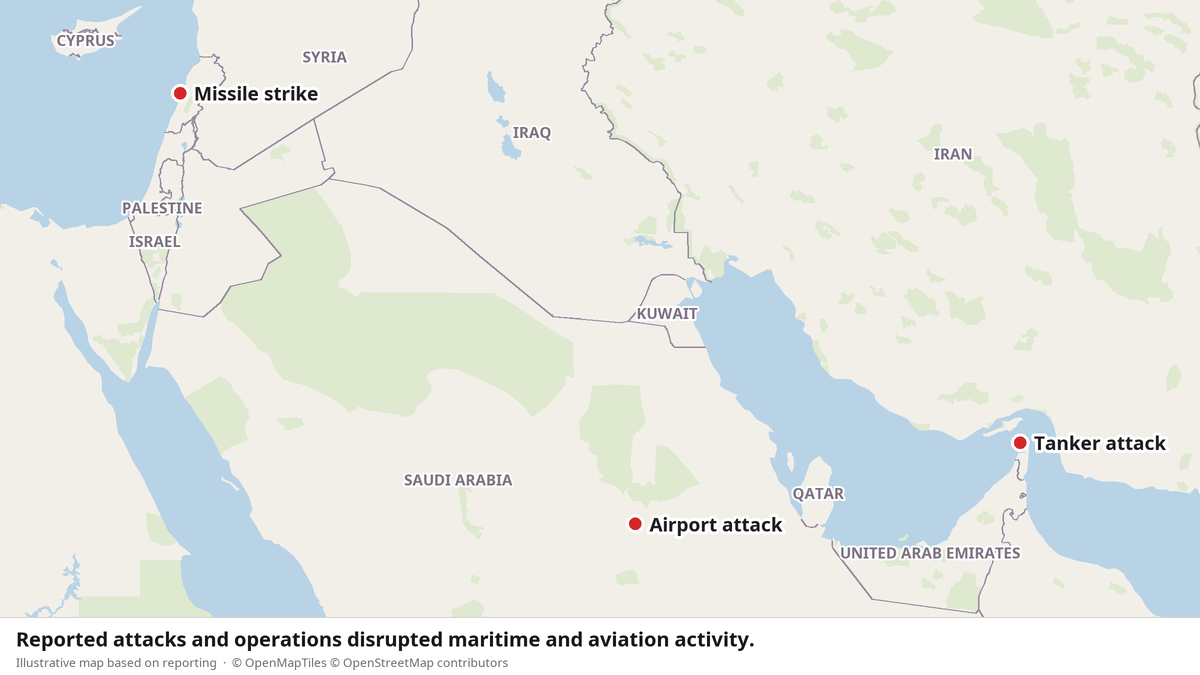
Three Saudi civilians died after Houthi missiles struck Riyadh airport on Thursday, wounding several others, damaging three planes and forcing the suspension of flight operations at one of the Middle East’s busiest aviation hubs. Another missile hit Friday evening, paralyzing civilian air travel across the kingdom and prompting dozens of international carriers to divert flights, leaving travelers stranded and commerce disrupted across a region already strained by wider hostilities.
The escalation lays bare a brutal reality of the broader conflict roiling the region: civilians pay the price when military actors choose confrontation over diplomacy. A Riyadh-bound Qatar Airways flight returned to Doha after Thursday’s attack. Kuwait Airways canceled all flights to and from Riyadh. The U.S. embassy warned that Middle East hostilities have the “potential to escalate rapidly.” The U.S. government required its own employees to get special permission to use Riyadh airport, while the State Department advised U.S. and British nationals to avoid it entirely.
The Price of Escalation
The airport attacks mark the most disruptive strike on Saudi civilian infrastructure in recent weeks. Two regional officials, who spoke anonymously because they weren’t authorized to brief the media, told the Associated Press that Houthi attacks damaged three planes on Thursday. Saudi Arabia’s General Authority of Civil Aviation confirmed Friday that three Saudi citizens were killed and several wounded in Thursday’s strikes. An official said air traffic faced another disruption Friday evening when the Houthis fired a missile at the airport. Flightradar24 recorded many flights diverting in real time.
The attacks aren’t isolated incidents. They form part of a wider pattern: the Iran-backed Houthis have escalated military operations as fighting between the group and Saudi-backed Yemeni government forces intensified. A Saudi-led coalition has provided air support for government forces seeking to reverse Houthi gains. A week earlier, Saudi-backed Yemeni government forces launched a major military offensive. President Donald Trump is currently evaluating whether the United States should join Saudi strikes against the Houthi rebels in neighboring Yemen.
Regional Instability and Commercial Consequences
The airport attack isn’t the only incident destabilizing the Persian Gulf. Commercial vessels crossing the Strait of Hormuz have faced a surge in attacks during the current U.S.-Iran conflict, as Tehran seeks to assert control over the waterway. The Islamic Revolutionary Guard Corps claimed an attack on a tanker in the Strait of Hormuz. Iran’s state-run IRNA news agency cited the Revolutionary Guard Corps navy as saying an oil tanker was burning after striking a naval mine while trying to cross the Strait of Hormuz. The UAE national guard rescued 22 crew members after a fire aboard an oil tanker in the Persian Gulf. The crew members, all of Asian nationalities, received first aid and were in stable condition.
Saudi Arabia urged stranded citizens to contact embassies amid flight disruptions. The UAE condemned the Houthi attack. The United States said it stood with Saudi Arabia and Yemen against the Houthis. Yet none of these statements has restored flight operations or brought the three dead civilians back to their families.
Why This Matters:
When non-state armed groups like the Houthis attack civilian infrastructure, they kill civilians and give governments a justification for military responses that often kill far more people. Riyadh airport’s closure shows how regional conflict reaches into ordinary lives: travelers stranded, commerce disrupted, and the Gulf’s already fragile economy further destabilized. The broader pattern is clear. Without serious diplomatic off-ramps, military escalation in the region creates widening circles of civilian harm. The U.S. evaluation of whether to join Saudi strikes raises a critical question: will deeper American military involvement push toward a political resolution, or further entrench the cycle of attack and counterattack that has already cost thousands of lives and displaced millions?