
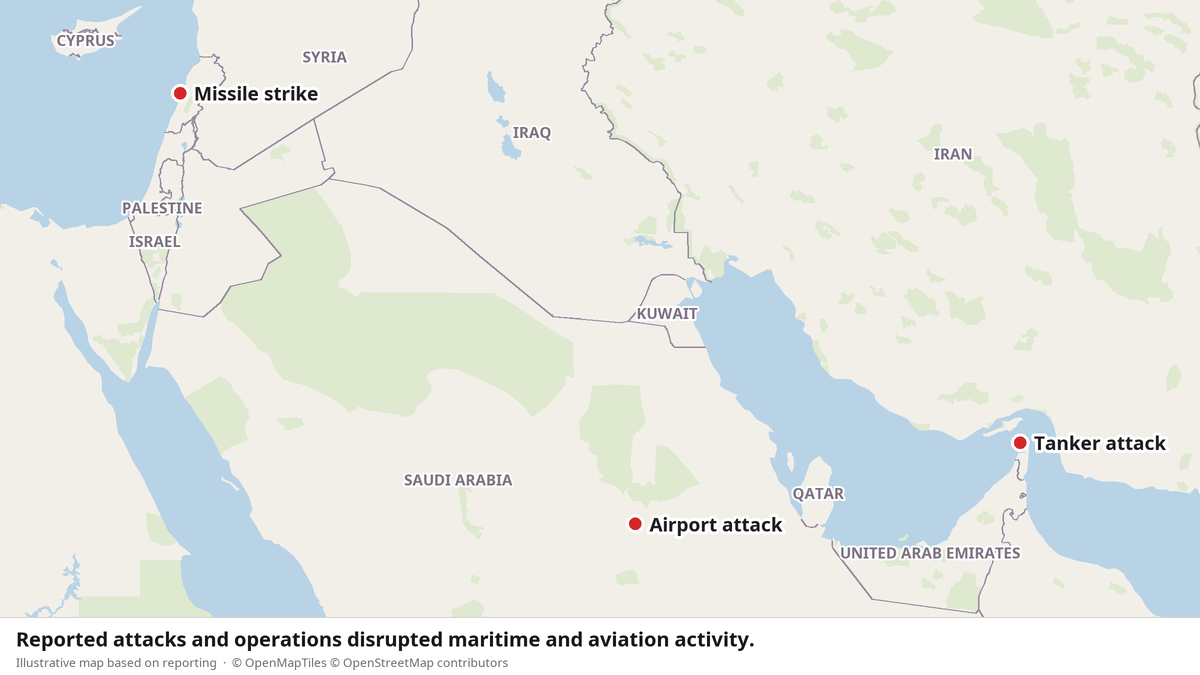
The Houthis struck Riyadh airport twice in 48 hours, killing three Saudi civilians, wounding several others, and forcing the kingdom’s aviation authority to suspend operations. On Thursday, Houthi attacks damaged three planes at the airport. Friday evening, another missile strike disrupted air traffic, forcing dozens of flights to divert and prompting Kuwait Airways to cancel all service to and from the city.
The attacks expose a critical vulnerability in Saudi Arabia’s air defenses and show Iran’s expanding ability to project power through proxy networks. The Revolutionary Guard Corps claimed it attacked a tanker in the Strait of Hormuz as part of the same escalation pattern, while fighting between the Houthis and Saudi-backed Yemeni government forces intensified across the border. Strikes on civilian aviation, attacks on shipping lanes, and ground offensives point to a coordinated pressure campaign Iran and its proxies are mounting across the region.
The Aviation Crisis
Saudi Arabia’s General Authority of Civil Aviation confirmed that three Saudi citizens died and several others suffered wounds in Thursday’s attack. The strikes damaged aircraft on the ground and forced the airport to cease operations. One official told reporters that the Houthis fired another missile Friday evening, disrupting air traffic again. Flightradar tracking data showed many flights diverting. A Qatar Airways flight bound for Riyadh returned to Doha after the attack. Kuwait Airways canceled all flights to and from the airport.
The disruptions spread across diplomatic and military channels. Saudi Arabia urged stranded citizens to contact embassies for assistance. The U.S. government required employees to obtain special permission before using Riyadh airport. The U.S. State Department and British Foreign Office advised their nationals to avoid the airport entirely. The U.S. embassy warned that Middle East hostilities had the “potential to escalate rapidly.”
The Strait of Hormuz and Tanker Operations
As the airport came under attack, the Revolutionary Guard Corps claimed responsibility for striking a tanker in the Strait of Hormuz. Iran’s state-run IRNA news agency, citing the Revolutionary Guard Corps navy, said an oil tanker was burning after it hit a naval mine while attempting to transit the waterway. The report said it wasn’t clear whether this was related to a separate incident in which the UAE national guard rescued 22 crew members after a fire aboard an oil tanker in the Persian Gulf. The crew members, all of Asian nationalities, received first aid and were reported in stable condition.
Commercial vessels transiting the strait have faced a surge in attacks. Tehran’s broader strategy seeks to assert control over one of the world’s most critical chokepoints for global energy supplies. The timing of the tanker claim alongside the airport strikes suggests a deliberate effort to create maximum pressure across several domains at once.
Yemen and the Wider Proxy War
Fighting between the Houthis and Saudi-backed Yemeni government forces has escalated significantly. A week earlier, the Saudi-led coalition launched a major military offensive with Yemeni government forces, providing air support in an attempt to reverse Houthi gains. The coalition described the operation as wide-ranging, though it hasn’t released specific operational details.
President Donald Trump was evaluating whether the United States should join Saudi strikes against the Iran-backed Houthi rebels in Yemen. State Department statements say the U.S. already stands with Saudi Arabia and Yemen against the Houthis. The UAE condemned the Houthi attack on Riyadh airport, adding regional diplomatic pressure to the military response.
Why This Matters:
The Houthi strikes on Riyadh airport and the claimed IRGC tanker attack expose a critical strategic problem: Iran and its proxy networks operate in multiple theaters at once—civilian aviation, shipping lanes, and ground combat—and can disrupt critical infrastructure while Saudi Arabia and its coalition partners struggle to maintain air defense coverage. Even a brief closure of a major international airport creates humanitarian and economic consequences that ripple across the region. If Iran’s proxies can strike civilian facilities with impunity, deterrence credibility and the costs of operating in contested airspace come into question. The escalation also complicates diplomatic efforts by raising the stakes for any negotiated settlement. For Israel and its regional partners, the pattern demonstrates why security guarantees must precede territorial concessions: proxy networks operating from ungoverned spaces or hostile states can strike civilian targets regardless of formal peace agreements. The U.S. decision on direct involvement in coalition strikes will signal whether pressure on Iran and its proxies carries real consequences or whether Tehran still sees further escalation as favorable.