
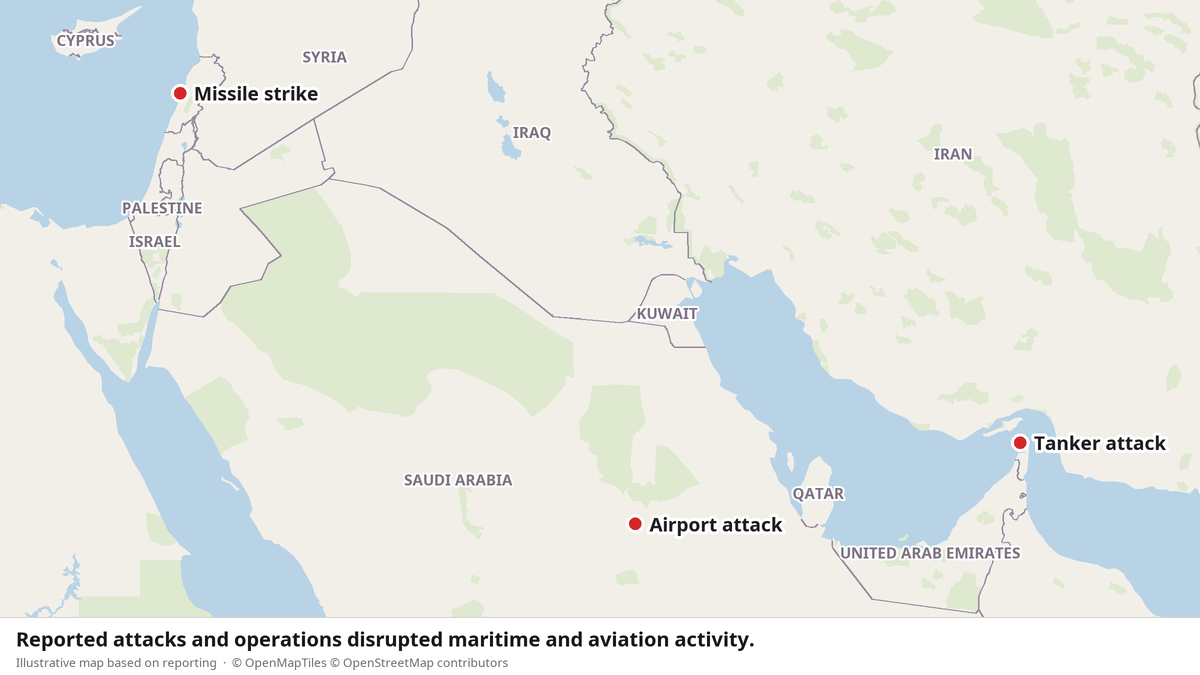
Houthi attacks on Riyadh airport damaged three planes and disrupted flights. A further missile fired at the airport Friday evening interrupted air traffic again, the Associated Press reported. Saudi Arabia’s General Authority of Civil Aviation said three Saudi citizens were killed and several people were wounded. The attacks have also triggered flight diversions, travel warnings and renewed attention to Iran-backed Houthi operations in Yemen.
Airport Under Attack
Two regional officials told the AP that Houthi attacks on Thursday damaged three planes. They spoke anonymously because they weren’t authorized to brief the media. On Friday, the General Authority of Civil Aviation announced that three Saudi citizens had died and several people were wounded. The reports describe a direct threat to a major civilian airport, but the article gives no further details about the circumstances of the deaths or injuries.
One official said the Houthis fired another missile at the airport Friday evening, disrupting air traffic once more. Flightradar24 said many flights were diverted. The National reported that a Qatar Airways flight bound for Riyadh returned to Doha after the airport attack. Kuwait Airways canceled flights to and from Riyadh, while Saudi Arabia urged stranded citizens to contact embassies.
Travel restrictions and warnings followed. U.S. government employees must obtain special permission to use Riyadh airport, and advice urged U.S. and British nationals to avoid it. The U.S. embassy warned that hostilities in the Middle East had the “potential to escalate rapidly.” The National also reported that the United States stood with Saudi Arabia and Yemen against the Houthis.
Yemen Fighting and U.S. Options
Fighting between the Houthis and Saudi-backed Yemeni government forces has escalated, the AP reported. A Saudi-led coalition is providing air support for government forces seeking to reverse Houthi gains. The National listed a wide-ranging coalition operation, but its extracted page content supplied no operational details.
The AP reported that Saudi-backed Yemeni government forces launched a major military offensive a week earlier. President Donald Trump was evaluating whether the United States should join Saudi strikes against the Iran-backed Houthi rebels in neighboring Yemen. The account didn’t say what decision he would make or provide further details of the offensive.
The airport attacks and fighting in Yemen appear alongside a separate claim involving the Strait of Hormuz. The Islamic Revolutionary Guard Corps claimed an attack on a tanker there, but the available account gave no further details. Iran’s state-run IRNA news agency cited the Revolutionary Guard Corps navy as saying an oil tanker was burning after hitting a naval mine while attempting to transit the strait. It wasn’t clear whether that tanker was the same vessel involved in the separate report of a fire.
Strait of Hormuz Incident Remains Unclear
The AP separately reported that the UAE national guard rescued 22 crew members after a fire aboard an oil tanker in the Persian Gulf. The crew, all of Asian nationalities, received first aid and were in stable condition, according to the statement. The guard didn’t identify the tanker or specify the fire’s location or cause, so it remains unclear whether the rescue, the IRNA account and the IRGC attack claim refer to the same incident.
The AP said commercial vessels transiting the Strait of Hormuz had faced a surge in attacks during the U.S.-Iran war as Tehran sought to assert control over the waterway. The reporting doesn’t establish who caused the tanker fire or confirm that a naval mine was involved. In Yemen, meanwhile, the confirmed airport damage, civilian deaths and flight disruption show the Houthi campaign’s immediate reach beyond the battlefield.