
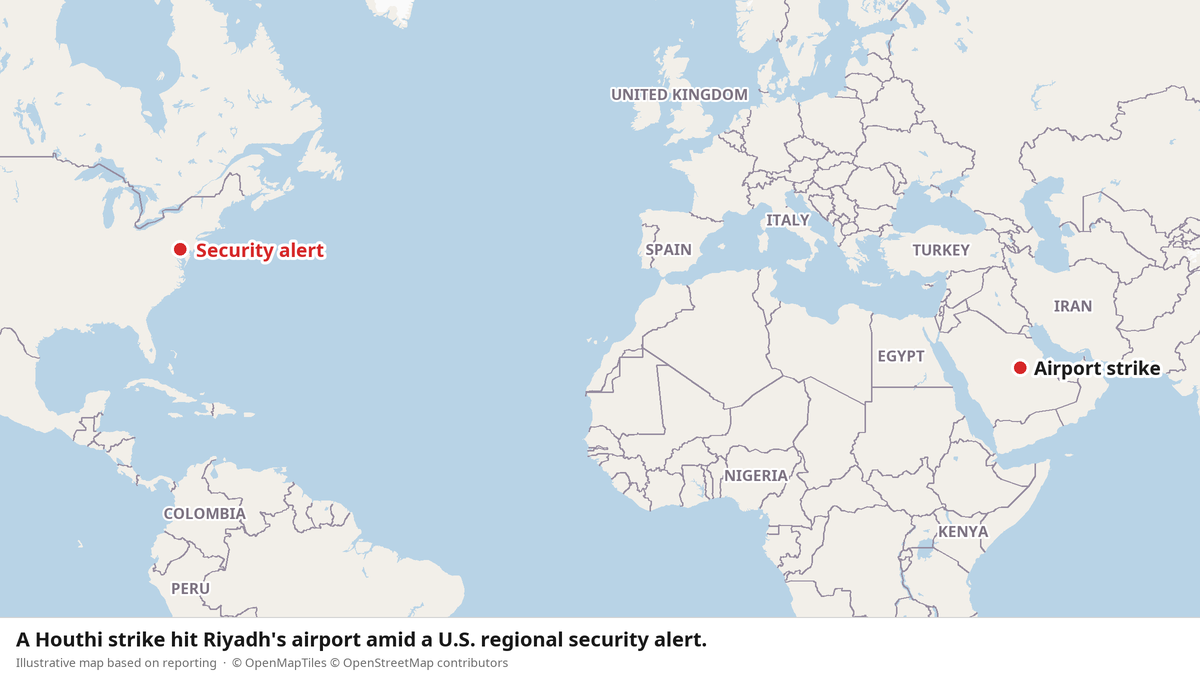
The United States urged Americans in the Middle East on Friday to “exercise heightened vigilance” after Yemen’s Houthi rebels claimed responsibility for an attack on Saudi Arabia’s Riyadh airport that killed three people on Thursday. The alert came as the Houthis stepped up missile strikes on Saudi Arabia and sought to shut down its airspace, Haaretz reported, citing Reuters, The Associated Press and Haaretz.
Regional fighting and oil routes
During the week, the Houthis carried out deadly attacks on airports in Saudi Arabia’s southern region and Riyadh. Debris from an intercepted ballistic missile damaged civilian sites in the kingdom’s capital. Attacks on ships in the Strait of Hormuz, a vital route for global crude shipments, have also increased, keeping oil prices volatile.
Oil prices fell on Friday after President Donald Trump said he wouldn’t order attacks on Iran before next month’s midterm elections. Brent crude, the benchmark for two thirds of the world’s oil, traded 0.82 per cent lower at $103.42 a barrel at 10.35am UAE time. West Texas Intermediate, which tracks U.S. crude, fell 0.74 per cent to $90.81 a barrel.
Brent had settled more than 4 per cent higher on Thursday, while WTI was set for a weekly decline. Separate Friday trading figures reported earlier in the article showed Brent down 1.38 per cent at $102.8 a barrel and WTI down 1.37 per cent at $90.24 a barrel.
“Brent crude rose 4.1 per cent to $104.20 per barrel on Thursday as renewed Middle East tensions coincided with disruption to US Gulf of Mexico production from Hurricane Isaias,” said Nick Stadtmiller, chief economist and group head of research at Emirates NBD. “Around 63 per cent of US Gulf oil production has been shut in ahead of the storm, while prices came off their intraday highs after President Donald Trump said the US was holding productive discussions with Iran.”
Washington’s pressure on Iran
Trump said Thursday that he had no intention of ordering attacks on Iran before next month’s midterm elections, temporarily easing concerns about supply. In a post on Truth Social, he described Iran as being in a “very bad condition” economically and militarily, said the U.S. blockade on Iranian shipments through the Strait of Hormuz would remain in “full force,” and said the countries were holding “productive discussions.”
The United States also announced fresh sanctions on 17 vessels transporting millions of barrels of Iranian crude oil, as well as petroleum and petrochemical products, to markets in southern and eastern Asia. The U.S. said it sought to squeeze Iran’s oil revenue and pressure Tehran as the regional war continued.
“Treasury is starving the tyrannical regime in Tehran of the money it uses to wage war in the region,” Treasury Secretary Scott Bessent said. In a statement, Bessent added: “We will continue exposing those who enable the regime’s oil sales.” The sanctions and the stated U.S. blockade restrict Iranian oil shipments as fighting and threats to shipping through the Strait of Hormuz continue.
Storm disruption adds to supply concerns
Hurricane Isaias was moving towards the U.S. Gulf coast, home to offshore oil production sites, refining infrastructure and export terminals. The storm was expected to reach the coast late Friday or early Saturday, bringing heavy rain and potentially flash floods. About 500,000 barrels per day of capacity faced risk, said Soojin Kim and Edward Bell from MUFG.
“Ongoing fighting between Saudi Arabia and its allies against the Houthis are keeping the geopolitical risk in oil markets elevated while shipping in the Gulf and Strait of Hormuz continues to be threatened,” they said. Isaias had already shut in around 63 per cent of U.S. Gulf of Mexico oil production, according to the report, while the threat to refining infrastructure and export terminals added another source of uncertainty for oil markets.