
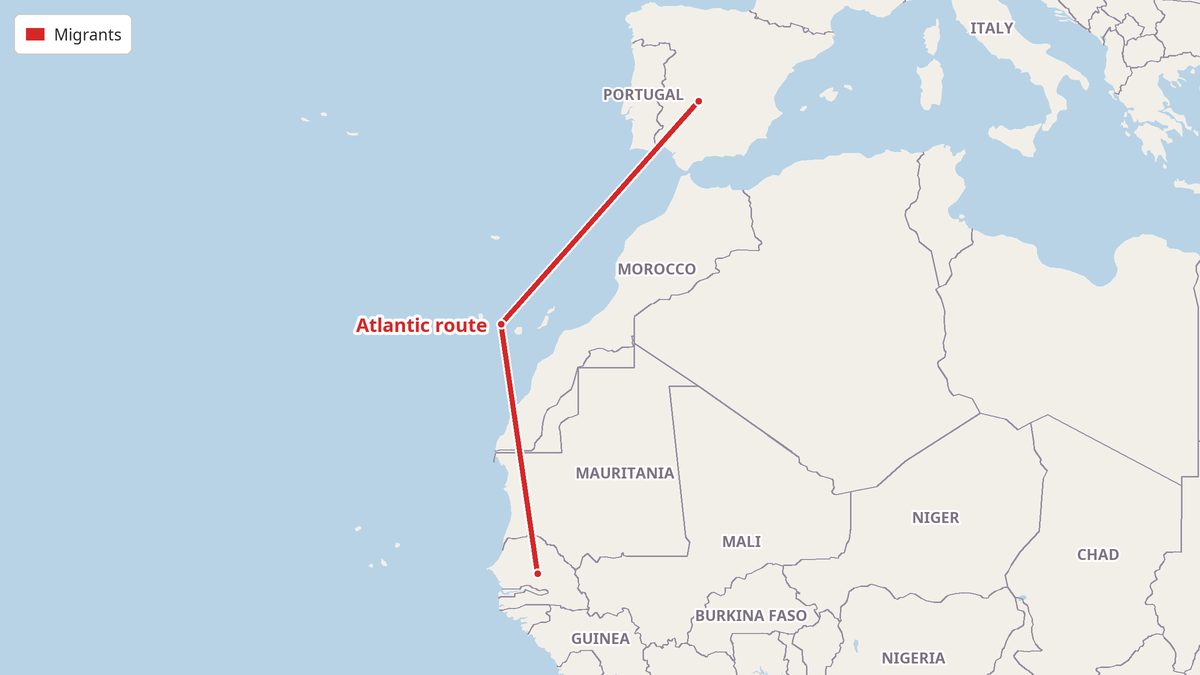
Twenty-one bodies. One survivor. That's the toll so far from a migrant boat that capsized off northwestern Senegal on Saturday, the latest deadly episode on the Atlantic route that carries West Africans toward Europe.
Senegal's interior ministry said in a statement that the figure was "provisional" as of late Saturday. The search was still going on, the ministry said, and the families of victims were being helped.
Media reports said the pirogue-type flat-bottom boat went down on Saturday off the Loumpoul dunes in Kebemer department, a stretch of coast between Dakar and the northern city of Saint-Louis. Le Soleil newspaper reported that most of the victims came from the Leona and Thieppe districts in that same department. These were neighbors from the same small communities, which means the grief is concentrated in a handful of places.
A Route That Keeps Killing
The sinking is hardly an outlier. Thousands of people from West Africa try each year to reach Europe on the Atlantic route, according to the base reporting, and thousands have died in recent years trying to reach Spain's Canary Islands. Each of those numbers is a person who judged that a flat-bottom boat on open ocean was a better bet than staying put.
The day before the capsizing, Senegalese authorities intercepted 142 migrants aboard a similar small boat bound for Spain. Police said the group included 23 women, two babies and two other children. They came from Senegal, Gambia, Guinea-Bissau, Guinea and Nigeria. Babies on a boat like that. It's a detail that says plenty about the desperation behind these departures.
Official Response
The Senegalese government on Saturday stressed "its determination to combat people smuggling networks, notably through strengthened cooperation with neighbouring countries," the interior ministry said. Senegal, Mauritania and Morocco have also stepped up maritime patrols around departure points for small boats.
But the patrols carry a cost the base reporting spells out plainly. They've forced boats to head further south, toward the coasts of Gambia, Guinea-Bissau and Guinea. That prolongs the duration of a crossing that was already hazardous. A longer trip in the same kind of vessel means more time exposed to the sea, and enforcement that pushes departures farther afield doesn't make the voyage safer for the people aboard.
Pressure on the Canaries
The arrivals haven't stopped. Spanish authorities on the Canary island of El Hierro declared an emergency on Saturday after a surge in migrant boat arrivals. Since the start of November, El Hierro authorities said, more than 3,300 people had arrived aboard around 30 boats. That's roughly 110 people per boat, crowded into vessels crossing one of the world's most dangerous migration routes, all within the first week of the month.
So the same weekend brought both a mass-casualty sinking in Senegal and an emergency declaration in Spain. One is a story of people who didn't arrive. The other is a story of how many did.
Why This Matters:
The sinking off Kebemer shows what's at stake when migration policy leans on interdiction alone. Stepped-up patrols by Senegal, Mauritania and Morocco have pushed boats toward longer routes, and longer routes mean more danger for passengers, including women and young children like those intercepted on Friday. Meanwhile, the emergency on El Hierro shows that Spain's island authorities are carrying the load of continued arrivals. Neither side of this crisis is being resolved by enforcement alone. Senegal's pledge to deepen cooperation with neighbors points toward the kind of regional coordination that could matter, but the families in Leona and Thieppe are left to mourn while the underlying pressures that send people to sea go unaddressed in the available reporting.
- migrant boat sinking
- senegal
- atlantic migration route
- people smuggling
- canary islands
- el hierro
- kebemer
- interior ministry