
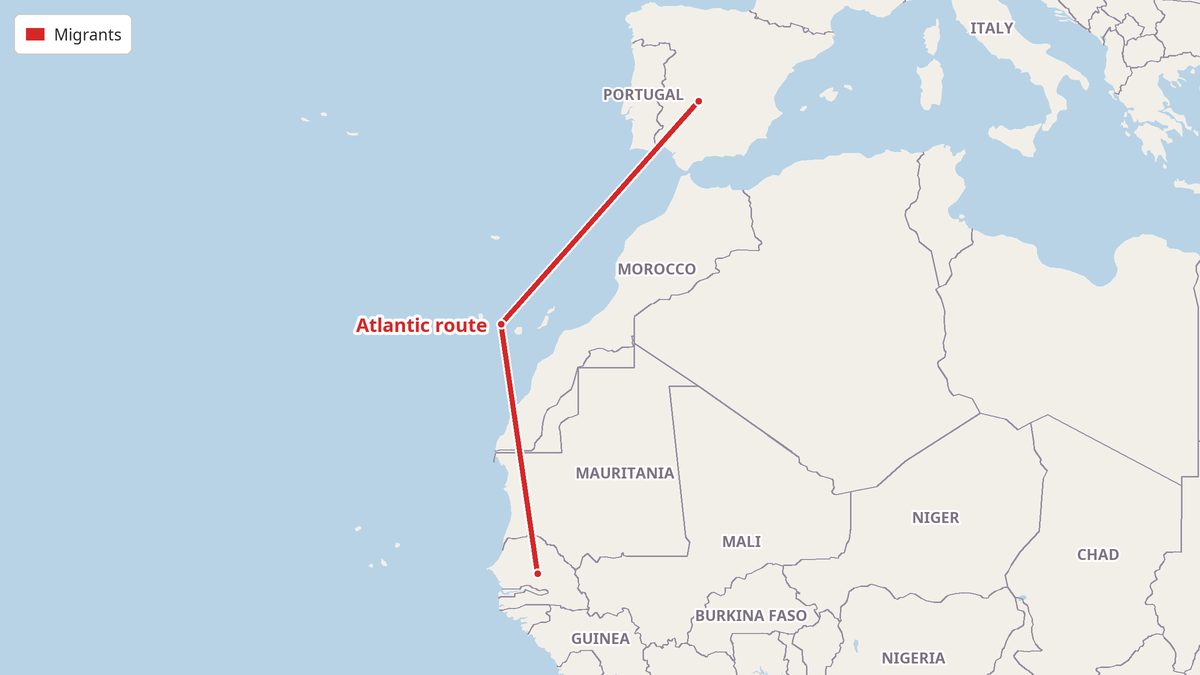
Twenty-one bodies have been pulled from the water off northwestern Senegal, and one survivor. That's the toll so far from a flat-bottom pirogue that capsized on Saturday off the Loumpoul dunes in Kebemer department, between Dakar and Saint-Louis, according to the Senegalese interior ministry. The ministry called the figure "provisional" as of late Saturday. The search was still going on.
Le Soleil newspaper reported that most of the victims came from the Leona and Thieppe districts in the same department. These weren't strangers to the coast. They were neighbors, working people from the same stretch of country they were leaving.
Who Pays
The dead are the latest on what the base reporting calls a "dangerous Atlantic Ocean route from Africa to Europe." Thousands of people from West Africa try it each year. Thousands have died in recent years trying to reach Spain's Canary Islands. The interior ministry said families of the victims were being helped.
The day before the sinking, Senegalese police intercepted 142 migrants aboard a similar small boat bound for Spain. Among them were 23 women, two babies and two other children. They came from Senegal, Gambia, Guinea-Bissau, Guinea and Nigeria. Those aboard were stopped by the state, not given safe passage.
The State's Role
The response from Dakar was framed as enforcement. The government on Saturday stressed "its determination to combat people smuggling networks, notably through strengthened cooperation with neighbouring countries," the interior ministry said in a statement.
The policy has a documented effect on the water. Senegal, Mauritania and Morocco have stepped up maritime patrols around departure points for small boats. Those patrols, the reporting says, force the boats to head further south toward the coasts of Gambia, Guinea-Bissau and Guinea. That prolongs the duration of what was already a hazardous crossing.
The patrols didn't stop the departures. They lengthened the voyage.
The Other End of the Route
On the same Saturday, Spanish authorities on the Canary island of El Hierro declared an emergency after a surge in migrant boat arrivals. Since the start of November, El Hierro authorities said, more than 3,300 people had arrived aboard around 30 boats. That works out to roughly 110 people per boat.
So the same weekend carried both outcomes of the same route: a drowned boat off Kebemer and an overwhelmed island in the Canaries. The response on the African side was interception and patrol. The response on the Spanish side was an emergency declaration.
No official quoted in the reporting proposed opening a legal route for those who left. The measures announced target smuggling networks and departure points, not the conditions that send people from districts like Leona and Thieppe toward the sea. The statement from the interior ministry pledged cooperation with neighbouring countries, a promise that, on the evidence of the patrol pattern, has so far meant longer and deadlier crossings.
The search off the Loumpoul dunes continued as the ministry issued its provisional count.
- migrant boat sinking
- senegal
- atlantic migration route
- people smuggling
- canary islands
- el hierro
- kebemer
- interior ministry