
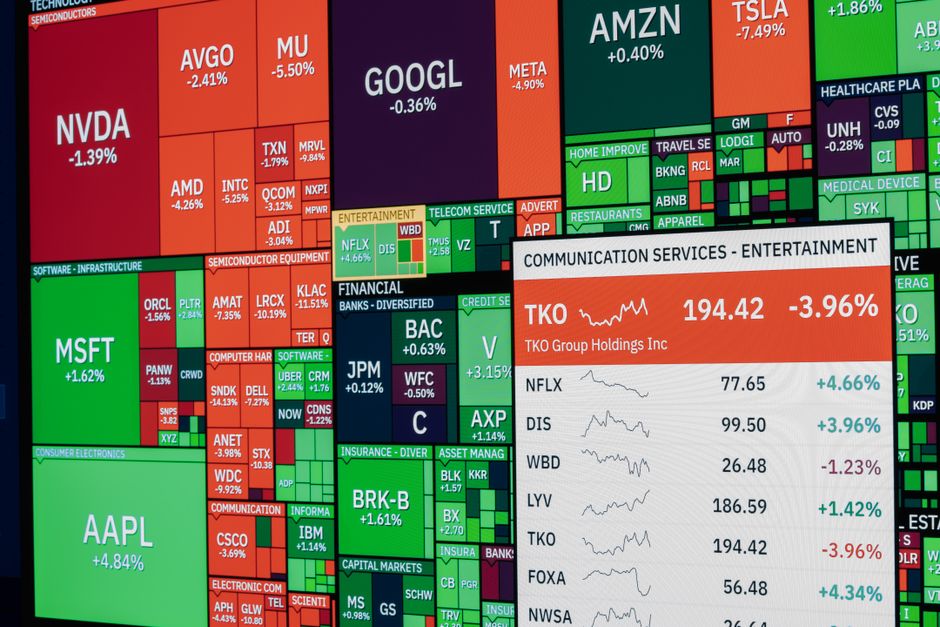
The Nasdaq Composite rose 421.2 points, or 1.73%, to 24,736.2 at 10:21 a.m. ET on Friday, as chip stocks rebounded after steep losses and investors weighed possible tighter AI regulation by a Democratic-led Congress. The political concern centers on whether Congress could slow AI data-center construction, a sector whose rapid growth helped propel stock markets to record highs this year.
The rebound followed a sharp reversal. On Thursday, the Nasdaq recorded its steepest one-day decline in 19 months, entered correction territory and headed for a fourth consecutive weekly fall. The selloff followed Democrats' midterm election victory, including in some key data-center states. The market reaction linked the election outcome to uncertainty over AI policy and the construction plans of data-center operators.
The Political Stakes for AI
The concern reported by investors is specific: a Democratic-led Congress could impose tougher AI regulation and slow data-center construction. The base of the market's recent gains had included optimism about the sector's rapid growth, and Thursday's losses came as that outlook faced political uncertainty. The source report doesn't identify any enacted law or completed transfer of authority; it describes investor concern about what Congress could do.
Technology shares led Friday's advance. Six of the 11 S&P 500 sectors traded higher, led by information technology, while consumer staples and health care lagged. The Dow Jones Industrial Average held steady at 51,530.05, and the S&P 500 gained 72.56 points, or 1%, to 7,426.29.
Nvidia rose 5.6% after suffering its worst day since January 2025, when the emergence of the low-cost Chinese AI model DeepSeek rattled Wall Street. The broader semiconductor index gained 4.6%, recovering after a fall of more than 12% in the previous session. AMD, Intel and Micron Technology rose between 3% and 10.5%.
Data-Center Stocks Recover
Data-center operators IREN and Applied Digital, neoclouds CoreWeave and Nebius Group, and AI-exposed utilities and equipment suppliers GE Vernova and Constellation Energy also recovered from deep losses in the previous session. Tesla, led by Elon Musk, and SpaceX rose 5.5% and 6.3%, respectively, after falling sharply in the previous two sessions.
The jobs report added another policy pressure point. U.S. nonfarm payrolls increased more than expected in October, while the unemployment rate fell to 4.1%, suggesting the labor market remained resilient. Traders increased bets that the Federal Reserve could raise rates as soon as next month, pricing in a 78% chance of a December move, compared with 70% earlier.
Rates and Market Volatility
“Those are strong numbers and normally that would say that the Fed would have to be more on the hawkish side,” said Joe Saluzzi, co-head of equity trading at Themis Trading. “The flip side of that is that what we saw yesterday and how volatility has spiked, will the Fed want to raise interest rates in the face of a market which is teetering?”
The CBOE Volatility Index, Wall Street's fear gauge, eased slightly Friday to 23.88 after its biggest one-day jump in about 19 months on Thursday. A jump in crude oil prices Thursday pressured equities amid concerns about energy-fueled inflation and the prospect of higher interest rates from global central banks. Brent crude futures were slightly lower Friday, and oil prices were set for sharp weekly declines. The S&P 500 energy index was on track to fall more than 11% for the week.
The S&P 500 was on pace for its worst week since March 2025, when concerns about the Trump administration's tariff policies roiled global markets. Software firm Atlassian fell 14.7% after reporting first-quarter results, while Airbnb gained 9.4% after raising its full-year 2026 revenue growth forecast.
- nasdaq
- chip stocks
- nvidia
- semiconductor index
- stock market
- artificial intelligence
- federal reserve
- interest rates