
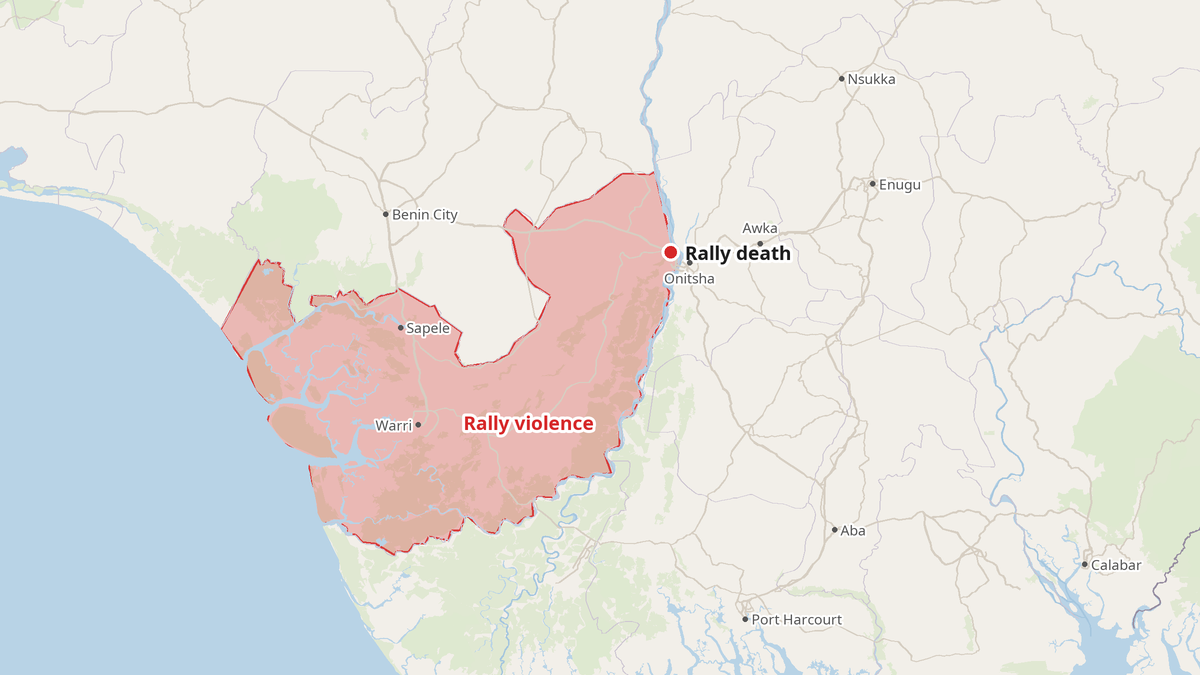
One person was killed and five others injured on Nnebisi Road in Asaba on Saturday, about 12.15 p.m., when a procession organised by the Obidient/OK Movement came under attack. Police say they saw it coming. The organisers say the police weren't there when it happened.
Who Has the Power
The Delta State Police Command, speaking through spokesperson Bright Edafe, said it had received intelligence about possible violence and invited the organisers to a security meeting. Officers recommended a designated venue where they could provide protection, rather than an open-road procession. The organisers, police said, went ahead anyway.
That's the apparatus's story: we warned them, they didn't listen. Notice what it leaves out. The published police account identified neither the victims nor those responsible. A person is dead, and the command has named no one.
Delta State coordinator Favour Emerure told a different story. He said the organisers had notified the command and complied with instructions not to assemble at Inter-Bua Junction. Then he asked the question the police haven't answered: why were officers absent when participants came under attack? His account didn't clarify whether the organisers had agreed to abandon the road procession altogether. Reports from the scene described damaged campaign vehicles and attacks on participants. Police said officers evacuated the injured, reinforced security and opened an investigation.
The Nigeria Democratic Congress accused people associated with the All Progressives Congress of involvement. Delta APC spokesperson Valentine Onojeghuo rejected that, saying no evidence linked his party to the violence.
What They're Calling Politics
While one person lay dead in Asaba, the campaign circus rolled on elsewhere. In Port Harcourt, at an APC rally at the Adokiye Amiesimaka Stadium, President Bola Tinubu accused Atiku Abubakar of using public funds to set up a private university while serving as vice-president between 1999 and 2007. The State House account provided no financial documents to back it up.
Atiku, the African Democratic Congress candidate, hit back through campaign spokesman Phrank Shaibu, saying he began laying the foundation for ABTI Academy in 1993, six years before he became vice-president. The university's own history dates ABTI Academy to 2002. Atiku also brought up Tinubu's 1993 United States civil forfeiture case, which wasn't a criminal conviction, a distinction the presidency has itself stressed. He renewed his proposal for a production-based fuel subsidy tied to domestic refining. The APC campaign council had challenged him in September to explain its cost, legal basis and funding. His Saturday response didn't touch those questions.
Two men who've both sat atop the state, trading accusations about who looted what.
Who Gets Crushed
Peter Obi, the NDC candidate, asked Tinubu what Nigerians gained from ₦15.8 trillion in subsidy savings and more than $100 billion he claimed the administration had borrowed. He demanded measurable improvements in poverty reduction, school attendance, primary healthcare, electricity supply and security.
The government's own paperwork is revealing. An August 2026 Finance Ministry analysis puts the additional resources tied to subsidy removal at ₦15.827 trillion between June 2023 and December 2025. That figure comes from comparing actual revenue against a hypothetical path assuming eight per cent annual growth. The ministry splits it: ₦5.007 trillion to the Federal Government, ₦6.525 trillion to states, ₦3.876 trillion to local governments. The Debt Management Office's June 2026 report records roughly $120.93 billion in outstanding public debt, a stock built up under successive administrations. And the government's own fiscal scorecard describes household welfare as weak, though beginning to improve.
Weak is the word for what ordinary people got, per the government itself, in this fourth year in office.
The Deal-Making Class
At the Port Harcourt rally, Rivers Governor Siminalayi Fubara pledged at least three million votes for Tinubu under the leadership of FCT Minister Nyesom Wike, and promised support for candidates adopted by the Rainbow Coalition, which pulls together politicians from the APC and the PDP without formally merging the parties. Tinubu praised the Fubara-Wike reconciliation and urged young Nigerians to collect their permanent voter cards. The coalition's cross-party arrangement has caused disagreements within the APC.
In Bauchi, Seyi Makinde launched the Allied Peoples Movement's presidential campaign with running mate Musa Daura. His 74-page Reset Nigeria Manifesto promises to bring the federal deficit within three per cent of GDP and cut the debt-service-to-revenue ratio to no more than 50 per cent. Makinde also told voters to accept campaign money but vote according to their conscience.
In Abuja, meanwhile, the PDP is still fighting over who owns the PDP. The Court of Appeal dismissed the Wabara-led Board of Trustees' bid to force INEC to recognise Kabiru Turaki's interim leadership, upholding a ruling for the rival leadership chaired by Abdulrahman Mohammed. Turaki said lawyers had been told to review the judgment. Candidates aligned with his camp urged a Supreme Court challenge. Sunday Biggs, their representative, also called for reconciliation. No appeal had been confirmed filed.
And so it goes. Manifestos, scorecards, court fights over party letterheads. One person dead on a road in Asaba, nameless in the official record.
- nigeria 2027 election
- asaba rally
- peter obi
- bola tinubu
- fuel subsidy
- atiku abubakar
- political violence
- delta state