
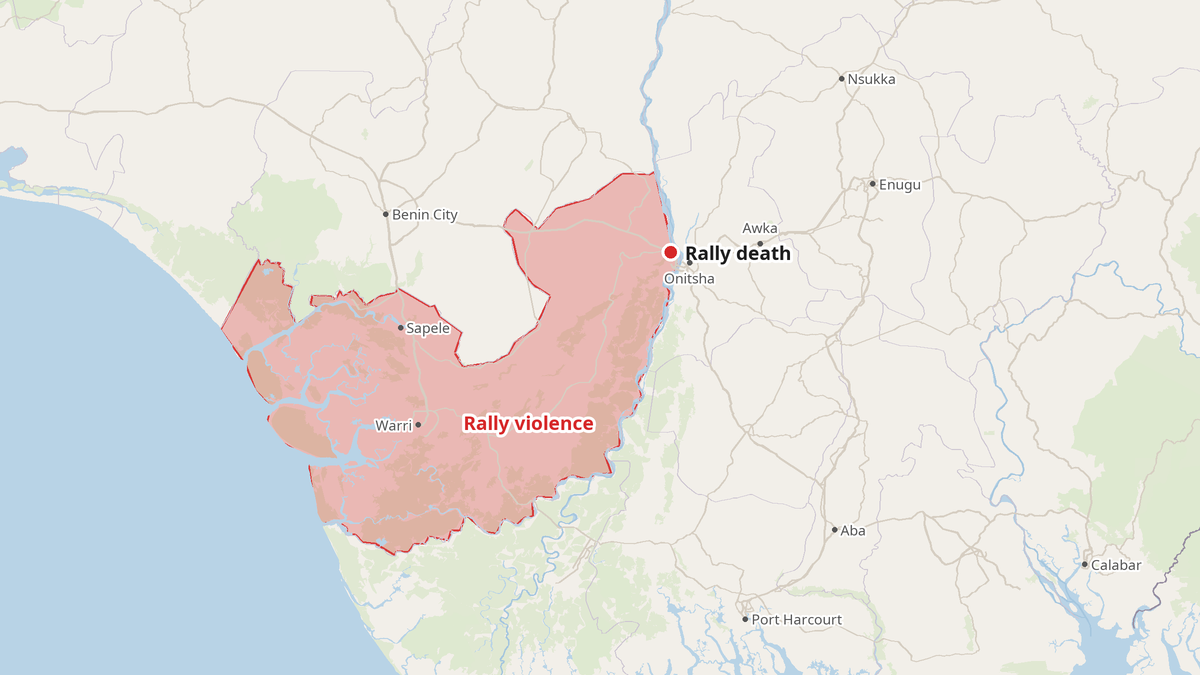
One person died and five were injured Saturday when violence broke out during an opposition procession on Nnebisi Road in Asaba, Delta State, according to police. The attack came at about 12.15 p.m. Police say they'd warned organisers beforehand. The organisers say that's not the whole story.
The Asaba Violence
The Delta State Police Command said it had received intelligence about possible violence and invited the organisers of the Obidient/OK Movement to a security meeting. The group backs Peter Obi and Rabiu Kwankwso on the Nigeria Democratic Congress (NDC) platform. Spokesperson Bright Edafe said officers recommended holding the gathering at a designated venue where protection could be guaranteed, rather than staging an open-road procession. Police said the organisers went ahead anyway.
Favour Emerure, the group's Delta State coordinator, disputed that account. He said the organisers had notified the command and complied with instructions not to assemble at Inter-Bua Junction. He also asked why officers weren't present when participants came under attack. His account didn't make clear whether the organisers had agreed to drop the road procession altogether.
Reports from the scene described damaged campaign vehicles and assaults on participants. The NDC pointed the finger at people associated with the All Progressives Congress (APC). Delta APC spokesperson Valentine Onojeghuo rejected that, saying no evidence tied his party to the violence. Police said officers evacuated the injured, reinforced security and opened an investigation. They named neither the victims nor any suspects.
Subsidy Savings Under Scrutiny
At a separate event, Obi challenged President Bola Tinubu to explain what Nigerians had gained from ₦15.8 trillion in subsidy savings and more than $100 billion he claimed the administration had borrowed. He demanded measurable gains in poverty reduction, school attendance, primary healthcare, electricity supply and security.
The subsidy number isn't invented. It closely matches an August 2026 Federal Ministry of Finance analysis estimating ₦15.827 trillion in additional federation resources tied to subsidy removal between June 2023 and December 2025. The ministry reached that figure by comparing actual net Federation Account revenue against a hypothetical path assuming eight per cent annual growth. Of the total, ₦5.007 trillion went to the Federal Government, ₦6.525 trillion to states and ₦3.876 trillion to local governments, with ₦419 billion going to other statutory allocations, including the Federal Capital Territory. The ministry also lists wage adjustments, infrastructure, electricity support and higher debt service costs among additional spending.
The borrowing claim is murkier. The Debt Management Office's June 2026 report records roughly $120.93 billion in outstanding domestic and external public debt across federal, state and Federal Capital Territory liabilities. That stock includes debts piled up under successive administrations, so it can't be treated as borrowing since Tinubu took office in May 2023. The government's own fiscal scorecard describes household welfare as weak, though beginning to improve.
Rallies and Coalition Politics
At an APC rally in Port Harcourt, Tinubu accused Atiku Abubakar of using public funds to set up a private university while vice-president. Atiku held that office from 1999 to 2007, which ended 19 years ago. The State House account offered no financial documents backing the charge. Atiku, the African Democratic Congress (ADC) candidate, rejected it through Phrank Shaibu of his campaign council, who said Atiku began laying the foundation for ABTI Academy in 1993, six years before taking office. The university's own history dates ABTI Academy to 2002, with the later university licensed as ABTI University in 2003.
Atiku also renewed his call for a production-based fuel subsidy tied to domestic refining. In September, the APC Presidential Campaign Council challenged him to explain its cost, legal basis and funding, and asked whether it would comply with the Petroleum Industry Act, which provides for market-based petroleum pricing. His Saturday response didn't address those questions.
Rivers Governor Siminalayi Fubara pledged at least three million votes for Tinubu under the leadership of FCT Minister Nyesom Wike, and promised backing for candidates adopted by the Rainbow Coalition, a grouping of APC and Peoples Democratic Party (PDP) politicians that hasn't formally merged the parties. Tinubu praised the Fubara-Wike reconciliation, urged young Nigerians to collect their permanent voter cards, defended his reforms and said his government was clearing inherited pension and gratuity arrears. The presidency said he presented his 2027 manifesto at the event. The cross-party arrangement has caused disagreements inside the APC.
In Bauchi, Seyi Makinde launched the Allied Peoples Movement's presidential campaign with running mate Musa Daura, whose name appears on INEC's final candidate list. Governor Bala Mohammed endorsed him. Makinde urged voters to accept campaign money but vote their conscience. His 74-page Reset Nigeria Manifesto sets hard targets for the end of an administration's third year: an actual federal deficit within three per cent of GDP, except where law expressly permits and disclosure follows, and a debt-service-to-revenue ratio of no more than 50 per cent, against a 67.22 per cent benchmark from the Federal Government's third-quarter 2025 budget report. It also promises literacy and numeracy gains in primary schools and quarterly scorecards.
In Abuja, governorship candidates aligned with the Kabiru Turaki-led PDP group urged a Supreme Court challenge after the Court of Appeal on Wednesday dismissed the Wabara-led Board of Trustees' bid to force INEC to recognise Turaki's interim leadership. Turaki said lawyers were reviewing the judgment. No appeal had been confirmed as filed.
Why This Matters:
A death at a campaign procession, with police and organisers trading accounts of who was responsible for security, tests the basic proposition that citizens can organise and vote safely. Without a named suspect, doubt will linger. The fiscal debate matters just as much. Subsidy removal freed trillions, yet the government's own scorecard calls household welfare weak, so voters will ask where the money went. Makinde's deficit and debt-service targets put numbers on the question, while Atiku's subsidy plan faces unanswered questions about cost and legality under a petroleum law built around market pricing. Court fights inside the PDP add institutional uncertainty. Markets and voters alike will want clarity.
- nigeria 2027 election
- asaba rally
- peter obi
- bola tinubu
- fuel subsidy
- atiku abubakar
- political violence
- delta state