
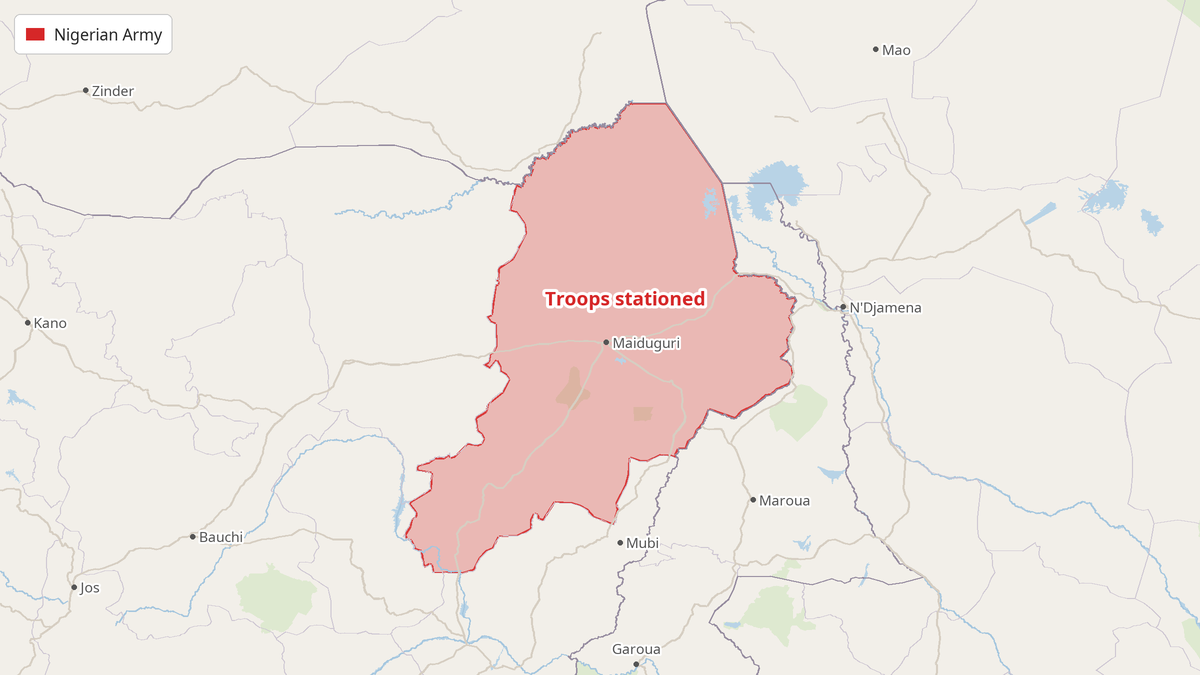
Fifteen Nigerian soldiers and five members of a civilian anti-jihadist militia died after Islamic State-aligned fighters overran a military base in Borno state. On Saturday, the country’s Army Chief of Staff traveled to the northeast to visit troops still reeling from the attack.
The assault struck the base in Mairari village, in the Lake Chad area, overnight from Tuesday to Wednesday. A large group of fighters from the Islamic State in West African Province, known as ISWAP, seized the position, looted weapons and set it on fire. “The terrorists killed 15 soldiers and five civilian JTF (anti-jihadist militia) assisting the soldiers during the attack,” a Nigerian military officer told AFP.
What Happened at Mairari
The officer said the militants “razed the base to the ground,” forcing surviving troops to retreat toward Monguno, a garrison town about 18 kilometres away. Several soldiers remain unaccounted for, and colleagues fear the jihadists may have captured them. The officer asked not to be named because he wasn’t authorised to speak publicly about the incident.
Residents described a similar attack. Grema Butari, who lives in Mairari, said fighters struck at around 2200 GMT and drove troops from the base after a “prolonged battle.” They remained there until daybreak. “They took everything of value they could carry and burnt the rest along with several vehicles,” Butari said, giving the same death toll. Another resident, Ahmad Sherif, said the jihadists were believed to have launched the attack from their base in Gudumbali, in neighbouring Guzamala district. He confirmed the base’s “total destruction.”
The five militia members killed were civilians who’d helped soldiers hold the position. That matters. Ordinary people get pulled into this conflict, and die alongside the troops they assist.
A Conflict Entering Its 18th Year
Borno sits at the center of more than 17 years of jihadist insurgency by Boko Haram and its later splinter group, ISWAP. The violence began in 2009. It has killed thousands and displaced millions across northeast Nigeria; after easing from its peak a decade ago, it has risen over the past two years. The United Nations says the insurgency has killed tens of thousands and driven around two million people from their homes.
The national picture is grim. Nigeria is living through its most violent period in nearly three decades. The second quarter of 2026 recorded the highest level of violence since the Armed Conflict Location & Event Data (ACLED) project began tracking it in 1997.
This wasn’t an isolated strike. Last week, around two dozen militants and soldiers died when ISWAP fighters attacked a military outpost in neighbouring Kukawa and looted weapons before fighter jets helped drive them back, according to military and local sources.
Official Response
The Army Chief of Staff visited troops stationed in the northeast on Saturday, a few days after the Mairari attack. The base article offers no detail on what he said or what measures he announced. The military hasn’t publicly addressed the missing soldiers beyond what officers have said off the record.
Why This Matters:
Two attacks on military positions in a single week, alongside a record quarter of violence nationwide, point to a security crisis that’s deepening rather than fading. For the roughly two million people displaced from their homes in the northeast, each overrun base is another sign that the state can’t guarantee their safety. Looted weapons strengthen the insurgents, while withdrawn troops leave villages like Mairari exposed. Civilian militia members died alongside soldiers, raising questions about who carries the burden of protection when formal forces are stretched thin. Families of the missing soldiers are left waiting for answers. Public institutions, from the army to the agencies serving displaced communities, will face growing pressure to show they can protect civilians and account for those lost.
- islamic state in west africa province
- borno state
- nigerian army
- military base attack
- soldiers killed
- jihadist insurgency
- nigeria