
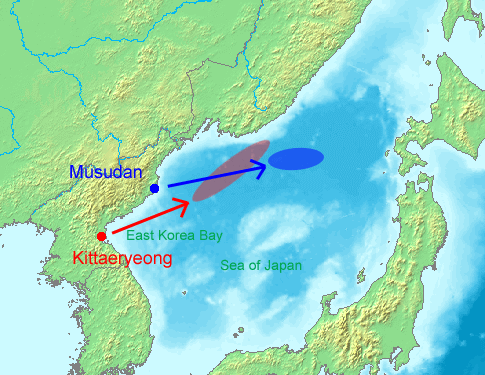
North Korea launched multiple short-range ballistic missiles toward the sea on Sunday, firing from the Sinpo area with each missile traveling approximately 140 kilometers (87 miles) toward the country's eastern waters, according to South Korea's Joint Chiefs of Staff. The provocative launches occurred just hours before South Korean President Lee Jae Myung departed for diplomatic visits to India and Vietnam, raising questions about Pyongyang's strategic timing and regional security implications.
Submarine Launch Capability Under Investigation
South Korea's military is analyzing whether the latest launches originated from a submarine, a land-based launcher, or both platforms, according to South Korean media. Sinpo, the launch site, is an eastern coastal city in North Korea where it maintains a major shipyard used for building submarines. If the launches involved a submarine, it would mark North Korea's first submarine-launched ballistic missile test in four years. North Korea obtaining a greater ability to fire missiles from underwater would be a worrying development because it's difficult for its rivals to detect such launches in advance. Last year, North Korea unveiled a nuclear-powered submarine under construction for the first time.
Japan's Defense Ministry said Tokyo strongly protested to Pyongyang, saying the launches threaten regional and international peace and violated U.N. Security Council resolutions that ban any ballistic activities by North Korea. Japan's Deputy Minister of Defense Masahisa Miyazaki told reporters that Japan was analyzing launch details in coordination with the U.S. and South Korea. The U.S. and Japanese militaries also detected the launches, and the U.S. Indo-Pacific Command said it remains committed to the defense of the U.S. homeland and its allies in the region.
Escalating Testing Pattern
Sunday's launches were the latest in North Korea's run of weapons tests this year. Last week, North Korea said leader Kim Jong Un supervised missile tests from the country's destroyer. In the previous week, North Korea said it had three days of testing activities to examine ballistic missiles armed with cluster-bomb warheads and other new weapons systems. Last month, it said it tested an upgraded solid-fuel engine for missiles capable of reaching the U.S. mainland.
Kim has focused on enlarging his nuclear and missile arsenals since his high-stakes nuclear diplomacy with U.S. President Donald Trump collapsed in 2019. Trump has repeatedly expressed his desire to restore diplomacy with Kim, and the North Korean leader has recently left open the door for dialogue with Trump but urged Washington to drop demands for the North's nuclear disarmament as a precondition for talks.
Nuclear Production Accelerating
Trump is to travel to Beijing for a rescheduled summit with Xi Jinping in May. Some observers believe North Korea's recent testing activities were likely meant to increase its leverage in future dealings with the U.S., as the Trump-Xi meeting could provide a diplomatic opening with Pyongyang.
On Wednesday, International Atomic Energy Agency Director General Rafael Grossi said that his agency has confirmed "a rapid increase" in activities at nuclear manufacturing facilities in North Korea. Grossi told reporters in Seoul that activities in North Korea point to "a very serious increase" in its nuclear weapons production capabilities. His comments echoed a view by many outside observers that North Korea has taken steps to expand its main Yongbyon nuclear complex and build additional uranium-enrichment sites in recent years. Last September, South Korea's Unification Minister Chung Dong-young said that North Korea was operating four uranium enrichment facilities and that they were running everyday.
Why This Matters:
The timing of North Korea's missile launches—hours before a South Korean presidential departure for regional diplomacy—demonstrates Pyongyang's continued willingness to disrupt allied coordination and test the resolve of security commitments in the Indo-Pacific. The potential development of submarine-launched capabilities represents a qualitative advancement in North Korea's ability to evade detection and complicate defensive planning, requiring increased defense expenditures and intelligence resources from regional allies. The IAEA's confirmation of accelerating nuclear production underscores the failure of diplomatic engagement without preconditions and validates a policy approach centered on deterrence, sanctions enforcement, and allied military readiness. As Trump prepares for summit diplomacy with China, North Korea's weapons development creates additional pressure for negotiations that preserve American interests and avoid concessions that would legitimize the regime's nuclear status while undermining the nonproliferation framework that protects U.S. security.