
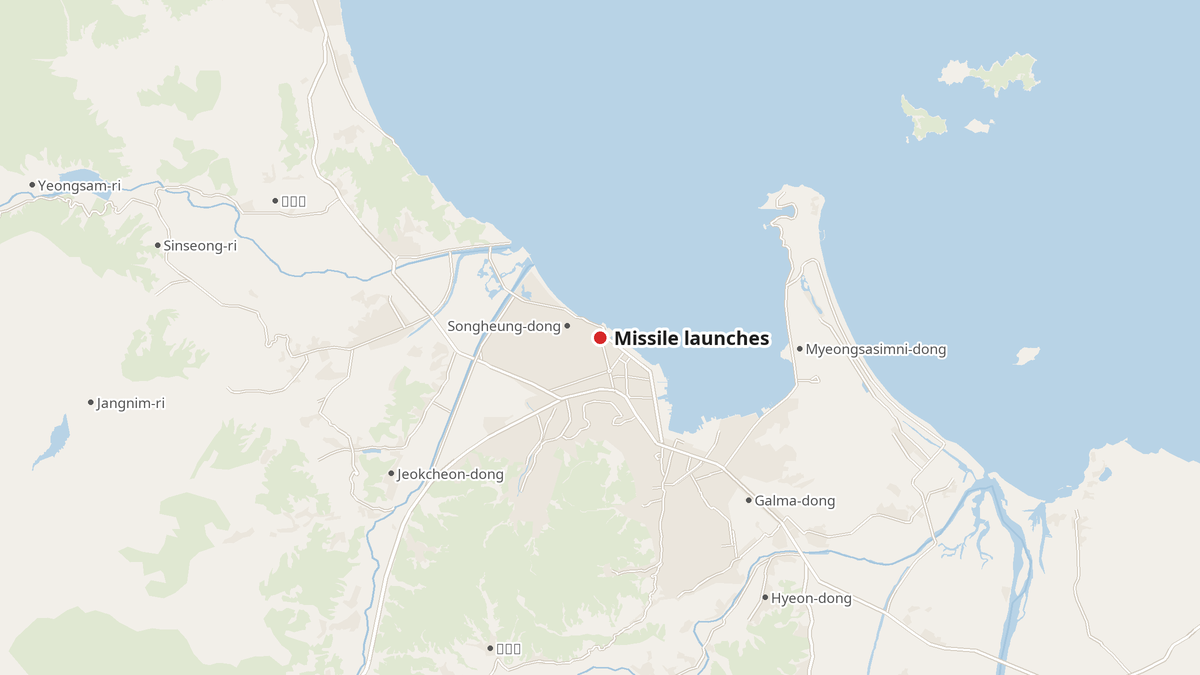
North Korea fired about 10 short-range ballistic missiles toward the sea from the eastern coastal town of Wonsan on Thursday, South Korea's Joint Chiefs of Staff said, raising the temperature on a border where soldiers have already been wounded this autumn. A Kyodo News breaking-news item put the number at a dozen. South Korea's military bolstered its surveillance posture and said it was closely exchanging information about the launches with the United States and Japan.
The barrage came just days after Pyongyang threatened to resume front-line propaganda loudspeaker broadcasts and deploy new weapons along the rivals' tense border. It also followed other recent tests involving submarine-launched cruise missiles and hypersonic missiles.
A Border Already on Edge
For the people who live and serve near the demarcation line, the risk of miscalculation isn't abstract. Land mine blasts on Sept. 21 injured three South Korean soldiers. Seoul accused North Korea of planting mines south of the military demarcation line. Pyongyang denied responsibility and warned of retaliation if provoked.
Last week, North Korea said it would restart propaganda broadcasts and deploy new weapons systems along the border, protesting what it called repeated warning shots by South Korean troops in border areas. South Korea later proposed talks to clarify the border and prevent accidental clashes. North Korea had not responded.
That offer matters. Clarifying where the line runs, and who is allowed to fire warning shots and when, is the kind of unglamorous diplomacy that keeps a tense standoff from becoming a shooting war. So far, Pyongyang has answered with silence on that proposal and missiles in the sea.
Kim's China Trip and the Question of Talks
The launches followed Kim Jong Un's surprise weekend visit to China, North Korea's main ally and economic pipeline. On Saturday, Kim crossed a newly inaugurated bridge to the Chinese border city of Dandong to pay respect at a memorial marking China's support for North Korea during the 1950-53 Korean War. It was his sixth visit to China since taking office in late 2011. At the memorial, Kim said North Korea would firmly carry forward "the invincible" friendship with China. He later met Wang Huning, a top Chinese Communist Party official, and reaffirmed his resolve to develop bilateral cooperation.
Kim has recently moved to strengthen ties with China after years of prioritizing relations with Russia, including by sending troops and ammunition to support Russia's war against Ukraine.
South Korea's National Intelligence Service offered a separate assessment, suggesting Kim may have conveyed Pyongyang's position on potential talks with the United States during the trip. The agency gave its view to lawmakers during a closed-door parliamentary intelligence committee audit Thursday, according to Rep. Youn Kun-young of the ruling Democratic Party and Rep. Yoo Yeong-ha of the main opposition People Power Party. The NIS noted that Kim may have had a purpose beyond commemorating China's role in the Korean War, pointing out that he was accompanied by senior diplomats, including Foreign Minister Choe Son-hui, rather than military officials.
Pressure Before the Summit
The timing is hard to miss. The visit came ahead of next month's Asia-Pacific Economic Cooperation summit in Shenzhen, China, which U.S. President Donald Trump is expected to attend. Trump has expressed interest in resuming dialogue with Kim.
Experts said North Korea likely aimed to pressure the United States into making bigger concessions as Trump expressed a desire to restore diplomacy with Kim. In other words, the missiles may be a bargaining chip, fired to raise the price of a seat at the table.
Why This Matters:
Every missile test and every threatened loudspeaker campaign raises the odds of an accident on a border where soldiers have already been hurt. The people most exposed aren't the leaders trading signals but the troops and nearby communities who would absorb the consequences of a clash. Seoul's unanswered proposal to clarify the border shows where practical risk reduction lies, and it points to the value of the multilateral coordination South Korea, Japan and the United States are already doing on intelligence. If Washington does return to talks, the experts' warning is worth keeping in view: Pyongyang appears to be using force to extract concessions, which makes patient, coordinated diplomacy, backed by allies, the sturdier path.
- north korea
- ballistic missiles
- kim jong un
- south korea
- united states
- china
- missile launches
- us-north korea talks