
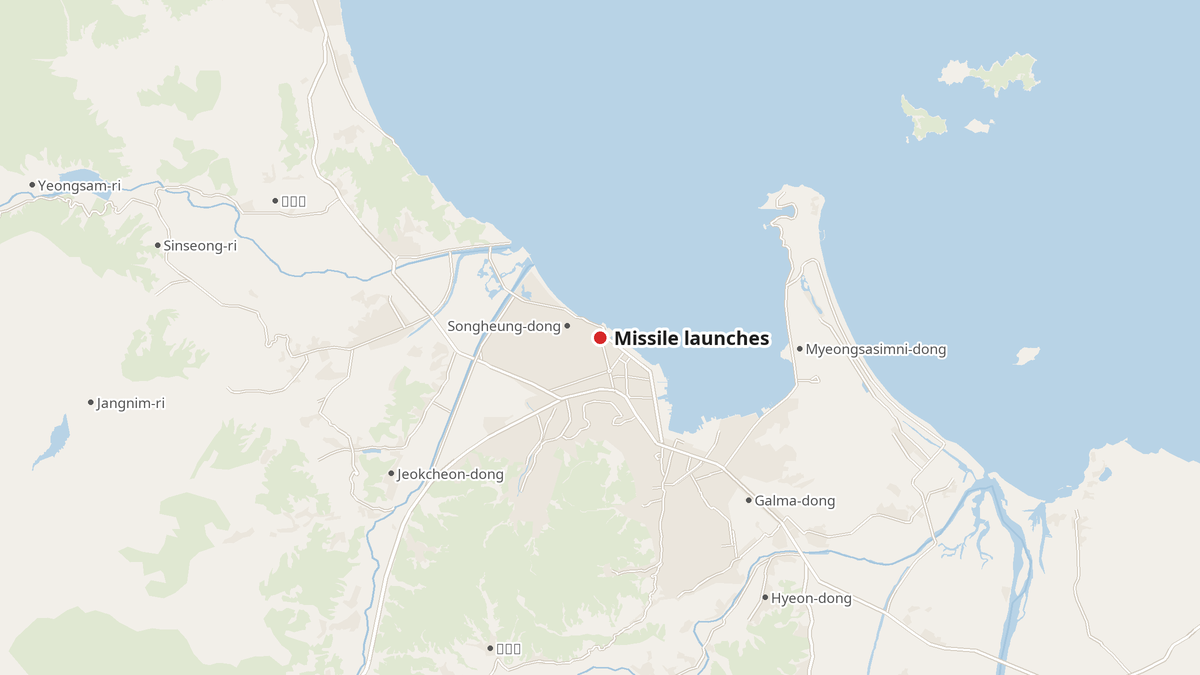
North Korea fired about 10 short-range ballistic missiles from Wonsan toward the sea on Thursday, South Korea’s Joint Chiefs of Staff said, as military tensions on the Korean border continued and possible talks with the United States remained in view. A Kyodo News breaking-news item described the barrage as a dozen missiles. South Korea bolstered surveillance and exchanged information about the launches with the United States and Japan.
Border Security and Military Responses
The launches came days after Pyongyang threatened to restart front-line propaganda loudspeaker broadcasts and deploy new weapons along the border. Last week, North Korea said it would take those steps in protest of what it called repeated warning shots by South Korean troops in border areas. South Korea later proposed talks to clarify the border and prevent accidental clashes. North Korea had not responded.
Tensions had also risen after land mine blasts on Sept. 21 injured three South Korean soldiers. Seoul accused North Korea of planting mines south of the military demarcation line. Pyongyang denied responsibility and warned of retaliation if provoked. The missile launches followed other recent weapons tests involving submarine-launched cruise missiles and hypersonic missiles.
South Korea’s military said it was closely exchanging information on Thursday’s launches with the United States and Japan. The report did not specify what information the three countries shared or describe any change to their military posture beyond South Korea’s bolstered surveillance. The launches were directed toward the sea, according to South Korea’s Joint Chiefs of Staff.
China Visit and Possible U.S. Talks
North Korean leader Kim Jong Un visited China over the weekend, seeking greater cooperation with Pyongyang’s main ally and economic pipeline. On Saturday, he traveled across a newly inaugurated bridge to Dandong, where he visited a memorial marking China’s support for North Korea during the 1950-53 Korean War. Kim said North Korea would firmly carry forward “the invincible” friendship with China.
Kim also met Wang Huning, a top Chinese Communist Party official, and reaffirmed his resolve to develop bilateral cooperation. It was Kim’s sixth visit to China since taking office in late 2011. He has recently moved to strengthen ties with China after years of prioritizing relations with Russia, including by sending troops and ammunition to support Russia’s war against Ukraine.
South Korea’s National Intelligence Service assessed that Kim may have conveyed Pyongyang’s position on potential talks with the United States during the China visit. The agency gave that assessment to lawmakers during a closed-door parliamentary intelligence committee audit on Thursday, according to Rep. Youn Kun-young of the ruling Democratic Party and Rep. Yoo Yeong-ha of the main opposition People Power Party.
The intelligence agency said Kim may have had a purpose beyond commemorating China’s participation in the Korean War. He was accompanied by senior diplomats, including Foreign Minister Choe Son-hui, rather than military officials, the agency noted.
Diplomacy Ahead of the Shenzhen Summit
Kim’s one-day trip to Dandong took place ahead of next month’s Asia-Pacific Economic Cooperation summit in Shenzhen, China. U.S. President Donald Trump is expected to attend the summit and has expressed interest in resuming dialogue with Kim.
Experts said North Korea likely aimed to pressure the United States into making bigger concessions as Trump expressed a desire to restore diplomacy. The source does not report a response from Washington to Thursday’s launches, or any reply from Pyongyang to South Korea’s proposal for border talks. The exchange of military information among South Korea, the United States and Japan, and the possible diplomatic message conveyed through China, remain the reported channels around the latest escalation.
- north korea
- ballistic missiles
- kim jong un
- south korea
- united states
- china
- missile launches
- us-north korea talks