
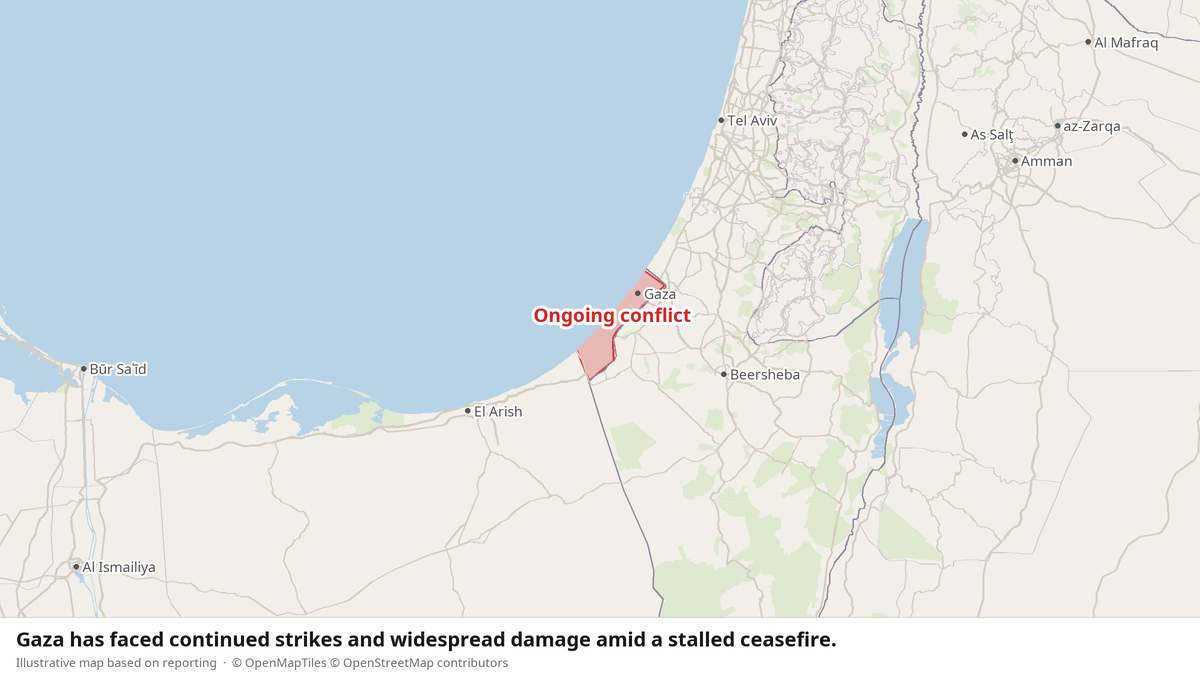
On the first anniversary of the October 10, 2025, ceasefire, Israeli forces control about 70 percent of Gaza, up from the 53 percent allowed under the agreement, and strikes continue almost daily. For Gaza’s 2 million Palestinians, the promised halt to violence and reconstruction remain mostly ink on paper.
In Jabaliya, Abdullah Abu Zubaida’s family lives in a shelter made from the debris of their house. “When the ceasefire began last October, we expected the war to halt, assassinations to cease, and aid to flow in,” he said. “None of that has happened.” Ne’man Abu Jarad, displaced from Beit Lahia to Khan Younis with his family, said: “The ceasefire is merely nominal, ink on paper.”
A line that keeps moving
The agreement allowed Israeli forces to remain in 53 percent of Gaza. A year later, official accounts put the area under Israeli control at about 70 percent, as Israel pushed the so-called yellow Line of Control westward toward the Mediterranean Sea. Israel was supposed to withdraw. Instead, it seized more territory and barred the new Palestinian administration from entering Gaza via Egypt.
Israel has reduced its attacks but continues to strike Gaza on a near-daily basis, including against people it accuses of violating the ceasefire, approaching the yellow line or taking part in the October 7 attack. Those strikes have often killed civilians. The Gaza Health Ministry says Israeli strikes have killed about 1,450 Palestinians since the ceasefire took effect; the United Nations considers the ministry’s figures accurate. Sporadic attacks have killed five Israeli soldiers in Gaza over the same period.
The ceasefire followed the October 7, 2023, attack by Hamas-led militants, who killed about 1,200 people and abducted 251. Israel’s bombardment and ground invasion have killed more than 74,000 Palestinians, according to the Gaza Health Ministry. The ministry, part of the Hamas-run government, says women and children make up around half of those killed, and doesn't distinguish civilians from militants in its death toll.
A handover without a handover
The agreement called for Hamas to transfer power to a committee of Palestinian administrators vetted by the Board of Peace, chaired by US President Donald Trump. Hamas announced in July that it was disbanding its governing body and handing Gaza’s administration to the US-blessed National Committee for the Administration of Gaza. It dissolved its government but left the civil service intact and remains the dominant power in roughly 40 percent of Gaza not controlled by the Israeli military. Hamas effectively remains in charge of security; Ali Shaath, appointed head of the committee, has kept a low profile.
A proposed International Stabilization Force, announced in February, has yet to materialize. Indonesia pledged the largest contingent, 8,000 soldiers, then put its plans on hold last spring as the world’s focus shifted to the Iran war. The agreement’s planned administration and outside force haven't displaced the armed authorities exercising power over people on the ground.
Hamas hasn't disarmed, and Israel has refused to begin withdrawing its forces. Hamas confirmed it had agreed to disarm, linking the step to Israel halting its strikes and withdrawing. Israel has tied progress on other issues to complete disarmament. Days after the July deal, Israeli Prime Minister Benjamin Netanyahu said Israel would not withdraw from any part of Gaza until Hamas was completely disarmed, rejecting the agreement Trump had announced. Netanyahu has demanded verifiable decommissioning of all weapons, down to individual guns.
Promises, committees, rubble
At a summit marking the ceasefire deal, Trump called for “a once-in-a-lifetime chance to put the old feuds and bitter hatreds behind us.” But the Board of Peace he set up hasn't delivered reconstruction money known to have reached Gaza. Trump promised $10 billion in US funding to the board in January; Gulf allies pledged additional funds. In September, the board proposed a $2.45 billion recovery plan intended to span over six months.
Virtually nothing has been rebuilt. Most people shelter in rodent-infested tent camps, the rubble of former neighborhoods or damaged buildings at risk of collapse. Hamas’s missile inventory was depleted by near-constant Israeli bombardment, which damaged or destroyed the vast majority of buildings in Gaza. The ceasefire anniversary also marked a year without Hamas rocket attacks on Israel.
The agreement halted major military operations, freed the remaining hostages and increased humanitarian access. Three days after it was announced, Hamas freed the 20 remaining living hostages seized in the October 7 attack; the agreement led to the return of all remaining hostages. Those concrete steps sit beside uncompleted promises: an end to Israel’s control over more than half of Gaza, Hamas’s disarmament, a new administration and reconstruction. Gaza’s residents are left between an expanding military line, armed rulers who remain in place, and international plans whose money and forces have yet to arrive.