
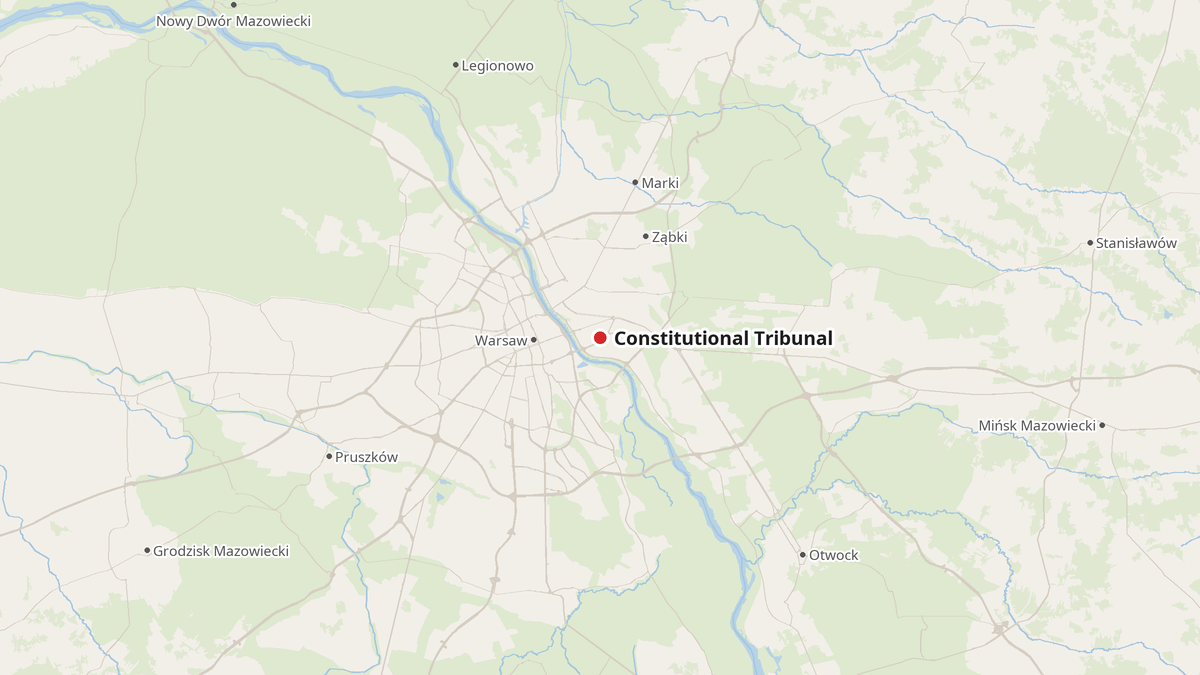
Riot police ringed Poland's Constitutional Tribunal in Warsaw on Friday evening, one day ago as this goes out, after a judge ordered the suspension of the court's president, Bogdan Święczkowski, and his deputy for a month. Anna Korwin-Piotrowska announced she was taking charge. Święczkowski rejected her authority and called it a "coup d'état." His deputy, Bartłomiej Sochański, was turned away at the building's gates. Welcome to the rule of law, European edition: a judge in charge, a judge locked out, and a cordon of police deciding who gets through the door.
Immunity, Fiefdoms and Fifty Volumes
The police deployment followed a move by Justice Minister Waldemar Żurek, who also serves as Poland's prosecutor general. He said he had submitted five requests to lift the immunity of Święczkowski and Sochański, backed by 50 volumes of case files, so criminal charges could be brought for not allowing judges to adjudicate. Żurek accused Święczkowski of turning the institution into his "private fiefdom." He told POLITICO that "now the judges have spoken," and insisted the government had nothing to do with Korwin-Piotrowska's decision. The same minister who wants two judges prosecuted says the government had no hand in removing them. Prime Minister Donald Tusk wrote on X: "Restoring the rule of law is our duty. After years of Law and Justice's lawlessness, this is a difficult, sometimes painful process that requires decisive action. There is no other way."
The tribunal's own X account answered in kind: "All persons participating in these actions are committing the crime of a coup d'etat." It said Święczkowski remained in office and that Korwin-Piotrowska could not become interim chief because she had not been sworn in by the president. The court's website was not accessible on Friday evening.
A Court Owned by Whoever Holds It
How did a constitutional court end up as a prize to be seized? The Law and Justice (PiS) government took office in 2015 and moved swiftly to appoint judges to the court to gain a majority there, because the court decides on the legality of legislation. It ruled for eight years and filled the tribunal with its appointees, including Święczkowski and his deputy. AFP said the court frequently ruled in favour of Polish legislation over EU law. The European Court of Human Rights and the Court of Justice of the European Union later ruled that the PiS majority had improperly elected three judges, and that the tribunal was no longer an "independent and impartial tribunal." Tusk's government used those rulings as grounds to stop publishing the tribunal's rulings.
Tusk, described by AFP as a strongly pro-EU figure, vowed to end the dispute with Brussels after winning an election three years ago. He hasn't. Presidential vetoes by Karol Nawrocki and his predecessor Andrzej Duda blocked his attempts. Five judges elected by parliament since March took their oaths in parliament instead, and Nawrocki has refused to swear them in, citing alleged flaws in their selection. Święczkowski barred them from hearing cases. Earlier this month the Venice Commission, the Council of Europe's advisory body, said Nawrocki should swear them in. He didn't. Parliamentary elections are scheduled next year, and some see Tusk's move as an attempt to boost his popularity.
Outside the Fence
Protesters, followers of the opposition right-wing PiS, clashed with police. Police said objects had been thrown at officers and three people were detained after climbing over the court's fence. Dozens of police guarded the entrance. Some demonstrators chanted "Tusk traitor" and tried to force through security barricades. Demonstrator Tomasz Zaleski told AFP that Tusk was "trampling on our constitutional rights." PiS leader Jarosław Kaczyński joined the protest and tried to force his way into the building, accusing Tusk of a "coup" and of turning Poland into a "police state." Police said they deployed following warnings of threats to judges and staff. Accounts differ on whether officers actually entered the premises.
Nawrocki cut short his trip to Senegal, where he was headed to the Summer Youth Olympic Games in Dakar, saying he called off the trip in mid-flight and ordered the plane back to Warsaw. "At a moment like this, the president must be in Poland," he said. He later entered the court and met Święczkowski and first chief justice Zbigniew Kapinski at the presidential palace. No details were given.
Even the Lawyers Wince
Lawyer Marcin Matczak, a critic of the PiS-era judicial reform who calls Święczkowski the court's worst president, said the suspension had no legal basis "for a million reasons." He wrote that it "buries this body and the issue of the rule of law for two decades," and warned that "images of armed police and legal interpretations according to which the minister of justice can remove the president of the Constitutional Court by decree will have a powerful, anti-rule of law backlash for years to come."
Two rival power blocs, each claiming to be the law, each reaching for police, prosecutors and presidential planes. The Venice Commission's advice sits unused. Nobody at the bottom was asked.
- constitutional tribunal
- poland
- donald tusk
- bogdan święczkowski
- karol nawrocki
- law and justice
- judicial overhaul
- rule of law