
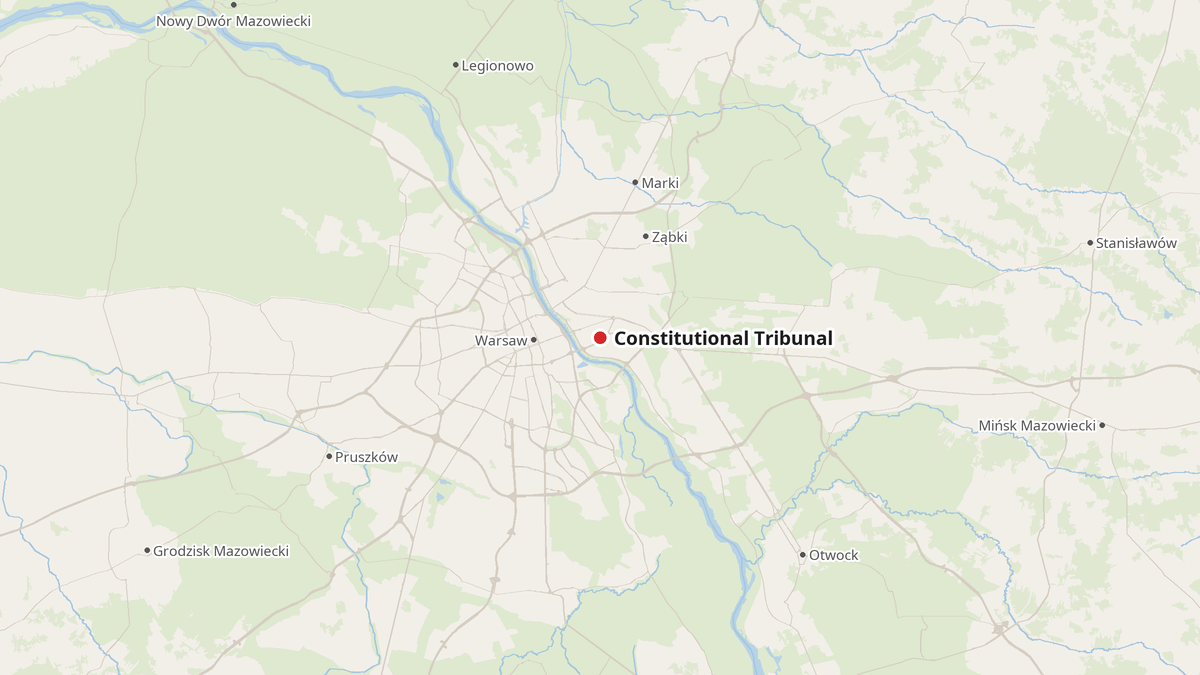
Riot police ringed Poland's Constitutional Tribunal in Warsaw on Friday evening after a judge ordered the suspension of the court's president, Bogdan Święczkowski, and his deputy for a month. The order set off a standoff between Prime Minister Donald Tusk's government and the nationalist right, and it has put one of Europe's longest-running rule-of-law disputes back at the centre of the political stage.
Anna Korwin-Piotrowska, a judge on the court, ordered Święczkowski and his deputy, Bartłomiej Sochański, suspended and announced she was taking charge. Święczkowski rejected her authority and accused those involved of a "coup d'état." Sochański was turned away at the building's gates. Korwin-Piotrowska is one of five judges elected by parliament since March whom President Karol Nawrocki has refused to swear in, citing alleged flaws in their selection procedure. "In modern Europe, a democratic state cannot function without a constitutional court (...) that acts as a guarantor of citizens' rights and freedoms," she said.
The Government's Case
The police deployment followed a request from Justice Minister Waldemar Żurek, who also serves as prosecutor general, to strip Święczkowski and Sochański of their immunity from prosecution. He said he had submitted five requests, backed by 50 volumes of case files, and argued the two men should face criminal charges for not allowing the judges to adjudicate. Żurek accused Święczkowski of turning the institution into his "private fiefdom" and blocking newly elected judges from doing their jobs. "And now the judges have spoken," he told POLITICO, insisting the government had nothing to do with Korwin-Piotrowska's move. "This court has become private property; we must restore its proper functioning," he told journalists.
Tusk defended the approach on X. "Restoring the rule of law is our duty," he wrote. "After years of Law and Justice's lawlessness, this is a difficult, sometimes painful process that requires decisive action. There is no other way."
Streets and Palace
Outside the tribunal, protesters from the opposition Law and Justice party (PiS) clashed with police. Some chanted "Tusk traitor" and tried to force their way through barricades. Police said objects were thrown at officers and three people were detained after climbing the court's fence. Police said they had deployed after warnings of threats to judges and staff. Demonstrator Tomasz Zaleski told AFP that Tusk was "trampling on our constitutional rights." PiS leader Jarosław Kaczyński joined the protest and tried to force his way into the building, accusing Tusk of staging a "coup" and turning Poland into a "police state."
Nawrocki, a PiS ally and Tusk's rival, cut short an official trip to Senegal. "At a moment like this, the president must be in Poland," he said, ordering his plane back to Warsaw mid-flight. He later entered the court and met Święczkowski and first chief justice Zbigniew Kapinski at the presidential palace. No details of any action were given. The Constitutional Court said on X that Święczkowski remained in office and that Korwin-Piotrowska could not be interim chief because the president hadn't sworn her in. Its website was inaccessible Friday evening. Accounts differ on whether police entered the building.
A Dispute With Brussels Behind It
The confrontation is the latest chapter in Tusk's effort to undo the judicial overhaul carried out by the PiS government, which took office in 2015 and filled the tribunal with its appointees, including Święczkowski and his deputy. That made the court central to Poland's clash with Brussels over the rule of law. The European Court of Human Rights and the Court of Justice of the European Union ruled that the PiS majority had improperly elected three judges and that the tribunal was no longer an "independent and impartial tribunal." Tusk's government has used those rulings as the basis for no longer publishing the tribunal's rulings.
Tusk vowed to end the dispute with Brussels after winning the 2023 election, but presidential vetoes, first from Andrzej Duda and now from Nawrocki, have blocked his attempts. The five judges elected by his parliamentary majority took their oaths in parliament, yet Święczkowski barred them from hearing cases. Earlier this month the Venice Commission, the Council of Europe's advisory body on constitutional matters, said Nawrocki should swear in the judges so they can sit on the bench.
Critics on Both Sides
Some of Tusk's own supporters have accused him of failing to act decisively. Parliamentary elections are scheduled for next year, and some see the move as an attempt to win over those voters. The method has also drawn fire from a prominent critic of the PiS-era reforms. Prof Marcin Matczak, who considers Święczkowski the court's worst president, said the suspension had no legal basis "for a million reasons." "Images of armed police and legal interpretations according to which the minister of justice can remove the president of the Constitutional Court by decree will have a powerful, anti-rule of law backlash for years to come," he wrote.
Why This Matters:
The case for restoring an independent constitutional court is strong, and European courts have said as much. But a court whose chief is displaced under police guard, on a legal footing a sympathetic expert calls nonexistent, risks handing the PiS camp a grievance and weakening the very principle the government invokes. Ordinary Poles depend on a constitutional court that citizens of every political stripe can trust to protect their rights. With elections next year, a presidency in open conflict with the government, and the Venice Commission's advice unheeded, the danger is that the rule of law is repaired through methods that deepen distrust in it. A lasting fix needs legitimacy as much as speed.
- constitutional tribunal
- poland
- donald tusk
- bogdan święczkowski
- karol nawrocki
- law and justice
- judicial overhaul
- rule of law