
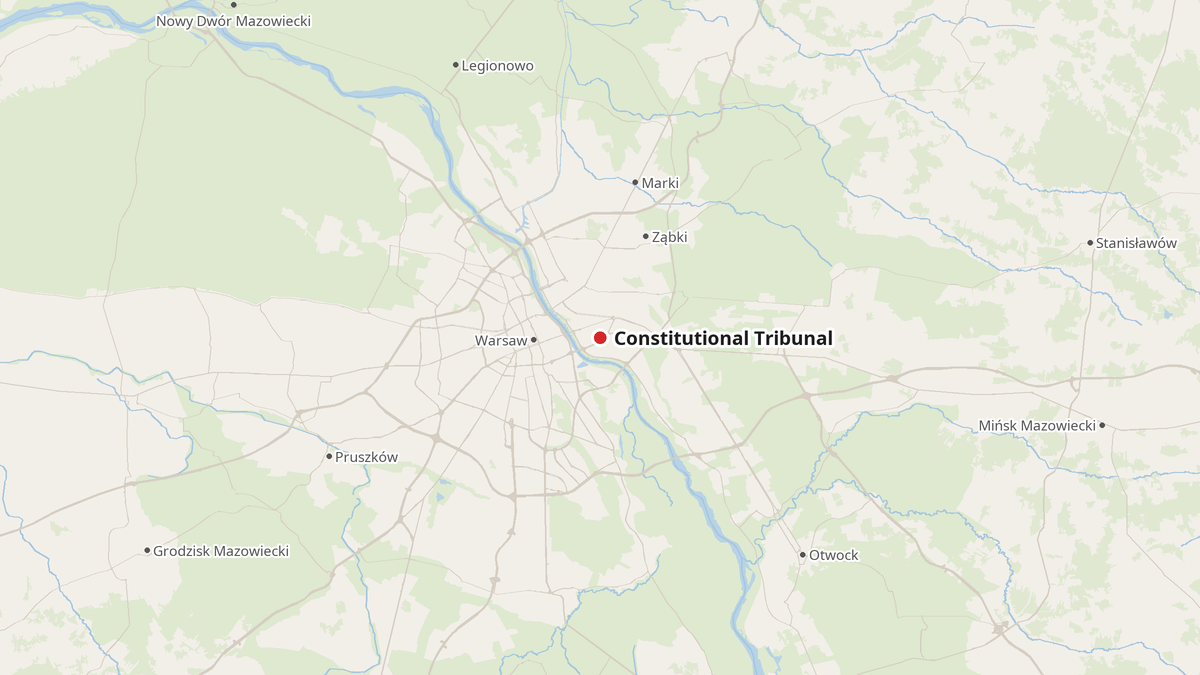
Riot police ringed Poland's Constitutional Tribunal in Warsaw on Friday evening after a judge ordered the suspension of the court's president, Bogdan Święczkowski, and his deputy for a month. The order set Prime Minister Donald Tusk's government against the nationalist right. The suspension came one day ago, on Friday, October 30, 2026, and the standoff has not been resolved.
Who Decided?
Anna Korwin-Piotrowska, a judge with the court, suspended Święczkowski and his deputy, Bartłomiej Sochański, and announced she was taking charge. Święczkowski rejected her authority and called the move a "coup d'état." His deputy was turned away at the building's gates. Korwin-Piotrowska is one of five Constitutional Court judges elected by parliament since March whom President Karol Nawrocki has refused to swear in, citing alleged flaws in their selection procedure.
The court itself pushed back in a social media post. "All persons participating in these actions are committing the crime of a coup d'etat," it said. It added that the two judges remain the legally appointed senior justices and that Korwin-Piotrowska could not become interim chief because the president had not sworn her in. The court's official website was not accessible on Friday evening.
The Brussels Factor
The European Court of Human Rights and the Court of Justice of the European Union ruled that the PiS majority had elected three of the judges improperly. The European courts held that Poland's Constitutional Court was no longer an "independent and impartial tribunal." Tusk's government has used those foreign rulings as a basis to stop publishing the tribunal's rulings.
AFP said the court frequently ruled in favour of Polish legislation over European Union law, and that the EU accused it of being too close to the nationalist political power of the time. The court has the power to decide on the legality of legislation. It sat at the heart of Poland's confrontation with Brussels over the rule of law.
Tusk, described by AFP as a strongly pro-EU figure, vowed to end the dispute with Brussels after winning an election in 2023. Earlier this month, the Venice Commission, the Council of Europe's advisory body on constitutional matters, said Nawrocki should swear in the judges to allow them to sit on the bench.
Police, Protesters, and the Justice Minister
Justice Minister Waldemar Żurek, who also serves as Poland's prosecutor general, said he had submitted five requests to lift the immunity of the two men, backed by 50 volumes of case files. He said they should face criminal charges for not allowing the judges to adjudicate. Żurek accused Święczkowski of turning the institution into his "private fiefdom." He insisted the government had nothing to do with Korwin-Piotrowska's move. "This court has become private property; we must restore its proper functioning," he told journalists.
Outside the tribunal, protesters clashed with police. Police said objects had been thrown at officers and three people were detained after climbing over the court's fence. Dozens of police guarded the entrance as followers of the opposition Law and Justice party (PiS) protested. Some chanted "Tusk traitor." Demonstrator Tomasz Zaleski told AFP that Tusk was "trampling on our constitutional rights."
PiS leader Jarosław Kaczyński joined the protest and tried to force his way into the court building. He accused Tusk of staging a "coup" and turning Poland into a "police state," and demanded presidential intervention.
The President Returns
Nawrocki, a PiS ally and rival of Tusk, cut short his official trip to Senegal. "At a moment like this, the president must be in Poland," he said. He had called off the trip in mid-flight and ordered the plane back to Warsaw. He later entered the Constitutional Court, according to his chief of staff, and met at the presidential palace with Święczkowski and the court's first chief justice, Zbigniew Kapinski. No details of any action were given.
Tusk defended the move. "Restoring the rule of law is our duty," he wrote on X. "After years of Law and Justice's lawlessness, this is a difficult, sometimes painful process that requires decisive action. There is no other way."
Legal Doubts From Tusk's Own Side
The criticism isn't confined to the right. Lawyer Marcin Matczak, a critic of the PiS-era judicial reform who calls Święczkowski the court's worst president, said the suspension had no legal basis "for a million reasons." He warned that "images of armed police and legal interpretations according to which the minister of justice can remove the president of the Constitutional Court by decree will have a powerful, anti-rule of law backlash for years to come."
Tusk has failed to undo the PiS-era changes, partly because Nawrocki and his predecessor Andrzej Duda used presidential vetoes to block his attempts. Parliamentary elections are scheduled for next year, and some see the move as an attempt to boost Tusk's popularity.
Accounts differ on whether police entered the building. One source says they had not. Other reporting describes police entering the tribunal's premises.
- constitutional tribunal
- poland
- donald tusk
- bogdan święczkowski
- karol nawrocki
- law and justice
- judicial overhaul
- rule of law