
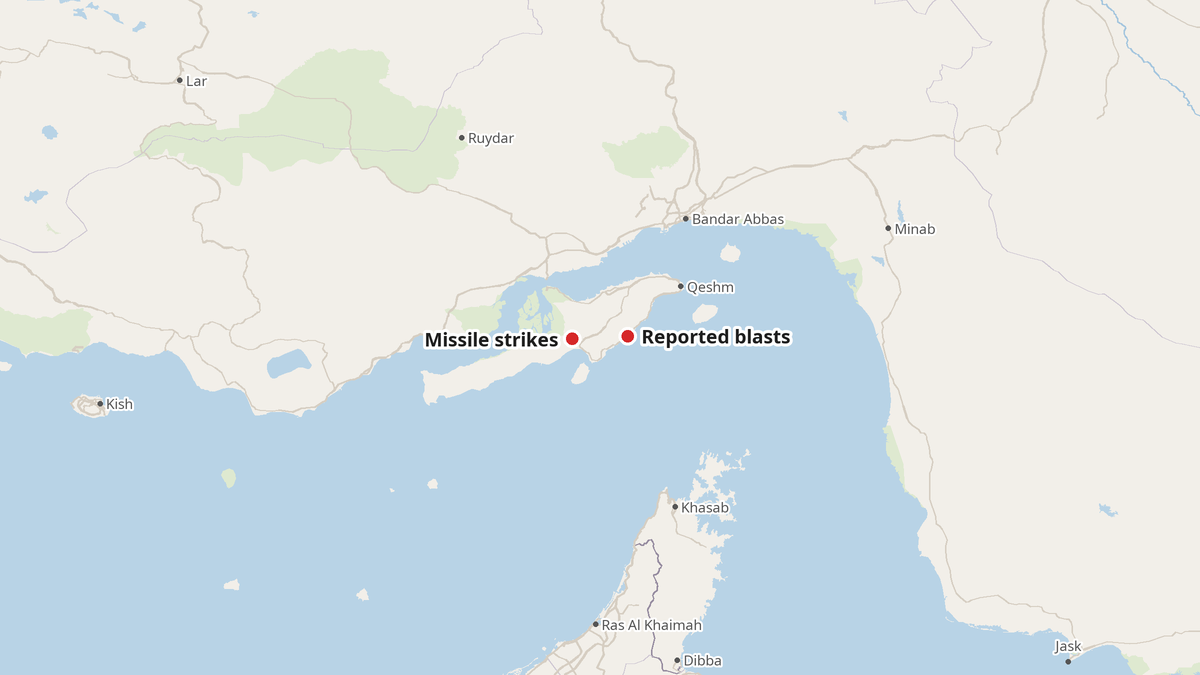
U.S. President Donald Trump said the U.S. military carried out a new round of “minor strikes” on Qeshm Island, claiming the attacks knocked out Iranian air-defense systems. The damage remains unclear. Iranian state media reported two blasts in the island’s Suza area, while the Iranian army said its air defenses had downed a U.S. drone over the island. Washington said the situation was “relatively calm.” The claims don’t resolve what happened on the ground; they show two governments announcing competing versions while military force sets the terms.
The State's Monopoly
Trump told reporters the air defenses were disabled “in about 15 minutes, maybe five.” The Iranian army’s account, carried by state broadcaster IRIB, said a U.S. drone had been brought down. Neither claim clarifies the damage on Qeshm. The public gets military statements and an unclear picture; the apparatus keeps operating regardless.
The strikes came during the U.S.-Israeli war on Iran, launched on February 28. Tehran closed the Strait of Hormuz after the war began, triggering a global energy crisis. Gulf News described the U.S. attacks as “defensive strikes,” a label that sits alongside Iran’s closure of a major maritime route and Washington’s military operations. Governments present their actions as security. The people and economies caught in the resulting confrontation don’t get to set its terms.
The United States has imposed additional sanctions as it seeks to compel Tehran to accept its demands, and has imposed a naval blockade to prevent Iran from exporting oil. On Saturday, U.S. Central Command announced a task force to support efforts to stop Iran using land routes to transport advanced weapons and other materials. These are not just statements about diplomacy: they are tools of state pressure, applied through military power and restrictions on trade.
Talks, Threats and Rewards
Trump said negotiations were continuing: “We're dealing with them now. They want to make a deal,” he said, adding, “We've made a lot of progress with Iran.” Gulf News reported that mediators were pursuing a possible agreement linking maritime access, sanctions relief and nuclear inspections. Qatar rejected reports that negotiations had stalled. “Promoting such false claims serves only those seeking to prolong the war and destabilise the region,” Majad al-Ansari, spokesperson for the Qatari Ministry of Foreign Affairs, said on X.
At the same time, the U.S. government is offering up to $20 million and possible relocation for information about Iran’s nuclear program. The reward covers facilities, equipment, associated personnel—including members of the scientific community—and the movement of people or items, according to U.S. Central Command and the State Department’s Rewards for Justice program. Negotiators discuss inspections; another arm of the same state solicits information about people and infrastructure. The language changes. The machinery of pressure doesn’t.
Middle East Eye reported that the strikes were the first since Trump’s Republican Party suffered a crushing defeat in the U.S. midterm elections, a loss it said was fueled in part by the war and rising energy prices. It also reported that Trump’s messaging had shifted between threats to “destroy” Iran and claims the war was nearing an end. On Friday, Washington was still offering a nuclear-program reward despite Trump’s repeated claims that Iran’s nuclear program had been obliterated.
Underground Arsenals, Wider Pressure
Iran’s Islamic Revolutionary Guards Corps said it was moving weapons production and storage underground. At a news conference in Tehran on Saturday, IRGC spokesperson Hossein Mohebbi said missile and drone production lines had rapidly moved from the surface to underground facilities. The semi-official Tasnim news agency said an “underground missile city” was among the achievements set to be unveiled. Mohebbi said the shift let production continue while adversaries assumed Iran’s stockpiles were dwindling.
Mohebbi claimed the IRGC’s weapons were made with “homegrown knowledge and expertise” and said improvements in stealth technology had helped Iranian missiles and drones penetrate air defenses and accurately strike targets in previous fighting with the United States and Israel. He also said restrictions on the range of Iranian missiles had been lifted. Supreme Leader Mojtaba Khamenei had warned there would be “no geographical limits” to Iran’s response if the United States and Israel attacked again. Rival governments issue warnings, build weapons and impose blockades; mediation continues alongside the preparations.
The confrontation also reaches beyond Qeshm. Reuters found that Iran had targeted Gulf infrastructure at least 135 times during previous rounds of fighting, causing billions of dollars in damage and lost revenues. The Wall Street Journal reported billions of dollars in damage to U.S. bases across the Middle East. Gulf News, citing the Journal, reported that vessels seeking passage through the Red Sea could email Yemen’s Iran-backed Houthis, who control swaths of Yemen and had declared a maritime blockade of Saudi Arabia earlier in 2026. Some ships began contacting them before transiting, with replies typically arriving within 24 hours. Different authorities, same crowded waterways: access is administered through power, and the costs travel far beyond the people making the decisions.
- qeshm island
- iran
- united states
- strait of hormuz
- airstrikes
- iran-us conflict
- qatar mediation
- iran nuclear program