
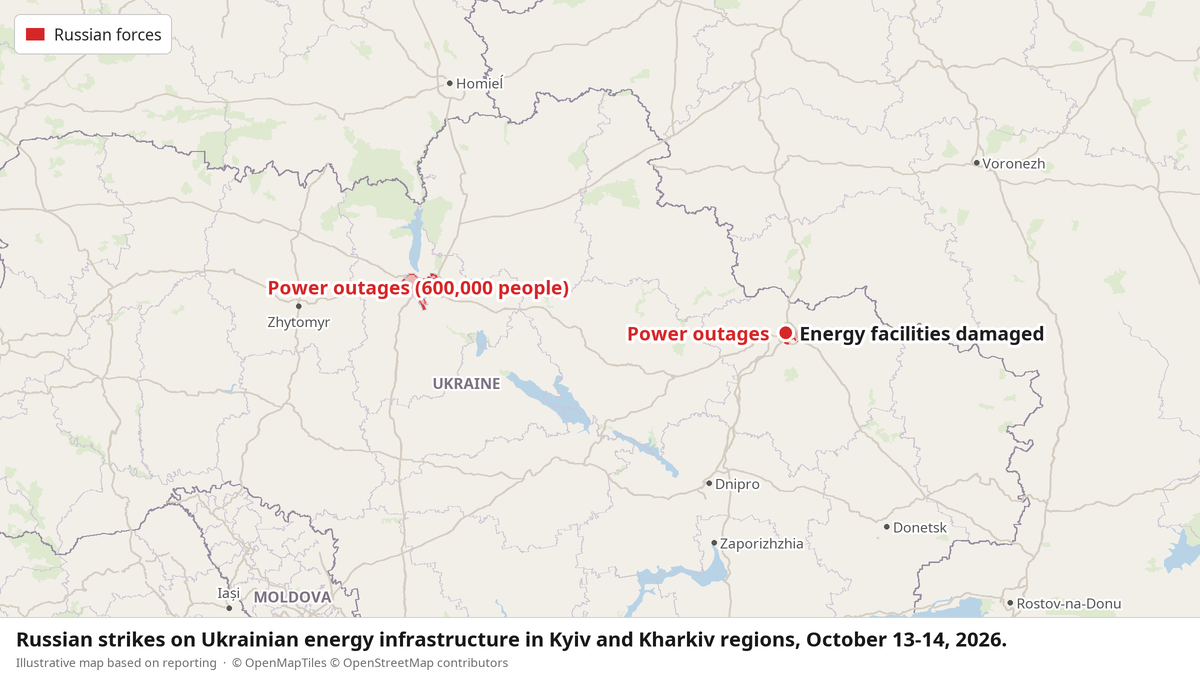
At least 600,000 people across Ukraine have no electricity after deadly overnight Russian missile and drone strikes, President Volodymyr Zelensky said. Russian forces hit “critical” energy infrastructure in Kyiv, the surrounding region and the north-eastern city of Kharkiv. The strikes came despite US President Donald Trump’s claim on Sunday that Russia and Ukraine had an “energy ceasefire.”
Human Impact
In Kyiv, at least three people died and 21 suffered injuries, Ukraine’s state emergencies service DSNS said. A Russian ballistic missile struck the city’s CHP-4 power plant on Tuesday evening. It also struck a residential building in the Desnianskyi district, Kyiv mayor Vitali Klitschko said, putting the number of wounded at around 20. Kyiv, home to about three million people, has faced intensifying drone and missile attacks, with energy infrastructure a key target.
The scale was considerable. Ukraine’s air force said Russia launched 39 ballistic and cruise missiles and 128 drones overnight; Ukrainian forces shot down four missiles and 115 drones. Zelensky said the strikes damaged 26 electricity facilities and four oil and gas installations. Russia’s defence ministry said its “massive” strikes targeted communications and energy facilities in the Kyiv and Kharkiv regions used by Ukraine’s military. It separately said Russian forces shot down 902 Ukrainian drones over Russian regions, including Moscow and Crimea, the peninsula Russia annexed in 2014.
No Warning, No Ceasefire
For a second consecutive night, Zelensky said, Ukraine received no early warning from its partners before Russian ballistic missiles hit Kyiv. “A Russian ballistic missile attack on Kyiv. Once again, no early warning from our partners,” he wrote on Facebook. “The main target was energy infrastructure, specifically the CHP-4. Unfortunately, it was hit.” Ukraine’s systems detected the missiles only as they neared the city, he said. “This is absolutely unjust: when they are destroying our infrastructure, and Ukraine is not even receiving early warnings about ballistic missile launches,” he added.
Ukraine depends heavily on Western intelligence, especially from the US, to detect incoming attacks and identify its own targets. Overnight from Monday into Tuesday, Kyiv residents heard explosions before air raid sirens sounded. That’s rare. Ukrainian officials said hard-to-detect Russian missiles or possible technical issues caused the delay.
Trump announced the “energy ceasefire” on Sunday on Truth Social, saying both parties had agreed to stop long-range strikes on power plants and oil refineries. “Do not break it!” he wrote. Zelensky has repeatedly said Ukraine is ready to halt strikes on Russian refineries if Moscow does the same. Russian Foreign Minister Sergey Lavrov said Ukraine doesn’t deserve the “respite” a ceasefire would bring, arguing Europe could use a truce to “pump [Ukraine] with new weapons.” Zelensky accused Moscow of “ostentatious disrespect toward the United States” and appealed to Trump for tougher sanctions and more Patriot interceptors. “We ask America and EVERYONE in the world who does not turn a blind eye to reality to respond and to respond forcefully,” he wrote.
Starlink Restrictions and Allied Pressure
On Wednesday, Ukrainian forces reported restrictions on military use of SpaceX’s Starlink system. The limits appear to affect StarShield, the military-grade version, with connectivity reportedly cut when terminals move faster than about 160 kilometres per hour. Serhiy Beskrestnov, a Zelensky adviser on military technology known as “Flash,” said SpaceX introduced the limit overnight without notifying Ukrainian forces. “Our defence forces did not receive a warning about this limitation and this led to the disruption of several missions,” he wrote on Telegram.
Volunteer Serhiy Sternenko suggested SpaceX might have acted at the request of Trump’s administration. No independent evidence supports that suggestion, and the reason remains unclear. No connection has been established between the restrictions and the diplomatic dispute. Still, the episode has raised concerns that access to American satellite communications could become another source of leverage over Kyiv, alongside reported US threats to curtail intelligence-sharing unless Ukraine halts strikes on Russian refineries. Washington has denied suspending intelligence-sharing, and Ukrainian officials say cooperation continues.
The tension has been building. Elon Musk, SpaceX’s owner, wrote on X on Saturday that “Zelenskyy has gone too far.” Trump has lashed out at Zelensky over the refinery strikes and suggested it was “time for Ukraine to get a new president.” Relations have deteriorated since Trump agreed with Moscow to ease restrictions on Russian diesel exports.
Why This Matters:
Russia launched its full-scale invasion in 2022, and this is now the fifth year of the conflict. Moscow controls about 20% of Ukrainian territory. For civilians in Kyiv and Kharkiv, the cost is measured in dark homes, damaged apartment blocks, and the dead and wounded. The episode also exposes how much Ukraine’s defence rests on decisions made in Washington, from early warnings to satellite links. From a European perspective, that dependence is hard to ignore: if allied intelligence or connectivity can become bargaining chips, the case for European capacity to sustain Ukraine’s air defence—and for diplomacy that includes Kyiv rather than sidelining it—grows harder to dismiss.