
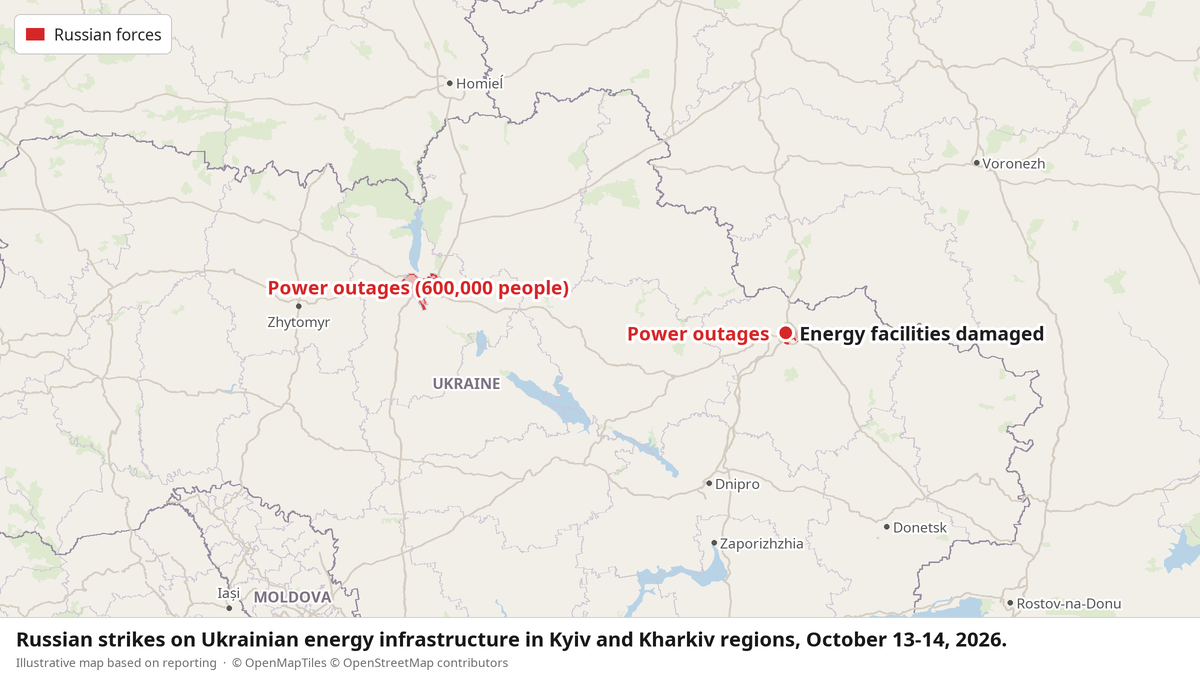
At least 600,000 people across Ukraine have no electricity after overnight Russian missile and drone strikes, President Volodymyr Zelensky said. Kyiv, home to about three million people, took the heaviest blow. A Russian ballistic missile hit the capital's CHP-4 power plant on Tuesday evening, as attacks on energy infrastructure intensify. For European governments, a country with a wrecked grid in the fifth year of the conflict is one people will leave. Nobody in Brussels has said who will be expected to take them.
The Border Question
The base reporting gives no refugee figures and mentions no displacement. It does, though, lay out the scale of the damage. Zelensky said 39 ballistic missiles and more than 120 attack drones and loitering munitions targeted Kyiv, the surrounding region and Kharkiv overnight. Twenty-six electricity facilities and four oil and gas installations suffered damage. Ukraine's air force said Russia fired 39 ballistic and cruise missiles and 128 drones; Ukrainian forces shot down four missiles and 115 drones. Moscow's defence ministry said its strikes targeted communications and energy facilities used by Ukraine's military. In Kyiv, at least three people died and 21 were injured, according to the state emergencies service DSNS. Mayor Vitali Klitschko said at least two people died in Tuesday evening's attack, which also hit a residential building in the Desnianskyi district and wounded around 20 others.
When the lights go out in a major Ukrainian city each winter, European capitals face the same question: who comes, how many, and who pays? People living in border regions and cities that absorb new arrivals haven't been asked.
Who Decided?
Decisions made far from any European parliament steer the war. President Donald Trump announced an "energy ceasefire" on his Truth Social network on Sunday. "Effective immediately, there is an ENERGY CEASEFIRE in the War between Russia and Ukraine. Both parties have agreed. Do not break it!" he wrote. Within days, Russian missiles struck the very infrastructure the announcement was supposed to protect. Zelensky wrote that "Russia has never before shown such ostentatious disrespect toward the United States."
Russia's Foreign Minister Sergey Lavrov offered his own reading. Ukraine does not deserve the "respite" a ceasefire would bring, he said, adding that under any truce Europe would be able to "pump [Ukraine] with new weapons" so it could continue the war. Trump, meanwhile, has repeatedly lashed out at Zelensky over strikes on Russian oil refineries and on Saturday suggested it was "time for Ukraine to get a new president."
Europe sits at the table as a payer and a neighbour, not as a decision-maker. Zelensky said its partners gave Ukraine no early warning before ballistic missiles struck Kyiv for a second consecutive night. "This is absolutely unjust," he said.
Security Implications
Ukraine depends heavily on Western intelligence, especially from the US, to detect incoming attacks and identify its own targets. Media reports say the Trump administration warned it could curtail intelligence cooperation unless Kyiv halts strikes on Russian oil refineries. Washington denies suspending intelligence-sharing, and Ukrainian officials say cooperation continues.
Then came Starlink. On Wednesday, Ukrainian forces reported an overnight change to SpaceX's military-grade service: connectivity dropped when terminals moved faster than about 160 kilometres per hour. Serhiy Beskrestnov, an adviser to Zelensky known as "Flash," wrote on Telegram: "Our defence forces did not receive a warning about this limitation and this led to the disruption of several missions." Volunteer Serhiy Sternenko suggested the Trump administration might have requested the change. There’s no independent evidence of that, and the reason remains unclear. Elon Musk, SpaceX's owner, wrote on X on Saturday that "Zelenskyy has gone too far." No connection between the restrictions and the diplomatic dispute has been established.
The pattern is plain enough. Washington can switch off warnings, intelligence and communications at will. Moscow currently controls about 20% of Ukrainian territory, after Putin launched the full-scale invasion in 2022 and annexed Crimea 12 years ago. A continent that can't guarantee its own security, energy or borders is a continent whose fate gets settled by others.