
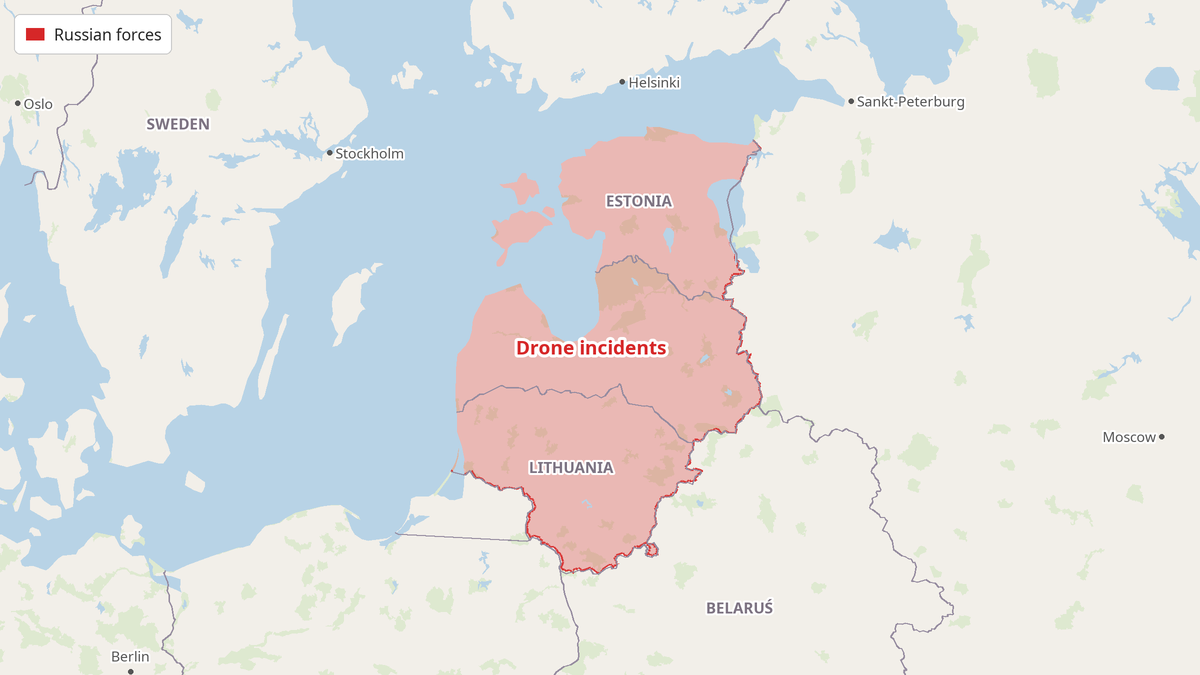
Masked, most likely armed men on the Belarusian side of the Latvian border escorted groups of migrants toward Latvia and threatened soldiers and border guards. On the same day, other masked people crossed into Latvian territory and deliberately damaged border infrastructure. Surveillance equipment was removed. That's the account Latvia's ambassador to Greece, Ieva Cesniece, gave Al Jazeera, and it's one piece of a pattern that European governments now warn is heading toward escalation.
People Used as Pawns
Latvian media reported that asylum seekers and undocumented migrants who tried to run back from the border were rounded up by Belarusian authorities and pushed toward Latvia again. Cesniece said Russia and Belarus are trying to destabilise the Baltic states by making their borders appear fluid. The people caught in the middle are not the authors of this strategy. They're its instruments, shuttled back and forth across a frontier by a state that has no interest in their protection.
Cesniece tied the border incidents to the wider war. "The weaker Russia appears in Ukraine, the more it tests our resilience, trying to weaken NATO and EU resolve and support for Ukraine," she said.
A Widening Pattern
European officials allege that Russian fighter planes entered Polish, Lithuanian and Estonian airspace to test response times. Suspected Russian drones have been downed over Poland, Finland and the Baltic states. Ukraine accuses Russia of using aerial and surface drones in two October operations to sink four cargo ships just outside Bulgaria's territorial waters. Bulgaria belongs to both the EU and NATO, and the attacks appeared to warn that Ukraine's grain exports through NATO waters might not be safe for long.
An August operation to blow up cargo planes at Germany's Leipzig/Halle Airport failed. The European Commission later verified it as a Russian operation. In September, Czech spy chief Michal Koudelka warned that Russia might attempt a military attack on a NATO member in "months, not years." Days later, Russian Foreign Ministry spokesperson Maria Zakharova said European defence industries supplying Ukraine were legitimate targets.
Representatives of five EU intelligence agencies told the Financial Times that Russia was seeking to "kill" European defence bosses and target their supply chains. Frankfurter Allgemeine Zeitung reported that Russia had planted incendiary devices in the Munich offices of defence companies Rohde & Schwarz and Helsing. Politico quoted EU security officials saying Russia planned to move beyond messaging and claim lives on European soil.
Deterrence Without Costs
Olena Tregub, cofounder and head of Ukraine's Independent Anti-Corruption Commission, said protecting infrastructure and strengthening intelligence services are essential. But deterrence, she argued, means convincing an adversary that continuing will become too costly. "And I'm not sure Russia currently sees those costs as sufficiently high." She said European governments hadn't done enough to identify networks behind operations, expose command structures, disrupt financing and logistics, and impose consequences.
Oleksandr Danylyuk, a Russian warfare expert with the Royal United Services Institute, was blunter. "Russians are limited right now only by their capabilities because they do whatever they want. There is no reaction." He urged more forward NATO troops in the Baltic states for "deterrence by denial," and called money the strongest deterrent. Each time Russian intelligence operations are detected in Europe, he proposed, combined support for Ukraine could rise by "10 percent, 20 percent." Allies, he said, are signalling the opposite.
Minna Alander of the Center for European Policy Analysis listed possible immediate responses: denying Russians travel visas, retaliatory cyberattacks, further interdiction of the Russian oil fleet, and sanctioning Chinese suppliers of defence goods to Russia. European officials have discussed hardening data centres, telecommunications and other vulnerable networks, but haven't spoken of retaliation.
The Funding Question
On October 16, Ukrainian President Volodymyr Zelenskyy asked journalists where Vladimir Putin will stop "if he is currently testing all these drones against European countries, even NATO countries." European leaders, he said, "are not talking about it very loudly yet. They don't want escalation... but you will talk very loudly when there are ballistic and cruise missiles and also thousands of drones."
He told the European Council the same day that the war will cost 155 billion euros next year, and Ukraine needs at least 70 billion euros more from Europe. With that money, he said, drone production could double or even triple.
The backdrop is uneasy. The United States withdrew its military and financial support in January 2025 and has recently cast doubt on the dependability of its satellite services. In France and Germany, governments trailed opposition leaders who wanted to stop aid to Ukraine. Meanwhile, Ukraine's two counteroffensives have blunted Moscow's main effort to take Donetsk and deprived Russia of territorial gains this year.
Why This Matters:
The sabotage campaign puts ordinary Europeans, from border guards in Latvia to workers in defence supply chains, directly in the line of fire of a conflict many assumed was somebody else's. It also exposes a gap between what EU governments say and what they deliver: warnings are loud, consequences for Russia are faint, and the funding Ukraine says it needs remains unpledged while the US steps back. No single member state can secure airspace, shipping lanes and borders alone; this is exactly the kind of threat only a coordinated European response can meet. Experts quoted here argue that sustained support for Ukraine is both a moral obligation and the most direct form of deterrence. The migrants pushed back and forth at the Belarusian border are a reminder that the human cost of this shadow war isn't confined to the battlefield.
- russia
- nato
- europe
- sabotage
- hybrid warfare
- ukraine
- baltic states
- cyberattacks