
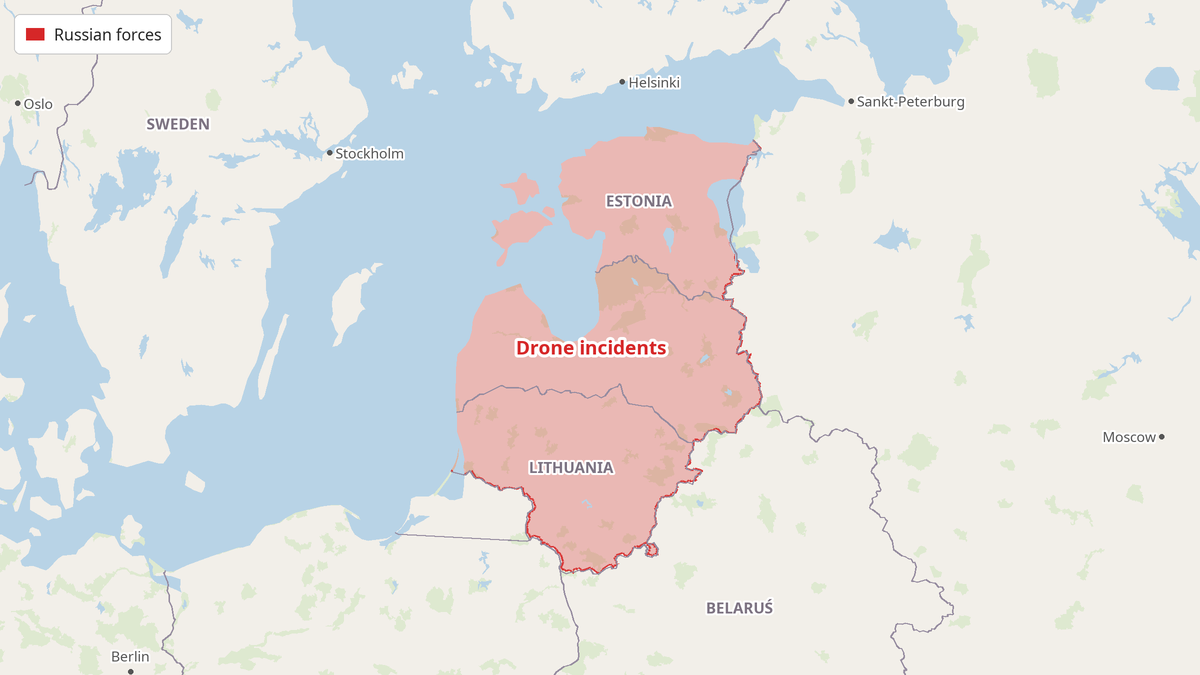
Latvia’s ambassador to Greece says masked people on the Belarus side of the border escorted groups of illegal migrants toward Latvia, threatened Latvian soldiers and border guards, and damaged border infrastructure in a separate incident. The allegations place the control of Latvia’s frontier alongside a wider series of reported Russian operations in Europe.
Pressure at the Border
Ieva Cesniece told Al Jazeera that “masked and most likely armed individuals on the Belarus side of the border escorted and attempted to push groups of illegal migrants into Latvia.” She said the individuals threatened Latvian soldiers and border guards.
In a separate incident the same day, Cesniece said, masked people crossed into Latvian territory and carried out deliberate sabotage. She said border infrastructure was damaged and surveillance equipment was removed. Latvian media reported that asylum seekers and undocumented migrants who tried to run back from the Latvian border were rounded up by Belarusian authorities and pushed toward Latvia again.
Russia and Belarus have also been accused of trying to destabilise the Baltic states by making their borders appear fluid. The reported incidents involve both attempted movement of migrants across Latvia’s border and damage to equipment used for surveillance.
Cesniece linked Russia’s war in Ukraine to what she called its shadow war in Europe. “The weaker Russia appears in Ukraine, the more it tests our resilience, trying to weaken NATO and EU resolve and support for Ukraine,” she said.
European officials have alleged that Russian fighter planes entered Polish, Lithuanian and Estonian airspace, testing response times. Suspected Russian drones have been downed over Poland, Finland and the Baltic states.
Threats Beyond the Baltic Border
Ukraine accused Russia of using aerial and surface drones in two operations in October to sink four cargo ships just outside Bulgaria’s territorial waters. Bulgaria is a European Union and NATO member. The alleged attacks appeared to warn that Ukraine’s grain exports through NATO territorial waters might not be safe for long.
European governments have warned of an imminent escalation of a Russian shadow war on the continent. Olena Tregub, cofounder and head of Ukraine’s Independent Anti-Corruption Commission, said protecting critical infrastructure, strengthening intelligence services and preventing attacks were essential. But she argued that deterrence must also convince an adversary that continuing operations will become too costly. “I’m not sure Russia currently sees those costs as sufficiently high,” she said.
Tregub said European governments had not done enough to identify networks behind operations, expose command structures, disrupt financing and logistics, and impose consequences. European officials have discussed strengthening the resilience of data centres, telecommunications and other vulnerable networks and industries, but haven’t spoken of retaliation.
An operation in August to blow up cargo planes at Germany’s Leipzig/Halle Airport failed. The European Commission later verified it as a Russian operation. In September, Czech spy chief Michal Koudelka warned that Russia might attempt a military attack on a NATO member in “months, not years.” Days later, Russian Ministry of Foreign Affairs spokesperson Maria Zakharova said European defence industries supplying Ukraine were legitimate targets for Moscow.
European Response Under Debate
Representatives of five EU intelligence agencies told the Financial Times that Russia was seeking to “kill” European defence bosses and target their supply chains. The report followed a story in the German newspaper Frankfurter Allgemeine Zeitung that Russia had planted incendiary devices in the Munich offices of defence companies Rohde & Schwarz and Helsing. A Politico report also quoted EU security officials as saying Russia planned to move beyond messaging and claim lives on European soil.
On October 16, Ukrainian President Volodymyr Zelenskyy asked journalists: “Where will he stop if he is currently testing all these drones against European countries, even NATO countries?” He said European leaders did not want escalation, but warned they would speak loudly when there were “ballistic and cruise missiles and also thousands of drones.”
Minna Alander, a leading European researcher in security and defence with the Center for European Policy Analysis, said possible immediate responses included denying Russians travel visas, conducting retaliatory cyberattacks, further interdicting the Russian oil fleet and sanctioning Chinese suppliers of defence goods to Russia. Oleksandr Danylyuk said NATO should place more forward troops in the Baltic states to create “deterrence by denial” and strengthen Ukraine.
The United States withdrew its military and financial support in January 2025 and had recently cast doubt on the dependability of its satellite services. In France and Germany, governments trailed opposition leaders who wanted to stop aid to Ukraine. Zelenskyy told the European Council on October 16 that the war would cost 155 billion euros next year and that Ukraine needed at least 70 billion euros more from its allies.
- russia
- nato
- europe
- sabotage
- hybrid warfare
- ukraine
- baltic states
- cyberattacks