
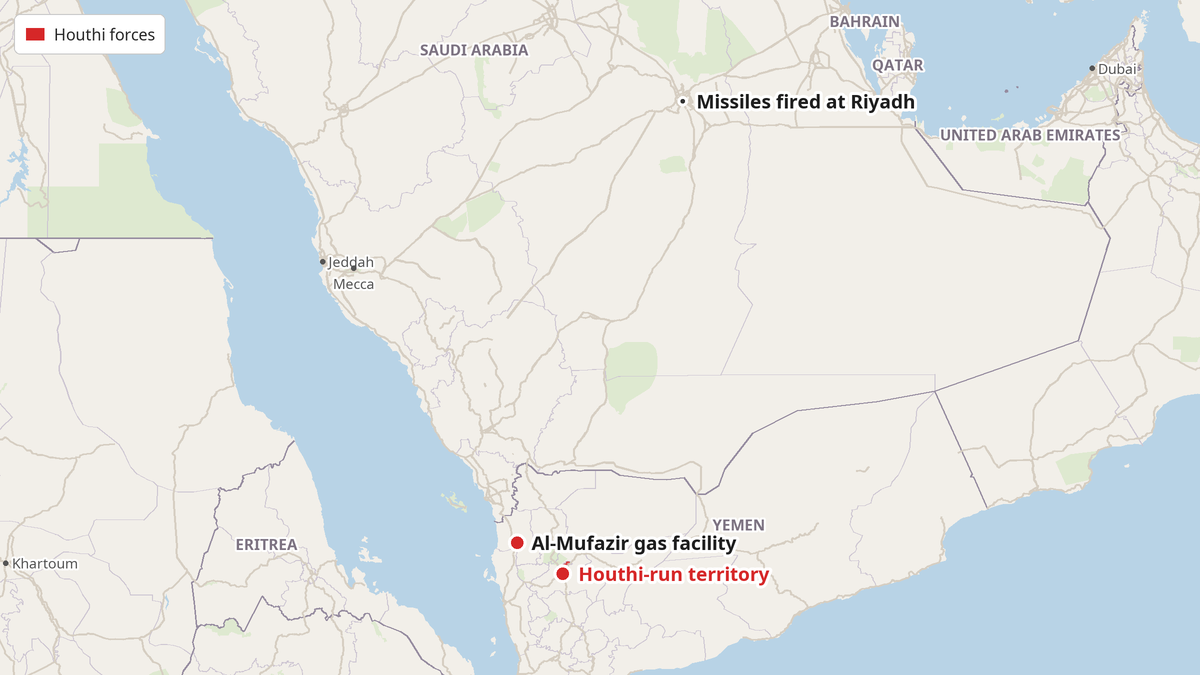
Residents of Riyadh got a text message on Tuesday telling them to take shelter from an "aerial threat." Multiple explosions followed, according to AFP. A later message from the civil defence agency said the danger had passed. That's the whole social contract, delivered by SMS: the people get the alert, the generals get the war.
Major-General Turki al-Maliki, spokesperson for the Saudi Arabia-led coalition fighting Yemen's Houthis, said in a series of posts on X that a ballistic missile and a cruise missile were intercepted and destroyed over Riyadh, and a second ballistic missile was downed over the southern part of the kingdom. He blamed the Iran-backed Houthis. There was no immediate comment from the Houthis.
Fire on Both Sides of the Border
The Houthi-run Saba news agency told its own version of the same day: coalition air strikes on Sanaa, the Yemeni capital the Houthis control. Saba said the strikes hit the al-Mufazir gas facility in the Jadar district, north of the capital, and a building belonging to the state oil company in southern Sanaa. Civil defence teams were working to put out a fire in gas trailers at the al-Mufazir station. The coalition didn't immediately confirm the strikes.
Two capitals, two ruling authorities, two state-run news agencies. Saudi Arabia's SPA and the Houthis' Saba each narrate the same war to their own captive audiences, and neither one is a neutral witness. Strip away the flags and what remains is the same machinery: ministries, spokesmen, air defence, air strikes, and a civilian population told where to hide.
Oil Is the Real Front Line
On Monday, the East-West oil pipeline in Saudi Arabia's Medina region was attacked again. A Saudi Ministry of Energy official told SPA the strike caused a "limited fire" that was extinguished and that "pipeline operations were unaffected." No injuries or deaths were reported. Notice the order of priorities in that statement: operations first.
The pipeline matters because it's a vital route for Saudi oil exports, given Tehran's restrictions in the Strait of Hormuz following the US-Israel war against Iran. It has come under attack several times. On Sunday, the Houthis said they attacked Riyadh's business district. Saudi officials said falling debris from an "attempted attack" caused minor damage to the Aramco Tower. SPA published images of the deputy governor of the Riyadh region and other officials inspecting the building, damage visible on several floors. The officials toured the oil company's tower. Nobody in the base reporting toured a home.
Who Pays for the Offensive
The exchanges come as fighting rages in Yemen between the Houthis and the internationally recognised government, which is backed by Riyadh. The coalition has supported a Yemeni government offensive to retake territory with air strikes. The Houthis, for their part, have repeatedly struck Saudi oil infrastructure, including refineries and storage facilities, with drones and missiles.
So the pattern is plain. A recognised government fights for territory with a foreign air force behind it. A rival authority holding the capital answers by hitting the oil that funds its enemy. The wider US-Israel war against Iran sits behind both, squeezing the Strait of Hormuz and turning a pipeline in Medina into the main artery.
The National's live blog listed the coalition's interception of missiles and drones and noted the Saudi and Oman foreign ministers calling for diplomacy. The same day the missiles flew, the diplomats made their appeal. Diplomacy, in this telling, is something the foreign ministries practise in the gaps between salvos, while the people in Riyadh and Sanaa wait for the next alert on their phones.
The base reporting contains no accounts from civilians in either city, no organizers, no voices from below. That silence is itself the story: every quoted source is a spokesman, a ministry official, or a state news agency.
- saudi arabia
- houthis
- yemen
- missile attack
- riyadh
- east-west pipeline
- aramco tower
- turki al-maliki