
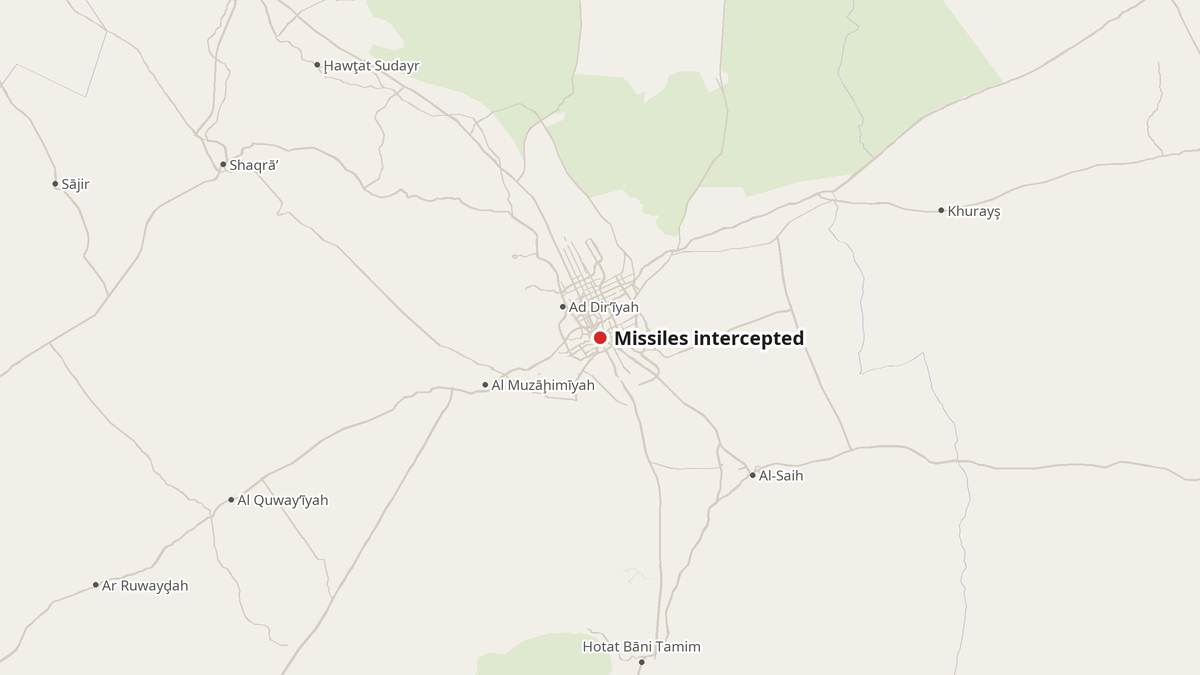
Two missiles fired by Yemen's Houthis toward Riyadh were intercepted and destroyed on Tuesday, the Saudi-led coalition said, according to a Middle East Eye live-blog entry timed 10 November 2026, 01:10 GMT. The coalition's statement doesn't mention casualties or damage. It says only that both missiles were brought down.
Saudi Arabia's civil defence authorities had warned earlier of a potential threat in the capital. They later lifted the alert after the danger was assessed to have passed. For residents of a major city, that sequence, a warning, a wait, then an all-clear, is its own kind of strain, even when nothing lands.
Civilian Exposure
The launch targeted a capital city. Riyadh is a densely populated urban center, and any missile fired in its direction puts civilians in the line of risk, whether or not it reaches its target. The civil defence alert is the part of this episode ordinary people actually experience: the notification, the uncertainty, the minutes before someone confirms it's over.
The base reporting is thin on detail. It doesn't say where the missiles were launched from, what they were carrying, or whether any debris fell in populated areas. It doesn't describe how residents responded. Those gaps matter, and they're a reminder that a single line in a live blog is a long way from a full account of what people on the ground went through.
A Wider Confrontation
The entry appeared in a live blog titled "Live: Trump says US ready to strike Iran 'if necessary.'" That placement signals how closely this launch is being read alongside a broader and more dangerous confrontation. The base article doesn't link the two events, and it would be wrong to assert a connection the reporting doesn't establish. But the proximity on the page is telling. A missile attack on a capital, and talk of possible US strikes on Iran, are being tracked in the same breath.
That's the pattern civilians in this region know well. Military signaling between governments and armed groups unfolds in the same airspace where families live. Interceptions can prevent a tragedy, but they don't remove the risk. They only mean it didn't happen this time.
What Remains Unanswered
The coalition's account is the only one in the base article. There's no statement from the Houthis, no independent verification of the interceptions, and no word from Saudi officials beyond the civil defence alert and its cancellation. Readers should weigh the claim accordingly: it's an official assertion, reported through a live blog, that two missiles were destroyed.
What the entry does establish is that the Saudi capital was put on alert, that the alert was lifted, and that the coalition says it stopped both missiles. Whether this is an isolated launch or part of a larger escalation isn't answered by the facts available.
Why This Matters: A missile fired toward a capital city carries civilian risk even when it's intercepted, and the placement of this report beside a live blog on possible US strikes on Iran shows how readily regional crises overlap. Each launch, each alert, each warning of wider American military action narrows the room for diplomacy and raises the odds that civilians, in Riyadh, in Yemen, or elsewhere, pay for decisions made far above them. Interception isn't resolution. Without a political track that actually restrains the armed actors involved, the cycle of launch, alert and retaliation can keep repeating, and the next missile may not be stopped.
- houthis
- saudi-led coalition
- riyadh
- missile interception
- yemen
- saudi arabia
- civil defence
- middle east