
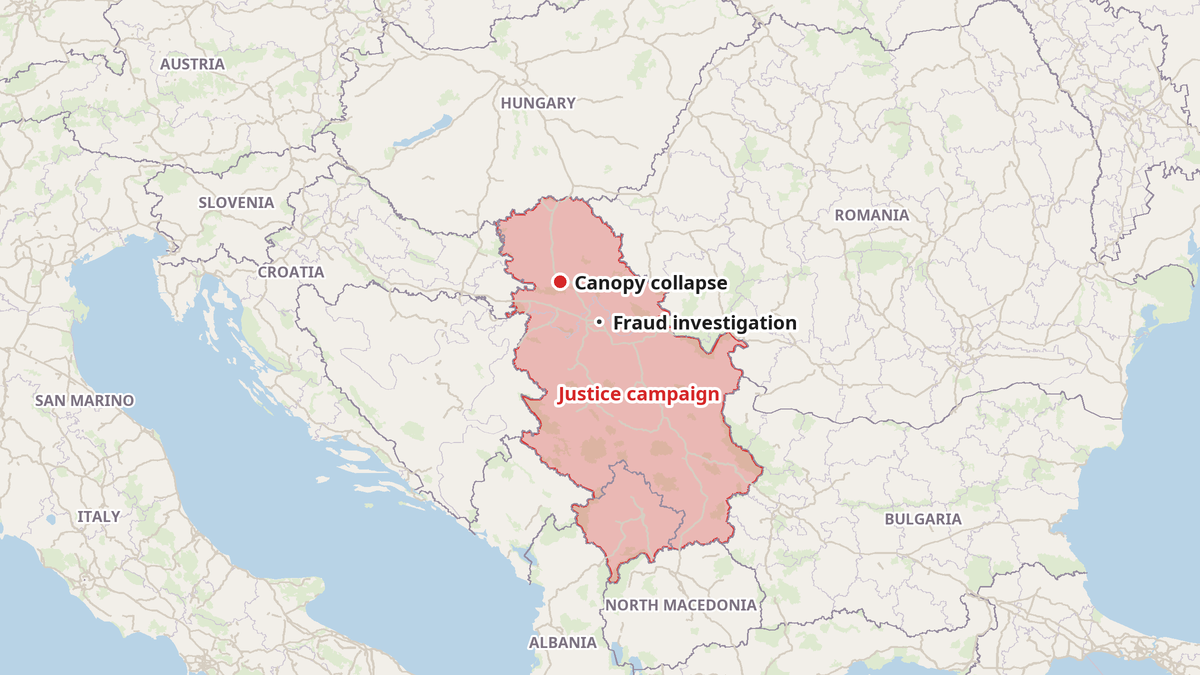
Sixteen people died when a concrete canopy fell on the renovated Novi Sad railway station on November 1, 2024. Fourteen were killed at the scene. Two more died of their injuries, in November 2024 and March 2025. Today is the second anniversary. The question the dead left behind, who signed off on a roof that killed them, still hasn't been answered in any courtroom.
Justice, Fast and Slow
What the state did next tells you where its priorities sit. On November 5, 2024, four days after the collapse, thousands gathered in Novi Sad to demand accountability. The protests ended in clashes with police, dozens of arrests and a damaged City Hall. Observers pointed to the swift judicial response to the protesters while the investigation into the accident itself stayed stalled. Arrests moved quickly. The roof inquiry didn't.
On November 19, 2024, opposition MPs, councillors and ordinary citizens blocked the entrance to the court and prosecutor's office in Novi Sad for three consecutive days. They wanted the arrested released and the investigation sped up. Riot police met them daily. Only after three weeks of public pressure, on November 21, did prosecutors announce 11 arrests tied to the deaths, including former Construction Minister Goran Vesic and other officials.
Binders and Indictments
On December 11, 2024, authorities released part of the reconstruction paperwork: eight binders, 195 documents. Students and others called it insufficient and demanded full transparency and criminal accountability for contractors and supervisory institutions. On December 30, prosecutors indicted 13 people for serious crimes against public security, improper execution of construction works and abuse of office. Higher courts then overturned detention orders for Vesic and Jelena Tanaskovic, acting General Director of Serbia Railways Infrastructure, and put them under house arrest. A dispute over which prosecution offices had jurisdiction, and over the transfer of case files, further clouded the proceedings.
On January 15, 2025, the organised crime prosecutor in Belgrade opened a separate investigation into financial fraud, corruption and money laundering in the station's reconstruction. It names Vesic, former Trade Minister Tomislav Momirovic and 12 others, including managers of construction and supervision companies. The people who built and signed off on the thing are in the file. The students who stood in the road are the ones who got prosecuted first.
Beatings, Arrests, Exile
From November 22 to 25, 2024, students and professors were attacked during a memorial service for the victims in front of the faculty of dramatic arts in Belgrade. That attack triggered the university sit-in, with demands for prosecution of the attackers, publication of the documents, and release of all detained protesters. On January 28, 2025, governing party activists attacked students of the Academy of Arts in Novi Sad and caused serious bodily harm. Prime Minister Milos Vucevic resigned, which the source calls the government's biggest political concession to date. Protests and blockades went on.
On March 11, 2025, thirteen activists and students were arrested in Novi Sad on the eve of planned large protests in Belgrade, charged with undermining the constitutional order and violent behaviour. Civil society organisations denounced the arrests as politically motivated. Four days later, on March 15, hundreds of thousands demonstrated in Belgrade. On May 28, Novi Sad's High Court swapped prison detention for house arrest for some of the detained. On June 25, with the prosecutor refusing to drop the constitutional-order charges and security services still applying pressure, some of the accused left Serbia for European Union countries to keep drawing attention to the situation. Exile, in other words, was the price of protesting a collapsed roof.
The Electoral Circus
On September 9, 2026, the informal student movement became a political force after snap parliamentary elections were announced for October. The Student List-Students Win grouping brought together students, professors and legal experts. On September 27, longtime leader Aleksandar Vucic resigned as president to head the Serbian Progressive Party-led list. On his last day in the job he pardoned all prosecuted students and activists, ending the proceedings for undermining the constitutional order and clearing the way for exiles to return. The move was widely seen as an attempt to ease social tensions ahead of the campaign. The state dropped the charges only when the ballot box loomed.
Vucic then conceded defeat to the Student List, in elections where turnout hit its highest level in more than 30 years. The source's timeline dates that concession to October 25, 2025, a date inconsistent with the surrounding 2026 events. Accountability for the station tragedy, the source says, remains a central issue after the results.
In an Irish Times opinion piece, writer Liz Carolan says the movement ran under the slogan "Serbia or the mafia" and won against an electoral system stacked against it. She describes voters disdainful of the conspicuous wealth of Vucic's allies, including a giant neoclassical palace under construction for the owner of the media company that promoted him. She also cautions that political scientists warn corruption-fought elections tend to bring populists and insurgents with limited experience to power, and that self-styled corruption fighters face a higher standard. Sixteen people are still dead. A new government is not a verdict.
- novi sad railway station
- serbia
- student list
- aleksandar vucic
- goran vesic
- railway station collapse
- protests
- corruption