
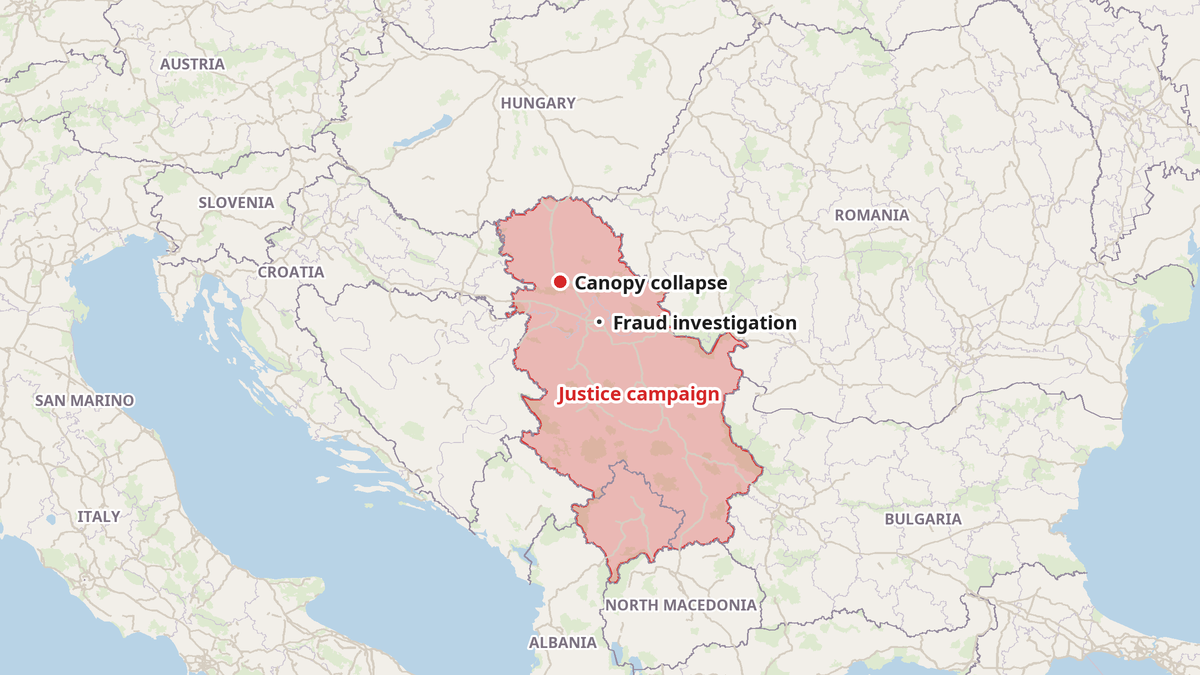
Sixteen people died when a concrete canopy collapsed on the newly renovated railway station in Novi Sad on November 1, 2024. Sunday marks the second anniversary of that day, and the families of the victims are still waiting for accountability even as the student-led movement born from their loss has swept into power.
Fourteen people were killed at the scene. Three more were taken to hospital in critical condition, and two of them later died, one in November 2024 and one in March 2025. The disaster raised hard questions about the quality of the work, the lack of transparency in how public money was spent, and endemic corruption.
From Grief to Mass Movement
On November 5, 2024, four days after the collapse, thousands gathered in Novi Sad to demand answers. The protests escalated into clashes with police. Dozens of protesters were arrested and City Hall was damaged. Observers noted an uncomfortable contrast: the judicial response to the protesters was swift, while the investigation into the accident itself stalled.
On November 19, opposition MPs, councillors and citizens blocked the entrance to the court and prosecutor's office building in Novi Sad for three consecutive days. They demanded the release of those arrested and a faster investigation. Daily confrontations with police in riot gear marked the blockade.
Pressure produced movement, if slowly. On November 21, after three weeks, the higher public prosecutor's office announced that 11 people had been arrested, among them former Construction Minister Goran Vesic and other officials.
Violence Against Students
Then came an attack. Between November 22 and 25, students and professors were assaulted during a memorial service for the victims in front of the faculty of dramatic arts of the University of Arts in Belgrade. Students responded with a university sit-in. Their demands were concrete: prosecute the attackers, publish the documentation on the station's reconstruction, and release all detained protesters.
On December 11, authorities published part of that documentation, eight binders containing 195 documents. Students and others dismissed it as insufficient. They wanted full transparency and criminal accountability for the contractors and supervisory institutions.
The Courts and the Streets
On December 30, prosecutors in Novi Sad filed an indictment against 13 people on suspicion of serious crimes against public security, improper execution of construction works and abuse of office. Higher courts overturned detention orders for Vesic and Serbia Railways Infrastructure's acting General Director Jelena Tanaskovic, placing them under house arrest. A dispute over the jurisdiction of the prosecution offices and the transfer of case files further clouded the proceedings.
On January 15, 2025, the public prosecutor's office for organised crime in Belgrade opened a separate investigation into potential financial fraud, corruption and money laundering. It involves Vesic, former Trade Minister Tomislav Momirovic and 12 other individuals, including managers of construction and supervision companies.
Thirteen days later, governing party activists attacked students of the Academy of Arts in Novi Sad, causing serious bodily harm. Prime Minister Milos Vucevic resigned, the government's biggest concession to date. The protests and blockades went on.
On March 11, 2025, thirteen activists and students were arrested in Novi Sad on the eve of planned large protests in Belgrade, charged with undermining the constitutional order and violent behaviour. Civil society organisations and citizens denounced the arrests as politically motivated. On March 15, hundreds of thousands of people demonstrated in Belgrade.
On May 28, Novi Sad's High Court replaced prison detention with house arrest for some of the imprisoned activists and students. By June 25, with the prosecutor refusing to withdraw the charges and security services continuing to exert pressure, some of the accused left Serbia for European Union countries, where they kept drawing attention to the situation.
The Ballot Box
On September 9, 2026, the informal movement became a political force after snap parliamentary elections were announced for October. The Student List-Students Win grouping brought together students, professors and legal experts. On September 27, longtime leader Aleksandar Vucic resigned as president to lead the Serbian Progressive Party-led electoral list. On his last day in office he pardoned all prosecuted students and activists, ending proceedings for "undermining the constitutional order" and allowing exiled activists to return safely. The move was widely seen as an attempt to ease social tensions before the campaign.
Vucic then conceded defeat to the Student List, in elections that saw turnout reach its highest level in more than 30 years. The source's timeline dates the concession to October 25, 2025, which is inconsistent with the surrounding 2026 events. Either way, accountability for Novi Sad remains a central issue after the results.
A Wider Echo
In an Irish Times opinion piece, freelance writer Liz Carolan, who specialises in technology and democracy, links Serbia to Tuesday's US midterm elections. She writes that the movement ran under the slogan "Serbia or the mafia" and won "despite the odds and an electoral system stacked against them." She describes voters disdainful of the conspicuous wealth of Vucic's allies, including a giant neoclassical palace under construction for the owner of the media company that backed him. She calls the ousting of a long-time strongman "a welcome boost for liberal democracy."
Carolan also sounds a caution. Political scientists warn that elections fought over corruption tend to bring to power both populists and insurgents with limited experience, and that self-styled corruption fighters are held to a higher standard.
Why This Matters: Sixteen people died because a public building project failed, and the courts have yet to deliver a verdict two years on. That gap between loss and justice is what drove hundreds of thousands onto the streets and then to the polls. For Serbia, the new government now faces the test of turning a movement into institutions that deliver transparent procurement and independent prosecutors. For Europe, a candidate-country electorate has chosen accountability over entrenched power, and that choice deserves attention, not just applause. Whether the Novi Sad investigations produce convictions will show if the rule of law can be rebuilt from below.
- novi sad railway station
- serbia
- student list
- aleksandar vucic
- goran vesic
- railway station collapse
- protests
- corruption