
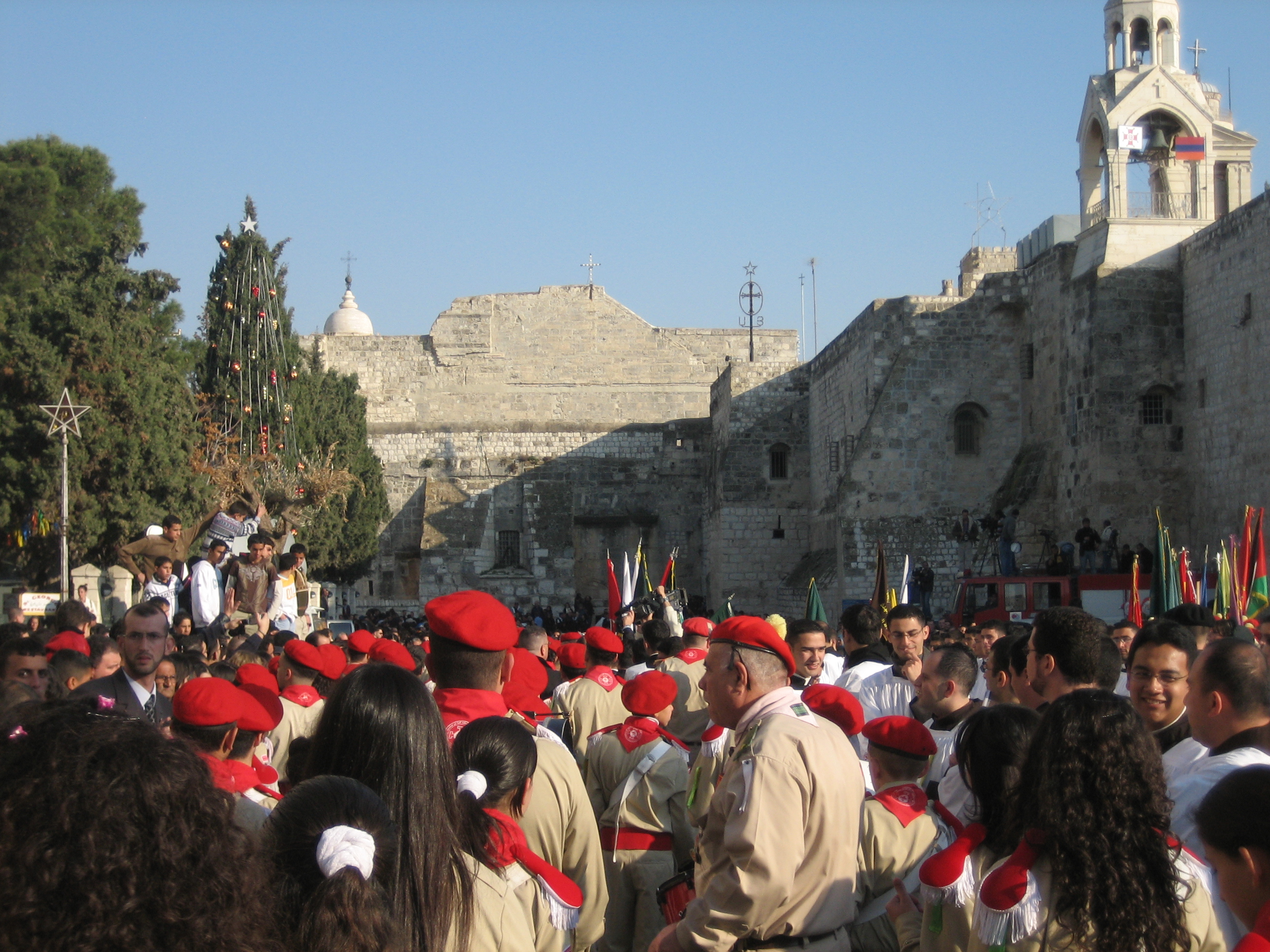
An estimated 47,000 Christians live in the Occupied Territories, with a fraction in Gaza and the majority in the West Bank, including Bethlehem. These communities, many tracing their faith back two millennia to the foundation of the religion in what is today Palestine, Israel, and Syria, observe Christmas traditions rooted in this ancient heritage.
Palestinian Christians Under Occupation
In Bethlehem, known as Bait Lahm in Arabic and located six miles south of Jerusalem, an annual church service is held at the Church of the Nativity. This site is believed to be the birthplace of Jesus. Celebrations commence with a joyous parade that marches through the city’s main streets on Christmas Eve, with local scout groups participating and playing instruments. A service is conducted just before midnight by the Roman Catholic bishop of Jerusalem. Many people from around the world travel to Bethlehem during this period to witness the parade.
The Palestinian Christmas feast typically features roast lamb or turkey, alongside “qedreh,” a rice and lamb dish prepared with chickpeas and whole cloves of garlic. “Sahlab,” a hot, sweet drink infused with rose water and nuts, is also consumed as a winter warmer. Crisp parcels of fried cheese sealed in a semolina pancake, known as “qatayef,” are enjoyed. Most Christians in the Occupied Territories follow the Eastern Orthodox church, though Catholic and Protestant communities are also present.
Ancient Roots, Enduring Traditions
The Christian communities of the Middle East are recognized as the oldest globally. Some Christians in parts of Iraq and Syria continue to speak dialects of the Aramaic languages that Jesus would have spoken, underscoring the deep historical continuity of their presence in the region. The largest Christian population in the region resides in Egypt, where Christians constitute between 10 and 20 percent of the population, or up to 20 million people. Most Egyptian Christians belong to the Coptic Orthodox church, which split from other Christian denominations 1575 years ago, while others belong to various Catholic, Greek Orthodox, and Protestant churches. The Coptic Church celebrates Christmas on January 7, preceded by a 43-day strictly vegan Nativity fast, often broken with “fattah,” a dish of layered bread and rice soaked in lamb stock and topped with lamb pieces and a garlic-vinegar sauce.
Across the broader Arab world, Christmas traditions vary. In Lebanon, Christians celebrate “Eid Milad Majid,” or Glorious Birth Feast, with significant fanfare. Lebanon’s over two million Christians, making up around a third of the population, are mostly Maronite Catholics, with Eastern Orthodox Christians also prominent. Lebanese traditions include lavish decorations and nativity scenes adorned with green shoots. Two weeks before Christmas, pulses like chickpeas, lentils, and beans are soaked and grown on damp cotton wool, with the resulting sprouts symbolizing birth and life. These are used to decorate nativity scenes, church altars, homes, and Christmas lunch tables. For Christmas dinner in Lebanon, “kibbeh bil sayinyyeh,” a national dish of minced lamb baked with bulgur and spices, is served. Stuffed turkey, often filled with spiced cinnamon rice instead of sage and onion, also appears. “Meghli,” an anise and cinnamon-spiced rice pudding, concludes the festivities.
In Syria, where Christianity traces its roots to the religion’s inception, families celebrate in a more subdued manner. Christmas camels are part of local tradition, believed to have carried the three wise men to Bethlehem. Children prepare shoes with hay and bowls of water on Christmas Eve to welcome the camel, which is said to bless well-behaved children with presents. Christians in Syria, who made up 10 percent of the population before 2011, belong to Eastern Orthodox, Catholic, and Chaldean communities. Like other Eastern Orthodox communities, many fast for 40 to 43 days before Christmas, abstaining from dairy, meat, eggs, and fish, breaking the fast on Christmas Eve with a feast of Levantine dishes. Christmas is celebrated on January 7 and is also known as “Laylatul Qadr,” the night of power.
Iraq hosts one of the world’s oldest Christian communities, present since at least the 2nd Century, primarily Chaldeans (Catholic) and Assyrian churches. A Christmas tradition in Iraq, sometimes also observed in Syria, involves a bonfire of dried thorned branches. Children recite the nativity story by candlelight from the Book of Psalms, then use the candles to light the thorns. Tradition holds that if the thorns burn completely to ash, the year ahead will bring good fortune. After the flames die, family members jump over the ashes three times, making a wish. Date-filled biscuits called “klecha” are also exchanged and enjoyed during the festive period.
In Jordan, where Christians constitute about eight percent of the population, mostly Eastern Orthodox, a rich and sticky Christmas cake is prepared. This cake, loaded with dried fruits and nuts and infused with alcohol, begins preparation weeks before Christmas, starting on the last Sunday before Advent. The cake mixture is stirred weekly, infused with alcohol, and then baked to be eaten on Christmas Eve. Brandy, rum, or arak, a local anise spirit, are used for infusion.