
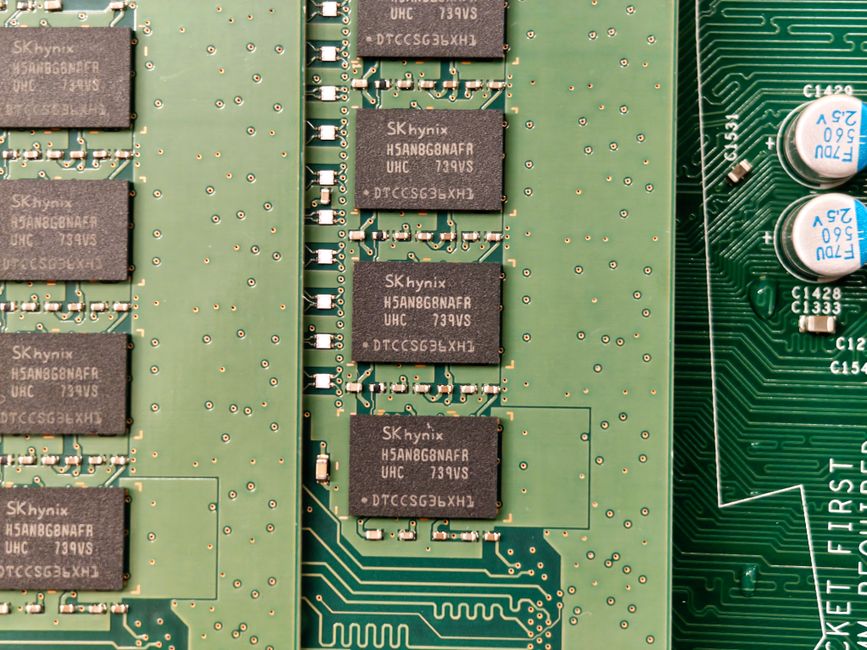
Demand for SK Hynix's $28 billion U.S. share sale was more than seven times available shares, a person familiar with the matter said, signaling a voracious appetite for capital accumulation in the burgeoning artificial intelligence sector. This offering from the South Korean chipmaker will finance new factories and equipment, further expanding its capacity to meet surging AI chip demand. It's poised to become the world's second-biggest share sale, following SpaceX's record-breaking $85.7 billion IPO last month.
SK Hynix declined comment on the confidential details of the share sale. The U.S. listing aims to narrow its valuation gap with U.S. rival Micron, which benefits from direct access to the world's largest pool of investors. Micron currently trades at a 12-month forward price-to-earnings ratio of 6.66 times, while SK Hynix sits at 5.5 times.
Capital's AI Gold Rush
SK Hynix has positioned itself as the most sought-after supplier of high-bandwidth memory chips, a strategic outcome of 14 years of investment that once drew skepticism. This long-term bet now places the company at the center of the global AI gold rush. Yoo Hoi-jun, an electrical engineering professor at the Korea Advanced Institute of Science & Technology, stated that "As long as there is demand for graphic processors and AI data centers, SK Hynix is indispensable." Nvidia CEO Jensen Huang affirmed last month that SK Hynix would remain the U.S. AI chipmaker's largest partner, predicting the current memory chip shortage would persist for a few years due to strong demand. This ensures continued high prices and profit margins for suppliers.
Semiconductor companies globally have seen historic gains, despite recent market fluctuations. Firms like SK Hynix and rival Samsung Electronics are experiencing soaring profits driven by insatiable demand for computer chips to power AI data centers. SK Hynix shares closed up 5% on Thursday, though they've dropped by a quarter in the last two weeks. Even with this recent dip, the stock has surged 680% over the past 12 months, reflecting immense surplus extraction.
Profits Soar, Workers' Share Limited
The company's earnings have been so substantial that each employee is expected to receive an annual bonus of approximately $574,500. This individual bonus, while significant, represents a fraction of the overall profits generated by the company's market dominance and the broader AI boom. The firm's 12-month forward price-to-earnings ratio has decreased to 5.5 times from 7.9 times at the end of October, indicating that even with massive profit growth, the valuation is still considered lower than some U.S. counterparts.
Global Capital Seeks Optimal Returns
SK Hynix plans to finalize the price of its ADR offering on Thursday, with ADRs commencing trade on the Nasdaq on July 10. Ten ADRs will represent one common share, with a Monday filing setting a reference price of 242,500 won per ADR, based on the July 3 closing price in Seoul. On Thursday, the stock closed at 2,186,000 won. Baillie Gifford Overseas, investment funds managed by Coatue Management, and Situational Awareness Partners have collectively indicated interest in purchasing up to $7 billion of the U.S. ADRs. Analyst Lee Min-hee of BNK Investment & Securities noted that the U.S. listing is not expected to significantly boost local shares, as domestic companies still contend with the "Korea discount," a tendency for them to trade at lower valuations due to concerns about corporate governance. This dynamic illustrates how global capital seeks the most advantageous environments for accumulation, often bypassing local market constraints to maximize investor returns.