
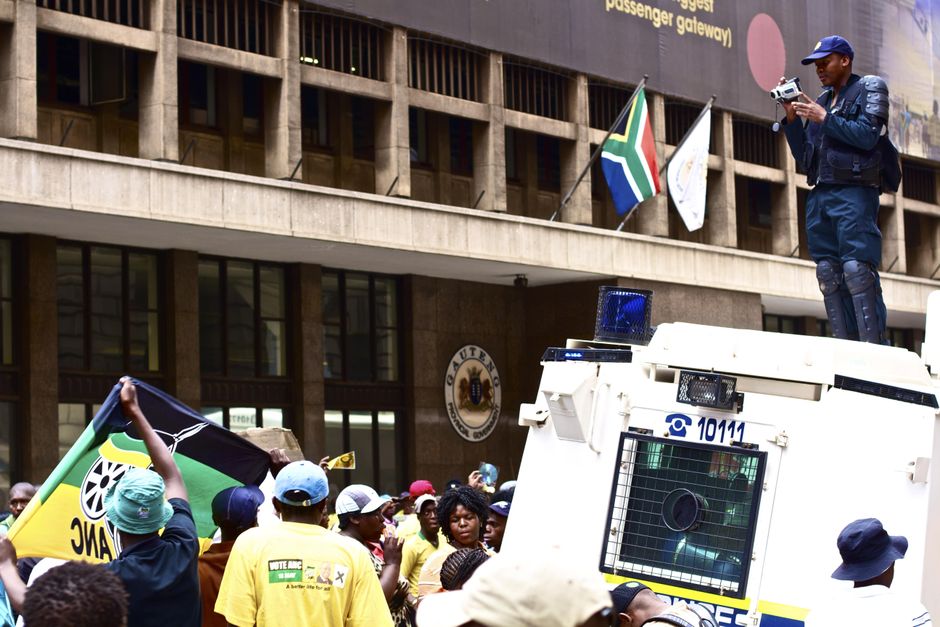
Anti-migrant protests in South Africa have intensified since April 2026, leaving at least five people dead and forcing thousands of people to flee or watch their businesses and property get vandalised. The violence has spread across several areas, and the state’s answer has been more police hardware, more shots, and more containment. Ordinary people are paying for a crisis driven through the streets by fear, looting, and the machinery of order trying to hold the line.
Who Pays First
In Thembisa, a northern suburb of Johannesburg, rioters threw stones at police and targeted suspected migrants. Near Johannesburg's central business district, sporadic gunfire was heard. Those are the sounds of a city being torn apart from below while the authorities scramble to reassert control. Reuters cited Daily Maverick reporting that police deployed tactical vehicles and fired shots in Benoni after being threatened by about 500 protesters. That’s the state’s familiar reflex: roll in the armored machines, answer disorder with force, and call it stability.
Reuters also cited SABC reporting that protesters looted shacks belonging to foreign nationals in Soweto. The people at the bottom of this mess are the ones who lose the most. Foreign nationals, suspected migrants, shopkeepers, and residents have been left exposed while the violence spreads and the institutions that claim to manage public life respond with force and spectacle. Thousands of people have been displaced or had their businesses and property vandalised since the protests began in April. The damage isn’t abstract. It lands in homes, stalls, and livelihoods.
The Apparatus Moves In
Police in Benoni fired shots after being threatened by about 500 protesters, according to Daily Maverick reporting cited by Reuters. Tactical vehicles were deployed too. That detail matters. The state doesn’t arrive as a neutral referee. It arrives as an armed apparatus, built to protect order as defined from above. When the streets erupt, the people on the ground get the guns, the vehicles, and the threat of escalation. The officials and institutions behind them get to describe it as response.
The protests have intensified since April 2026. That timeline matters because the violence didn’t appear out of nowhere and it hasn’t stayed contained. It has spread across several areas, with at least five people dead. The dead don’t get press conferences. The displaced don’t get tactical vehicles. They get the bill.
What “Order” Looks Like
In Thembisa, rioters threw stones at police and targeted suspected migrants. In Soweto, protesters looted shacks belonging to foreign nationals. Near the central business district, gunfire was heard. These are the facts Reuters reported, and they show a society where the weak are made into targets while the state tries to restore a version of calm that never protected them in the first place.
The cities have been shuttered amid the violence, a blunt sign that public life bends when the conflict between protest, repression, and fear reaches a breaking point. The official response doesn’t erase the underlying damage. It just manages it, often with more force, more displacement, and more people left to pick through the wreckage.
Since April, thousands have been displaced or had their businesses and property vandalised. That’s the real ledger. Not speeches. Not police deployments. Not the language of control. Just people pushed out, livelihoods smashed, and neighborhoods left to absorb the cost of a conflict that keeps climbing while the institutions above it reach for the same old tools.