
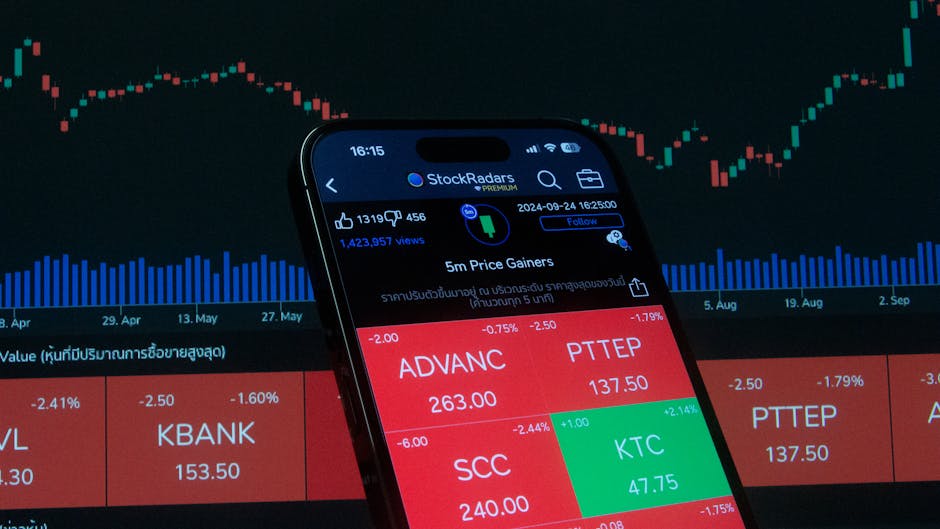
South Korea's benchmark KOSPI stock index plunged into bear territory on Wednesday, dropping more than 20% from its record high just over two weeks earlier and wiping out months of gains for ordinary investors who'd ridden the artificial intelligence boom. The index closed at 7,246.79, down 409.52 points or 5.35%, marking its lowest close since May 20 and confirming what financial markets call a "bear" condition—a threshold that typically signals sustained economic concern.
The collapse reveals a troubling pattern: retail and institutional investors alike have been drawn into increasingly risky financial products tied to chipmaker stocks, precisely at the moment when those bets are unraveling. Finance Minister Koo Yun-cheol acknowledged the danger, pledging to closely monitor what he called "risk factors" in the market, particularly newly introduced single-stock leveraged exchange-traded funds linked to chipmaker stocks. These products allow investors to bet with borrowed money on individual companies—a strategy that amplifies both gains and catastrophic losses.
The Chip Sector's Fragile Foundation
Samsung Electronics and SK Hynix, the companies driving much of South Korea's recent market enthusiasm, both suffered sharp declines. Samsung fell 6.3% while SK Hynix dropped 5.7%, though intraday swings were far more severe—Samsung slid as much as 7.6% and SK Hynix dropped as much as 5.2% in afternoon trading. The volatility was so pronounced that the exchange triggered a "sidecar" trading curb that temporarily halted algorithmic trading, a sign of market dysfunction.
The selloff followed Samsung's announcement on Tuesday of a 19-fold jump in quarterly operating profit, driven largely by strong demand for AI memory chips. Yet investors weren't satisfied. Han Ji-young, an analyst at Kiwoom Securities, explained the disconnect: "There seems to be spill-over effects from a slump in the previous session, which came despite Samsung Electronics' strong earnings, while there are worries about a slowdown in memory price growth and uncertainty over an earnings 'peak-out.'"
This matters because South Korea's entire economy has become increasingly dependent on these two chipmakers. When their stock prices collapse, it doesn't just affect wealthy investors—it ripples through pension funds, insurance companies, and the savings of ordinary workers whose retirement accounts hold these stocks. The market's 5.35% single-day drop on Wednesday followed a 4.9% decline on Tuesday, which itself triggered a circuit breaker for the sixth time this year.
Rising Costs, Shrinking Demand
Behind the market panic lies a harder economic reality: the AI boom may not sustain the price growth that chipmakers have relied upon. Park Yuak, an analyst at Kiwoom Securities, cut his target price for Samsung by about 9% to 390,000 won, citing rising prices for components like CPUs and package substrates. These cost increases, he noted, are pushing up prices for personal computers and smartphones, making customers more cautious about purchasing additional memory chips.
JPMorgan analysts warned that memory prices would remain the key driver of earnings in the second half of the year, but acknowledged what they called "growing customer resistance to higher costs." The bank suggested that while supply constraints should support some pricing power, the days of unchecked price increases may be ending.
The broader context matters here. South Korea isn't unique in this moment—the U.S. semiconductor sector also suffered sharp declines overnight. Intel fell 9.7%, Micron dropped 4.7%, and AMD slid 6.5%, with the Philadelphia Semiconductor Index losing 4.7%. These declines suggest that investors globally are reconsidering whether spending on artificial intelligence infrastructure can grow indefinitely, or whether the initial wave of enthusiasm has outpaced actual demand.
Currency and Capital Flight
One bright spot emerged: the South Korean won strengthened against the dollar, trading 1.2% higher at 1,498.5 per dollar on Wednesday, hitting its strongest level since May 29. Deputy Finance Minister Moon Ji-sung attributed this partly to dollar-selling related to SK Hynix's planned U.S. share sale, which is expected to be one of the world's largest new share offerings. Foreigners, who had sold shares for 13 straight sessions, became net buyers on Wednesday, purchasing shares worth 335.9 billion won ($223.86 million).
Yet this stabilization masks deeper vulnerabilities. When foreign investors flee a market and then return, it often reflects profit-taking rather than genuine confidence in underlying economic health. The fact that a major chipmaker must raise capital in U.S. markets—rather than through domestic channels—also signals concern about the sustainability of South Korea's domestic investment appetite.
Why This Matters:
South Korea's market collapse matters because it exposes how concentrated economic power in a handful of companies creates systemic risk for the entire country. When Samsung and SK Hynix struggle, the impact extends far beyond their shareholders—it affects pension funds that hold their stock, workers whose job security depends on their performance, and the government's tax revenues. The emergence of leveraged ETFs tied to these stocks suggests that retail investors, who typically have less access to information and sophistication than institutional players, have been drawn into increasingly dangerous bets at precisely the wrong moment in the cycle. The gap between Samsung's reported earnings growth and investor disappointment also reveals a troubling reality: the artificial intelligence boom may have created unsustainable expectations that the real economy can't support. When companies delivering record profits still disappoint markets, it suggests the market itself has become disconnected from genuine economic value—a condition that historically precedes sharper corrections.