
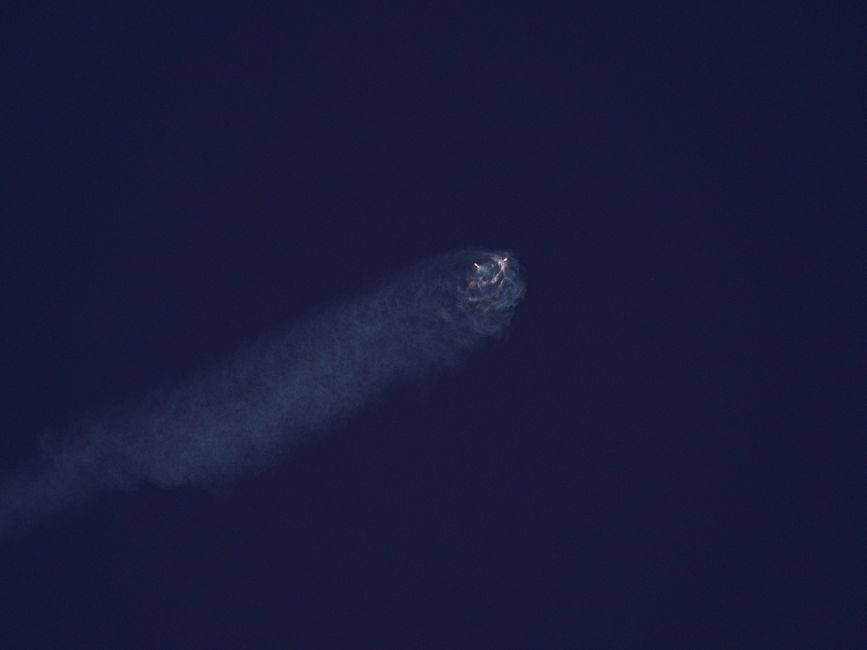
A 4,000-kilogram piece of a SpaceX rocket slammed into the Moon at 8,690 kilometres an hour yesterday, highlighting what one expert called "a certain carelessness" about how the commercial space industry disposes of its leftover hardware. The school-bus-sized object — the second stage of a Falcon 9 rocket that launched a lunar lander 1 year ago — struck near Einstein Crater on the Moon's western limb around 4:35pm AEST Wednesday.
The European Southern Observatory's Very Large Telescope at the Paranal Observatory in Chile detected the impact's aftermath. An ESO spokesperson confirmed that "the telescope detected spectral lines of sodium and lithium gas in the impact plume lasting for 5 to 10 minutes after impact." The sodium gas is believed to have originated from lunar soil, while lithium traces may have come from the rocket stage itself.
A Pattern of Orbital Neglect
The rocket piece had been drifting off course for the past year after launching Firefly Aerospace's lunar lander toward the Moon in January 2025. SpaceX's Julianna Scheiman said this week the company was working with NASA to track future wrecks, stressing that this projected crash wasn't deliberate. She blamed solar activity and gravity for accidentally putting it on a collision course with the Moon.
Bill Gray, creator of widely used astronomy software Project Pluto, said the impact presented no danger to anyone, "though it does highlight a certain carelessness about how leftover space hardware [space junk] is disposed of." Gray said by January he was "pretty sure it would hit," and by April he was confident enough to post an announcement.
Carl Schmidt, the lead astronomer conducting the impact observations, acknowledged the data wasn't perfect. "This observation did not go perfectly, and this is a very crude analysis, but I wanted to share something quickly, and we can say more about these results in time," he said.
Crowded Lunar Orbit
This isn't the first time space debris has struck the Moon. A Chinese rocket stage crashed into the lunar surface 4 years ago in March 2022 after completing a test mission. The incident follows a troubling pattern of uncontrolled crashes on the Moon in recent years.
Russia's nuclear-powered Luna-25 mission spun out of control and crashed 3 years ago in 2023. Its small power source of plutonium-238 likely remains on the lunar surface. India's Chandrayaan-2 lander mission crashed 7 years ago in 2019. Israel's Beresheet lander crashed that same year, carrying tiny tardigrades — microscopic animals known for surviving harsh environments — which may still be on the surface.
NASA's Lunar Reconnaissance Orbiter probe and South Korea's Pathfinder Lunar Orbiter were planning to take images of the impact site, but it could take days to receive that information. The impact occurred near the Moon's terminator line, the boundary between the sunlit side and its far side.
Scientific Value vs. Safety Concerns
Gray noted the crash "may be of some, probably minor, scientific interest, and we may learn some things from it." NASA has intentionally crashed rocket stages into the Moon before for research purposes. 17 years ago in 2009, the agency deliberately crashed a rocket stage to study the plume of lunar material, leading to the key discovery that lunar dirt contains traces of water ice. NASA also intentionally crashed stages from its Saturn V Moon rocket into the Moon in the 1970s to study seismic effects.
The US space agency plans to build a lunar base and send routine astronaut missions to the lunar surface beginning later this decade under its multi-billion-dollar Artemis program. It wouldn't want errant pieces of space junk impacting those assets.
Why This Matters:
As commercial space companies launch more rockets without comprehensive tracking and disposal protocols, the Moon risks becoming a dumping ground for industrial debris. NASA's planned Artemis program will place astronauts and expensive infrastructure on the lunar surface within years, making uncontrolled impacts from private sector negligence a genuine safety concern. The incident underscores the urgent need for stronger international regulations governing space debris, particularly as profit-driven companies expand their orbital operations. Without mandatory tracking systems and disposal requirements, the space industry's rapid growth threatens both scientific missions and future human settlements. This isn't just about one wayward rocket stage — it's about whether public oversight can keep pace with private space ventures.