
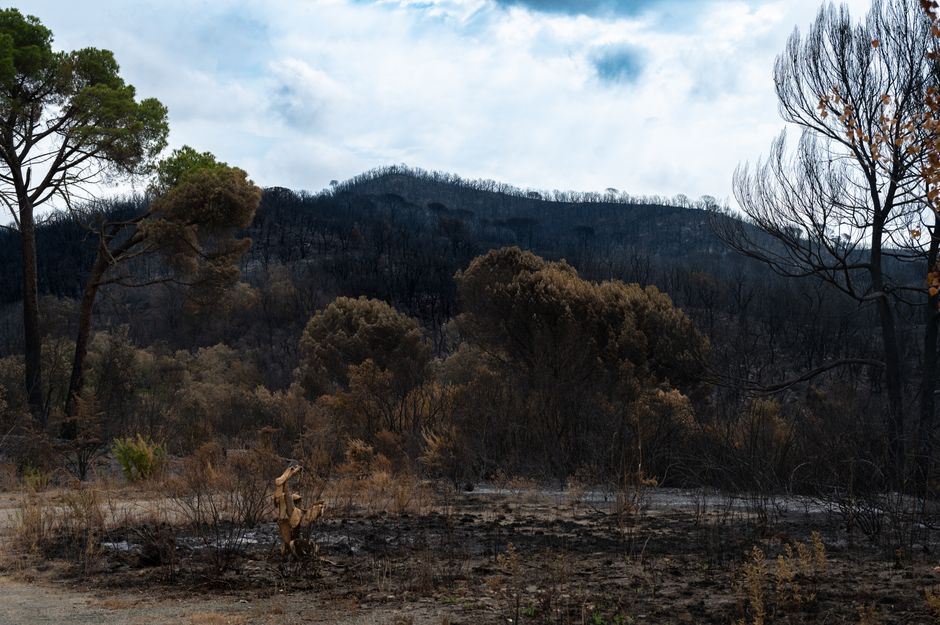
Spain declared a national emergency over wildfires on Friday, opening up federal funding as huge blazes merged outside Madrid and tens of thousands of people fled fires in southwest France by car and boat. The machinery of the state moved fast on money and command structures. The fire moved faster.
French authorities ordered the total evacuation of the Cap Ferret peninsula, a tourism hotspot on the Atlantic Coast, while about 110,000 people, many of them tourists, were told to leave as two major fires threatened homes and campsites. Both France and Spain asked for help from the European Union as emergency services strained under searing heat across the region. Brussels, always ready with the language of coordination, again appeared as the place where states go when their own systems are overwhelmed.
The State Scrambles, People Run
French President Emmanuel Macron asked the army to support firefighting efforts, a source close to the president said. Spain's national emergency was the first it had ever declared over a wildfire. That declaration opened federal funding to tackle the crisis. The state can find the budget line when the smoke gets thick enough. Before that, people are left to watch the horizon.
In southwest France, authorities sent boats to help the evacuation. Yoan Urien, who fled late on Thursday after police ordered his neighbourhood in the town of Biscarrosse to evacuate, said it was possible to see the fires from his home. "We could see the clouds becoming darker and darker," the 26-year-old told Reuters. Marie Duelz, a 51-year-old Belgian tourist vacationing at Cap Ferret, said she saw "a cloud of ash that was blocking the sun, basically." Those are the terms of the emergency: police orders, boats, ash, and the long wait for the next instruction from above.
Interior Minister Laurent Nunez told broadcaster TF1 that the fire near Saumos was "a convective fire: It is self-sustaining, changes direction, and is moving mainly eastward, toward the Bordeaux metropolitan area." The other major fire, which began in the nearby village of Saumos, north of Cap Ferret, is threatening to cut off the only road out of the peninsula and is the largest so far this season in France, Nunez told local television. The peninsula’s only road out. A neat little bottleneck, ready-made by geography and then managed by authority.
Fortress Europe Meets Fire Season
The fire in southwest France has torn through more than 14,000 hectares of forest and destroyed more than 100 homes and one campsite, officials said. Family caregiver Corinne Paillaube said, "It breaks my heart. Because it's such a pleasant place to live, seeing it go up in smoke is truly sad." Ambre Dubos, from the nearby Landes region, said, "It's totally apocalyptic." The language of disaster is plain enough. The response is still routed through ministries, police, and emergency services, with the European Union waiting in the background as the continental manager of crisis.
In Spain, more than 19,000 people were ordered to evacuate from towns in the mountains west of Madrid, as more than 2,000 personnel and 10 aircraft struggled in vain to prevent the fires converging, Interior Minister Fernando Grande-Marlaska said. Enrique Martin, speaking in a shelter in Cebreros, west of Madrid, said, "I had to run from my house. There was a ball of fire. If I'd taken five more minutes, it would have wiped us out." The shelter, the evacuation order, the aircraft, the ministerial briefing. That’s the modern arrangement when the heat turns lethal.
A third fire in Avila province was on the verge or may have already merged with the two in Madrid, Nicanor Sen, the government representative for the Castile and Leon region, told reporters. Spanish police said they had arrested one person and were investigating another suspected of starting that fire by using heavy machinery in a prohibited area. The state’s answer, as ever, is a mix of emergency powers and criminal procedure.
Heat, Infrastructure, and the Price of Control
Madrid's regional leader Isabel Diaz Ayuso said, "This is the worst wildfire in our region's history." She added, "It's the perfect storm of very high temperatures and ceaseless winds that aren't letting up." The area west of Madrid, where many residents from the capital have second homes, is densely populated. In just one development 43 homes had been destroyed, Diaz Ayuso said. That played a role in the government decision to declare a national emergency, Grande-Marlaska said. Dense population, second homes, destroyed houses, emergency funding. The hierarchy notices damage fastest when property is in the frame.
It is the second consecutive year that Spain has faced a particularly destructive fire season. More than 29 major fires have broken out in Spain so far this year, damaging a surface area five times greater than at the same stage in 2025, when a record area was destroyed, Environment Minister Sara Aagesen said in a social media post. Wildfires have burned more land in Europe already this year than the annual average in the past two decades, data shows, as the world's fastest-warming continent has endured three stifling, virtually back-to-back heatwaves so far this year.
Scientists say human-driven climate change is increasing the intensity of heatwaves, droughts and wildfires, while also creating conditions for sudden, destructive storms. Greece was sending two firefighting aircraft to Spain, and Croatia provided a similar plane and staff to aid France while Italy dispatched a firefighting plane to Tunisia which also has wildfires, authorities said. The continent’s states keep trading aircraft and staff across borders while the fires ignore the borders entirely.
After a short reprieve over the weekend, average temperatures in France are expected to rise sharply again next week, according to official weather forecaster Meteo France. The high temperatures are expected to warm French rivers that cool nuclear reactors and could lead to reduced power output. The Golfech 2 nuclear reactor in southern France has remained offline since July 7 due to heat-related restrictions, operator EDF's data showed. Weeks of hot weather are also taking a toll on the condition of the maize crop in France. The emergency doesn’t stop at the tree line. It reaches the reactors, the grid, and the crop fields too, where the costs of a warming continent are absorbed by systems built to keep everything running until they can’t.