
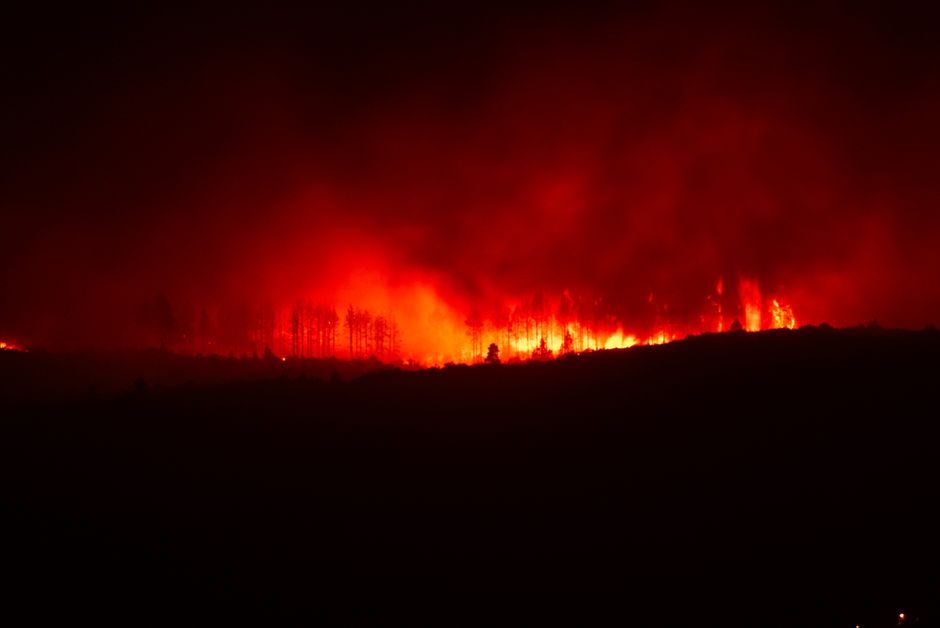
Spain declared its first-ever national wildfire emergency on Friday as tens of thousands fled blazes in southwest France and fires merged outside Madrid, forcing both countries to seek European Union assistance amid mounting pressure on emergency services and national budgets.
The declaration opened federal funding streams to tackle the crisis. More than 19,000 people were evacuated from mountain towns west of Madrid as over 2,000 personnel and 10 aircraft failed to prevent three major fires from converging. "This is the worst wildfire in our region's history," Madrid's regional leader Isabel Diaz Ayuso said. "It's the perfect storm of very high temperatures and ceaseless winds that aren't letting up."
The Scale of Destruction
In southwest France, authorities evacuated roughly 110,000 people — many of them tourists — from the Cap Ferret peninsula and surrounding areas as two major fires threatened homes and campsites. French President Emmanuel Macron asked the army to support firefighting efforts, a source close to the president said. Interior Minister Laurent Nunez described the fire as "convective" — self-sustaining, changing direction, and moving mainly eastward toward the Bordeaux metropolitan area.
The fire that began in Saumos, north of Cap Ferret, is the largest so far this season in France. It's torn through more than 14,000 hectares of forest and destroyed more than 100 homes and one campsite, officials said. "It's totally apocalyptic," said Ambre Dubos, from the nearby Landes region.
Yoan Urien, who fled late on Thursday after police ordered his neighbourhood in Biscarrosse to evacuate, said clouds were becoming "darker and darker" as flames approached. Marie Duelz, a 51-year-old Belgian tourist vacationing at Cap Ferret, saw "a cloud of ash that was blocking the sun, basically."
Spain's Unprecedented Crisis
Spanish police arrested one person and were investigating another suspected of starting a fire in Avila province by using heavy machinery in a prohibited area. That fire was on the verge of merging — or may have already merged — with two fires in Madrid, Nicanor Sen, the government representative for Castile and Leon, told reporters.
The area west of Madrid is densely populated with second homes owned by capital residents. In just one development, 43 homes had been destroyed, Diaz Ayuso said. That destruction played a role in the government's decision to declare a national emergency, Interior Minister Fernando Grande-Marlaska said.
"I had to run from my house. There was a ball of fire," evacuee Enrique Martin said in a shelter in Cebreros, west of Madrid. "If I'd taken five more minutes, it would have wiped us out."
It's the second consecutive year Spain has faced a particularly destructive fire season. More than 29 major fires have broken out this year, damaging a surface area five times greater than at the same stage in 2025, when a record area was destroyed, Environment Minister Sara Aagesen said in a social media post.
The EU Response and Economic Impact
Greece sent two firefighting aircraft to Spain. Croatia provided a similar plane and staff to aid France. Italy dispatched a firefighting plane to Tunisia, which also has wildfires, authorities said. The cross-border assistance highlights the strain on national emergency services and the fiscal burden of repeated climate-related disasters.
Wildfires have burned more land in Europe already this year than the annual average in the past two decades, data shows, as the continent has endured three stifling, virtually back-to-back heatwaves so far this year. Scientists say human-driven climate change is increasing the intensity of heatwaves, droughts and wildfires, while also creating conditions for sudden, destructive storms.
After a short reprieve over the weekend, average temperatures in France are expected to rise sharply again next week, according to official weather forecaster Meteo France. The high temperatures are expected to warm French rivers that cool nuclear reactors and could lead to reduced power output. The Golfech 2 nuclear reactor in southern France has remained offline since July 7 due to heat-related restrictions, operator EDF's data showed. Weeks of hot weather are also taking a toll on the condition of the maize crop in France.
Why This Matters:
Spain's first-ever national wildfire emergency declaration signals the fiscal and operational pressure climate-related disasters are placing on European member states. The need for cross-border firefighting assistance — Greece to Spain, Croatia to France, Italy to Tunisia — reveals that national emergency services can't handle the scale of destruction alone. France's nuclear reactor offline since July 7 shows how heatwaves threaten energy security at precisely the moment Europe needs reliable baseload power. The destruction of more than 100 homes in France and 43 in a single Spanish development represents direct economic loss that will require reconstruction funding. With wildfires burning more European land this year than the annual average over the past two decades, governments face mounting costs for emergency response, reconstruction, and climate adaptation — costs that will compete with other fiscal priorities and test the limits of national budgets and EU solidarity mechanisms.