
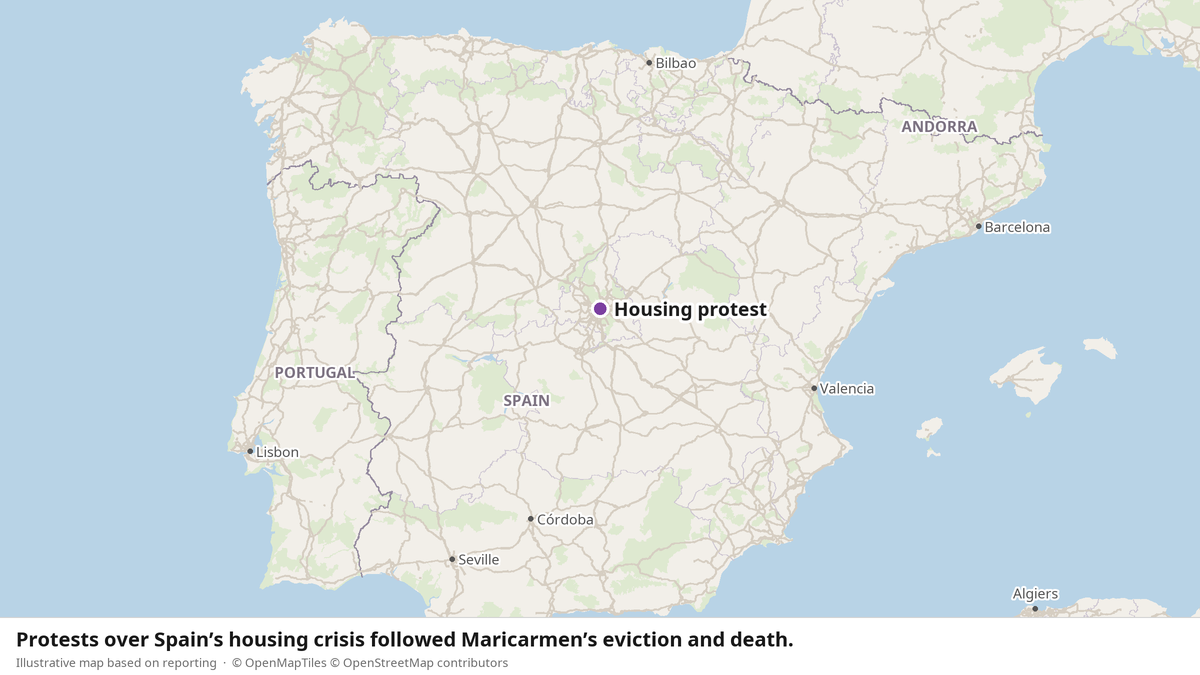
Thousands marched through central Madrid on Thursday after María del Carmen Abascal, an 87-year-old known as Maricarmen, died in hospital following her eviction from the home where she had lived for seven decades. Police cordoned off the street and removed protesters as officers carried Maricarmen, a wheelchair user, from the apartment on a stretcher. The state enforced the eviction; the rent had climbed far beyond her pension.
Maricarmen died on Wednesday. Reuters reported that she had been hospitalised with severe anxiety and exhaustion since her eviction on Sept. 23. No cause of death had been announced. Her lawyer, Beatriz Duro, also declined to disclose a cause when confirming the death to Cadena Ser radio.
An eviction, then a late agreement
An investment fund bought the building, and Maricarmen lost a lengthy legal battle after rent increases far exceeded her pension income. The real estate company later agreed to let her return after public pressure. While she was in hospital, the parties reached an agreement that would have allowed her back into the apartment. She died before she could return.
The Madrid Tenants' Union said: “Although a historic agreement was reached that would have allowed her to return home, this solution came too late,” calling it “an entirely avoidable situation following a harrowing ordeal.” Beatriz Duro said Maricarmen's case left “the image of the shameful violence of these types of evictions and the impact they can have on people's health.”
Tenants Union members in orange vests carried a wreath from their protest camp in Puerta del Sol to Maricarmen's former home near Retiro Park. Protesters chanted, “They're not deaths; they're murders,” and, near Spain's Parliament, “Maricarmen lives, the fight goes on!” People left candles, flowers, handwritten notes and children's drawings outside the building. Campers in Puerta del Sol held a minute of silence.
“Maricarmen only wanted to die in her home. She wasn't asking for anything else,” said Eugenio Melchor, 22. He added: “They have killed her. I mean, there's no other word for it, and I hope those responsible for this pay and go to trial.” Alex Marinero, a 21-year-old protester, called her “the straw that broke the camel's back” and “a symbol of resistance and unity.”
The electoral circus meets the rent bill
Protests over housing shortages and rising rents came as parliament rejected government proposals to address the crisis. Socialist Prime Minister Pedro Sanchez called a snap general election for Nov. 29 after Congress rejected his emergency measures. Sánchez said he was legislating “against those who consider housing just another object on the market with which to speculate.”
Left-leaning parties blamed conservatives for rejecting legislation intended to curb soaring rents. Right-wingers said the central government had failed to tackle the crisis after eight years in power. Alberto Nuñez Feijoo, leader of the conservative opposition People's Party (PP), accused Sanchez and the Socialists of exploiting the issue. Madrid regional assembly opposition leader Manuela Bergerot of the leftist Mas Madrid party said Maricarmen had died because of “miserable people who put gain above a person's life.”
Bergerot said Madrid regional leader Isabel Diaz Ayuso's last action while Maricarmen was alive was to “laugh at her,” referring to Ayuso's Sept. 28 remark: “At what age do I get to stop paying my landlords? Let me know.” Ayuso blamed Sanchez, saying Maricarmen had been evicted under his government. The PP, which has absolute majorities in the Madrid regional and local assemblies, refused to hold a minute of silence. Hard-left deputies held one outside City Hall; during a tense regional assembly debate they gave Maricarmen a 60-second standing ovation while PP lawmakers sat with folded arms.
Rent rises, empty homes and political delay
Idealista reported average Spanish rental costs had risen 84% over the previous 10 years, including 113% in central Málaga and just under 150% in Marbella. The government said 26% of Spanish renters spent an average of 40% of their income on rent and utilities, compared with 18% of renters across the European Union. A Centre for Sociological Research study found 79% believed the right to housing should take precedence over treating homes as a market commodity; 76.3% supported market intervention to guarantee access to housing.
The figures point to a severe shortage. The Bank of Spain estimated a shortfall of about 750,000 homes; deputy governor Soledad Núñez warned in September it could reach one million by 2028. The National Statistics Institute counted 3.8 million empty properties, many in depopulated rural areas, while others awaited renovation or were caught up in inheritance disputes. Spain had about 1.2 million new households between 2021 and 2025, driven in great part by migrants who contributed to recent economic growth, but built fewer than half a million homes.
Jorge Galindo, director at the Esade centre for economic policy, cautioned that available data made it difficult to establish how many properties so-called “vulture funds” owned and used for speculation. Bank of Spain figures from 2024 showed companies owned 8% of rental properties. Galindo said the available data didn't show a notable concentration among a small number of owners; he identified the shortage of supply compared with demand as the main explanation for rising rents.
Carmen Pérez, a retired widow originally from Ecuador who had lived in Spain for 17 years, said she had moved in with her daughter and son-in-law while looking for affordable rent. “The rent is always too high for me,” she said. “All of this has affected my health — I've got depression, I don't have any stability or security.” Francisco Pardo, an 81-year-old retired taxi driver, put the arithmetic plainly: “No worker should have to spend 75% or 80% of their salary on rent, because what are they supposed to eat?”