
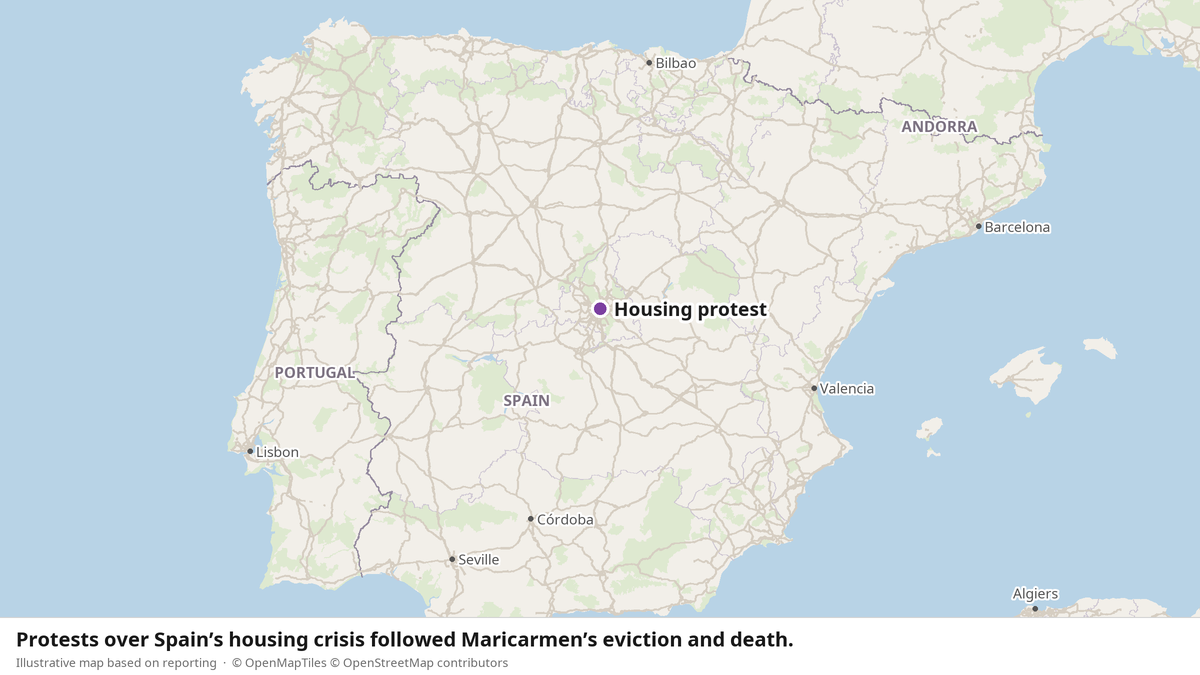
Thousands marched through central Madrid on Thursday, Oct. 8, to mourn María del Carmen Abascal, known as Maricarmen. The 87-year-old’s eviction from the home she had lived in for seven decades sparked protests across Spain. She died in hospital on Wednesday. No cause of death has been announced; her lawyer, Beatriz Duro, didn’t disclose one when she confirmed the death to Cadena Ser radio.
Maricarmen had been in hospital with severe anxiety and exhaustion since her eviction on Sept. 23, 17 days before today. Televised images showed police cordoning off the street and removing protesters as officers carried her, a wheelchair user, out on a stretcher. The pictures travelled fast. Protests followed in Madrid and other cities.
A Home Lost, a Deal Too Late
She’d lived in the apartment almost her entire life, first with her parents and brother. Later, she worked as a secretary for the board of a pharmaceutical company and retired in 1998. Spanish media reported that black-and-white family photographs were among the few belongings she took to hospital.
An investment fund bought the building. She lost a lengthy legal battle after rent increases far exceeded her pension income. In hospital, she reached an agreement that would have let her return; the real estate company had agreed to take her back after public pressure. She died before she could go home.
The Madrid Tenants' Union said: "Although a historic agreement was reached that would have allowed her to return home, this solution came too late," calling it "an entirely avoidable situation following a harrowing ordeal." Duro said the case "leaves us the image of the shameful violence of these types of evictions and the impact they can have on people's health."
On Thursday, Tenants Union members in orange vests walked arm-in-arm, carrying a wreath from a protest camp in Puerta del Sol to her former home near Retiro Park. Marchers chanted, "They're not deaths; they're murders." Mourners left candles, flowers, handwritten notes and children's drawings outside her building. Eugenio Melchor, 22, said: "Maricarmen only wanted to die in her home. She wasn't asking for anything else." Iciar López, a 32-year-old psychologist, said she felt "a great deal of sorrow" that Maricarmen couldn’t see whether the movement she had sparked would achieve anything. Several people who had received eviction orders have died by suicide in Spain in recent months.
Politicians Trade Blame
The protests landed in a political crisis. Congress rejected Prime Minister Pedro Sánchez's emergency housing measures, and he called a snap general election for Nov. 29, 50 days from now. Sánchez said he was legislating "against those who consider housing just another object on the market with which to speculate." He also offered condolences on X: "All my love to Maricarmen's family and loved ones."
The opposition pushed back. Alberto Núñez Feijóo, leader of the conservative People's Party, accused the Socialists of exploiting the issue: "We will not allow this attempt to manipulate the emotions of the Spanish people; all of this has happened during their eight years in government." Manuela Bergerot of Más Madrid said Maricarmen died because of "miserable people who put gain above a person's life," and pointed to Madrid regional leader Isabel Díaz Ayuso's Sept. 28 remark: "At what age do I get to stop paying my landlords? Let me know." Ayuso blamed Sánchez, noting the eviction happened under his government.
The PP, which holds absolute majorities in the Madrid regional and local assemblies, refused a minute of silence. Hard-left deputies held one outside City Hall and gave Maricarmen a 60-second standing ovation in the regional assembly. PP lawmakers stayed seated with folded arms.
What the Numbers Say
The squeeze is measurable. Idealista reported average Spanish rents up 84% over 10 years, 113% in central Málaga and just under 150% in Marbella. The government said 26% of Spanish renters spend an average of 40% of their income on rent and utilities, against 18% across the European Union. An El País study found the average Spaniard has 5% less spending power in real terms than a decade ago. The average monthly salary in the Madrid region is €1,550.
Experts disagree on the cause. Jorge Galindo of the Esade centre for economic policy said companies owned 8% of rental properties in 2024 Bank of Spain figures, and the data showed no notable concentration among a few owners. "What explains it is the shortage of supply compared to demand over recent years," he said. The Bank of Spain estimates a shortfall of about 750,000 homes; its deputy governor, Soledad Núñez, warned it could reach one million by 2028. Spain added about 1.2 million new households between 2021 and 2025, driven in great part by migrants who contributed to recent economic growth, but built fewer than half a million homes. Galindo said short-term tourist rentals probably push up prices in particular urban areas rather than everywhere.
Young protesters see it differently, or at least more bluntly. Jorge Moreno, 19, living in a tent in central Madrid, called housing "an abusive business." Carmen Pérez, a retired widow from Ecuador who has lived in Spain for 17 years, now stays with her daughter and son-in-law. "The rent is always too high for me," she said. "I've got depression, I don't have any stability or security."
Public opinion leans toward intervention. A CIS survey published Thursday found 76.3% support market intervention to guarantee access to housing, and 79% believe the right to housing should take precedence over treating homes as a market commodity. An earlier CIS study found 72% back higher taxes for people with 10 or more properties and 76% want limits on short-term tourist accommodation.
Ombudsman Ángel Gabilondo said tackling the crisis demands greater commitment from all levels of government. His office is preparing a housing report, and he reiterated calls to expand public housing, restrict tourist rentals, increase rent assistance and strengthen eviction protections for vulnerable households.
Why This Matters: Maricarmen's story shows what happens when a housing market fails the people least able to absorb its shocks: a pensioner priced out of the home she’d known for 70 years. The figures show Spanish renters carrying a heavier burden than the EU average, and the Bank of Spain expects the supply gap to widen. Even economists who downplay investment funds agree the core problem is too few homes. That points toward the public housing, rent assistance and eviction protections the Ombudsman has urged. With an election 50 days away and Congress having rejected emergency measures, the question is whether any party can turn public grief and a clear majority view into policy that outlasts the campaign.