
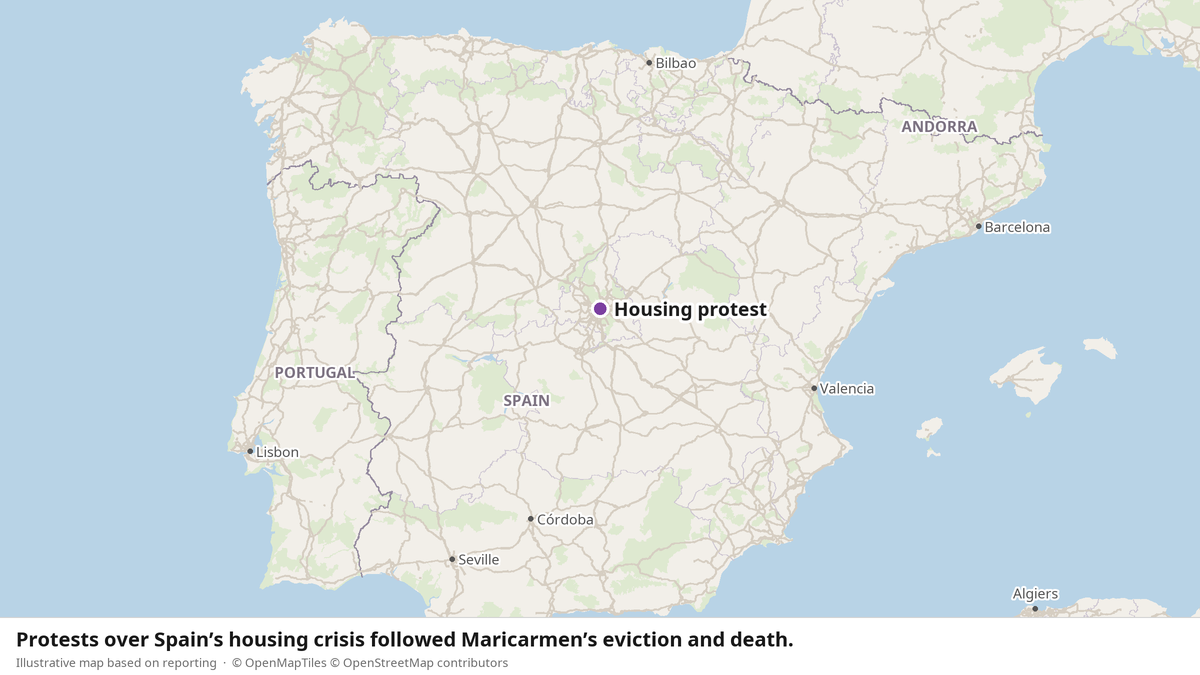
Spain added about 1.2 million households between 2021 and 2025, driven in great part by migrants who contributed to recent economic growth, while it built fewer than half a million homes. The figures sit at the centre of a housing crisis that brought thousands onto Madrid’s streets after 87-year-old María del Carmen Abascal, known as Maricarmen, died following her eviction from the home where she’d lived for seven decades.
More households, fewer homes
The Bank of Spain estimated a shortfall of about 750,000 homes. Its deputy governor, Soledad Núñez, warned in September that the deficit could reach one million by 2028. Jorge Galindo, director at the Esade centre for economic policy, said the recent demographic boom exposed the cost of failing to build enough homes. “It was not a priority for us to build new houses,” he said. “But, once the demographic boom came, we realised how costly it was for us.”
Construction shrank after the Eurozone crisis, materials became substantially more expensive after Covid, and a lack of political consensus created legal obstacles to building. Galindo said available data pointed to a shortage of supply relative to demand as the main explanation for rising rents, rather than a notable concentration of rental properties among a small number of owners. Bank of Spain figures from 2024 showed companies owned 8% of rental properties.
The National Statistics Institute counted 3.8 million empty properties. Many sat in depopulated rural areas; others awaited renovation or remained tied up in inheritance disputes. Galindo said short-term tourist accommodation probably raised rents in particular urban areas, rather than having an overall impact.
Rent pressures and Maricarmen’s eviction
Idealista reported that average Spanish rental costs had risen 84% over the previous 10 years, with increases of 113% in central Málaga and just under 150% in Marbella. The government said 26% of Spanish renters spent an average of 40% of their income on rent and utilities, compared with 18% of renters across the European Union.
Maricarmen was evicted on Sept. 23 after rent increases far exceeded her pension income and she lost a lengthy legal battle. She’d worked as a secretary for the board of a pharmaceutical company and retired in 1998. After the eviction, she was hospitalised for severe anxiety and exhaustion, and died in hospital on Wednesday. No cause of death had been announced.
Following public pressure, the real estate company agreed to let her return to the apartment. While in hospital, she reached an agreement that would have allowed her home. She died before returning. Her lawyer, Beatriz Duro, said the case showed “the shameful violence of these types of evictions and the impact they can have on people's health.”
Thousands marched through central Madrid on Thursday. Members of the Tenants Union carried a wreath from a protest camp in Puerta del Sol to Maricarmen’s former home. Protesters chanted, “They're not deaths; they're murders,” and, near Spain’s Parliament, “Maricarmen lives, the fight goes on!” The Madrid Tenants' Union said the agreement came too late and called the outcome “an entirely avoidable situation following a harrowing ordeal.”
Political blame as election nears
Parliament rejected government proposals to address the housing crisis. Socialist Prime Minister Pedro Sanchez called a snap general election for Nov. 29 and said he was legislating “against those who consider housing just another object on the market with which to speculate.” The left blamed conservatives for rejecting legislation intended to curb soaring rents; right-wingers said the central government had failed to tackle the crisis after eight years in power.
Alberto Nuñez Feijoo, leader of the conservative opposition People's Party (PP), accused Sanchez and the Socialists of exploiting the issue. “We will not allow this attempt to manipulate the emotions of the Spanish people; all of this has happened during their eight years in government. It won't fly,” he said.
An El País study found the average Spaniard had 5% less spending power in real terms than a decade earlier because of taxes, social security and inflation. In the Madrid region, the average monthly salary was €1,550. Francisco Pardo, an 81-year-old retired taxi driver, said: “No worker should have to spend 75% or 80% of their salary on rent, because what are they supposed to eat?”