
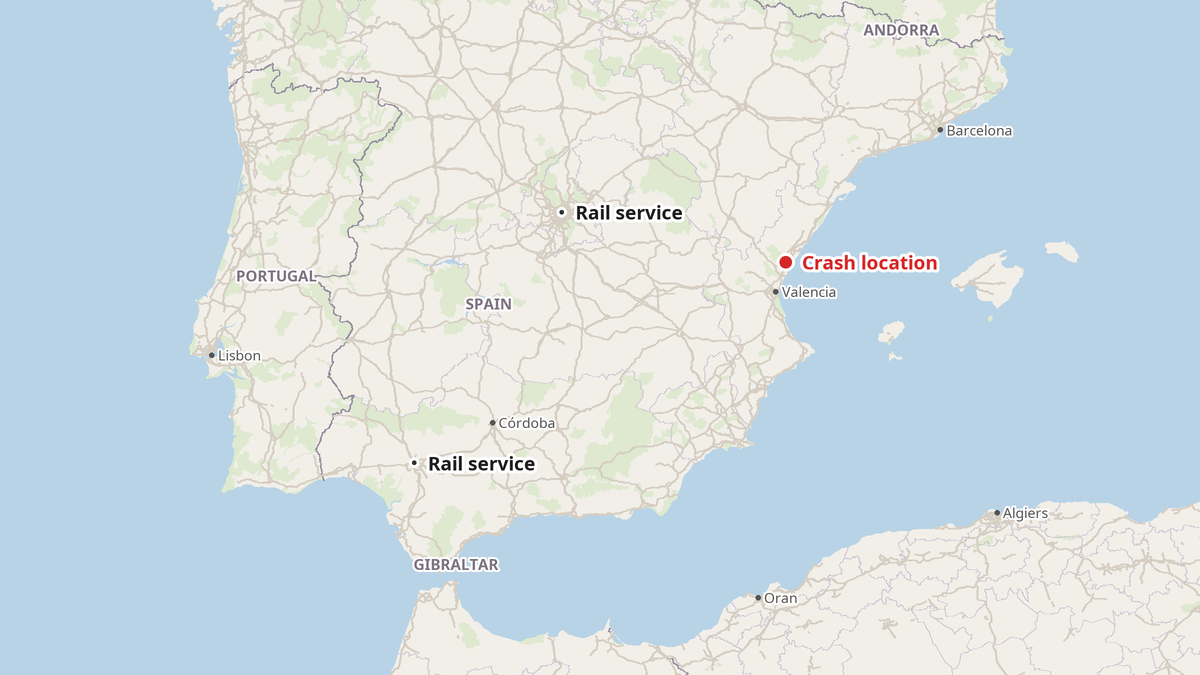
Spain began three days of national mourning on Thursday after 68 people died in a high-speed train collision in Castilla-La Mancha, south of Madrid. The crash brought the state rail company RENFE and private operator Iryo into the same wreckage: on Wednesday morning, a RENFE train struck the back of an Iryo train that had stopped on the track.
Emergency crews worked through the night, using cranes to shift mangled metal as they searched for survivors and bodies. Relatives gathered at nearby facilities, trying to find information about passengers still missing. Authorities collected DNA samples from relatives in Madrid, Toledo, Cordoba and Seville to help identify them.
The disaster is Spain’s second high-speed rail catastrophe of the year. In January, 46 people died when a train derailed and collided with another train in the southern Andalusia region. Now a new collision has put rail safety under scrutiny again, while the people left waiting for news face the immediate consequences.
The decision on the track
Transport Minister Oscar Puente blamed the crash on what he called an “inexplicable” decision to let one train continue after an automatic control system failed along a stretch of track. He said the RENFE train travelled about 25 kilometers before hitting the stationary Iryo train. The account identifies both a system failure and a decision to continue running the train; it does not provide further details about who made that decision.
Prime Minister Pedro Sanchez visited the crash site and pledged a full investigation and measures to strengthen rail safety. “It is clear that we need to reinforce the safety of our train service to rebuild the trust in our high-speed rail,” Sanchez said. He also said: “It is not acceptable for a country like Spain to endure two high-speed train accidents in the same year.” The pledge now sits beside the minister’s account of a failed control system and a train allowed to continue. The investigation has yet to report its findings.
Those searching for answers
A British tourist rescued from the RENFE train described the violence of the collision to the Associated Press: “suddenly, everything started falling apart.” He added: “We realized carriage two, carriage one, all gone, all smashed. There was blood all over.” His account gives the scale of the wreckage in the words of someone who was inside it.
Residents of Urda brought first-aid supplies, water and blankets to help emergency workers. Red Cross teams offered support, and Red Cross psychologist Carmen Garcia told AFP that many people were in shock and “haven't taken on board what has happened.” “The grieving will be complicated,” she said. The local supplies and support teams met needs at the scene as relatives waited for information and authorities worked to identify the missing.
Promises after another disaster
Spain’s national mourning began the day after the collision. The earlier Andalusia disaster, which killed 46 people in January, makes this the second fatal high-speed rail disaster in the country this year. The latest collision also came weeks before Spain’s November 29 general election.
Sanchez has promised an investigation and stronger safety measures. Those promises are now part of the record alongside the deaths, the failed automatic control system cited by Puente, and the decision he says allowed a train to continue for about 25 kilometers. For the families, the immediate questions are more concrete: who remains missing, and what happened on the track before the impact? The answers depend on the investigation the prime minister has pledged.
- train collision
- spain
- castilla-la mancha
- renfe
- iryo
- rail safety
- national mourning
- pedro sanchez