
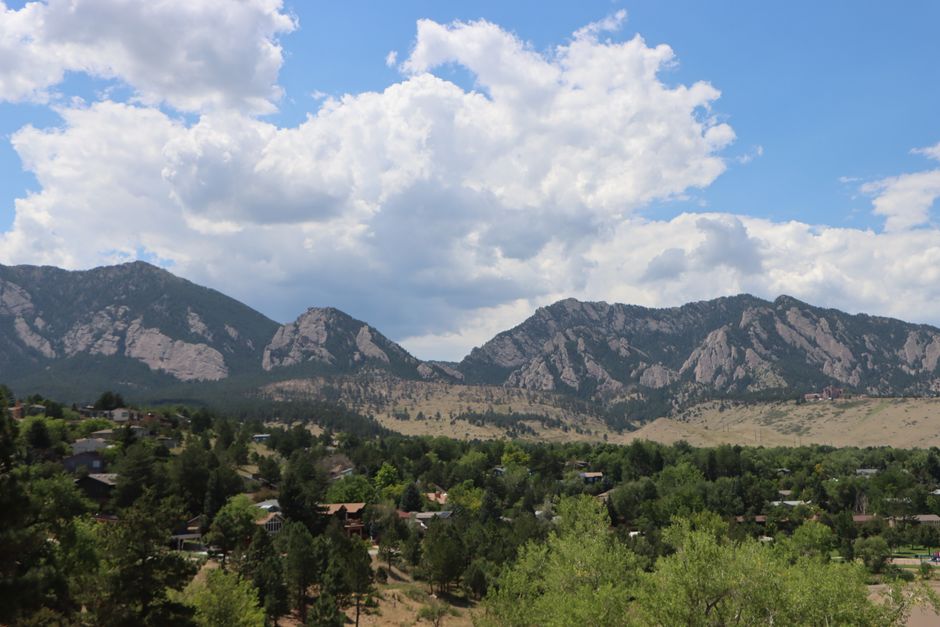
The U.S. Supreme Court opens its new term Monday, Oct. 5, with a question reaching far beyond Colorado: can a city make ExxonMobil and Suncor answer in court for the local costs of climate change? Boulder and Boulder County say taxpayers shouldn’t have to absorb millions of dollars in added government costs from wildfires, severe storms, extreme heat and flooding. Dozens of similar suits have been filed around the country, with billions of dollars potentially at stake.
A Town’s Bill for Fire and Flood
For Maddison “Maddi” Schink, the stakes are anything but abstract. Schink, now a 26-year-old graduate student at the University of Denver, lived through the Dec. 30, 2021, Marshall Fire, Colorado’s most destructive in history. It burned more than 1,100 homes and a hotel, and killed two people along with multiple pets. She and other Boulder-area residents filed a friend-of-the-court brief supporting the lawsuit.
Hurricane-force winds drove the fire through her neighborhood. Her grandmother called and asked what to save. Schink grabbed a camera, a childhood blanket and a backpack covered in patches, then drove to safety. The family’s home just outside Boulder survived.
“It’s here. It’s here to stay, and we need to do something about it,” Schink said. The fire, she said, “really just brought climate change home.” She’s signed up for air-quality alerts from the Suncor refinery in Colorado. Earlier this year, after a small grass fire broke out near her home, she canceled her plans and recorded a video of her belongings for insurance purposes. “I have a really hard time not watching fire alerts, air quality alerts,” she said.
Climate change is drying areas that were once wetter and snowier, experts say. That raises the chance that embers from dry grasses, driven by stronger windstorms, will reach suburbs and ignite fires where houses become fuel.
Deception, Law and the Defense
Boulder says oil companies intentionally misled the public for decades about fossil fuels’ role in worsening climate change, even as they knowingly contributed to the problem. The city points to an internal 1979 Exxon memo describing effects of rising carbon dioxide levels: hotter, drier southwestern states, a diminished Colorado River and a more acute water shortage in the Southwest. In a 2000 New York Times advertisement titled “Unsettled Science,” ExxonMobil said “fundamental gaps in knowledge leave scientists unable to make reliable predictions about future changes.”
“They deceived the public for decades about the harms they knew their products were going to cause,” said Corey Riday-White, legal director of the Center for Climate Integrity. “And this case is about holding them accountable for that deception.” Deepak Gupta, who teaches at Harvard Law School, said companies told the public “the opposite of what the company’s own scientists knew.”
Exxon and Suncor say in court filings that they recognize greenhouse gas emissions contribute to climate change, and that the right approach is “balancing risk reduction with affordable energy.” They argue a Colorado jury shouldn’t regulate the global atmosphere. The Trump administration backs their appeal. It has also dismantled federal climate regulations, withdrawn from international climate agreements and promoted fossil-fuel production.
Todd Zywicki, a George Mason University law professor who filed a brief for the companies, put it bluntly. “This is about whether a bunch of rich hippies in Boulder County are allowed to dictate environment and energy policy to the entire rest of the world,” he said. But the county’s claim is narrower: it wants compensation for local costs, and the Marshall Fire alone destroyed more than 1,100 homes.
Fordham Law School Professor Adam Orford said allowing the suit to proceed wouldn’t guarantee damages. A court could find Boulder residents’ own driving and other activities contributed so much that no one is responsible. But blocking the suit would mark a major shift in how the law usually works. “It is just one of those very important, fundamental precepts in the U.S. legal system that if someone hurts you, you should be able to bring them into court and at least ask them to compensate you for the harm,” he said.
Bridget Fahey of the University of Chicago Law School called the companies’ federal-law argument “striking and very novel.” They don’t point to specific language in federal law or the Constitution, she said. “I think it’s more of a vibes case than a law case.” NPR said most court observers still see an uphill battle for environmentalists. Justice Samuel Alito has recused himself, raising the possibility of a 4-4 split that would let the suit continue.
A Docket Beyond Climate
The term also brings other high-stakes disputes. The court will weigh whether the Department of Homeland Security may deport migrants to “third countries” when their home countries refuse them. NPR said the administration has deported thousands of people to places where they have no connections, may not speak the language, have often been jailed and allegedly faced torture. Another case concerns detaining undocumented immigrants without bond hearings, regardless of how long they’ve been in the country.
The justices will hear a challenge to semi-automatic weapons bans in December, along with a Colorado dispute over whether a Catholic parish can receive state pre-kindergarten funding while refusing LGBTQ students or students with gay or trans parents. The state says funding it would violate its anti-discrimination law.
Georgetown law professor Stephen Vladeck said the term’s biggest cases “are not on the docket yet.” Emergency appeals have ballooned, he said, so “now we have twice as many full court rulings on emergency applications as we have on the merits docket.” The court issues those rulings with little briefing, no oral arguments and little or no explanation.
Why This Matters: Boulder's case will help decide who pays for damage from a warming climate: companies accused of misleading the public, or local taxpayers. If the court bars these suits, communities like those hit by the Marshall Fire may have fewer ways to seek compensation. The same term could shape whether migrants face deportation to countries where they’ve allegedly been tortured. It could also determine how much of the court’s work happens in public. Emergency-docket rulings with little or no explanation leave lower-court judges, liberal and conservative alike, without adequate guidance. Citizens can’t easily scrutinize decisions made that way.