
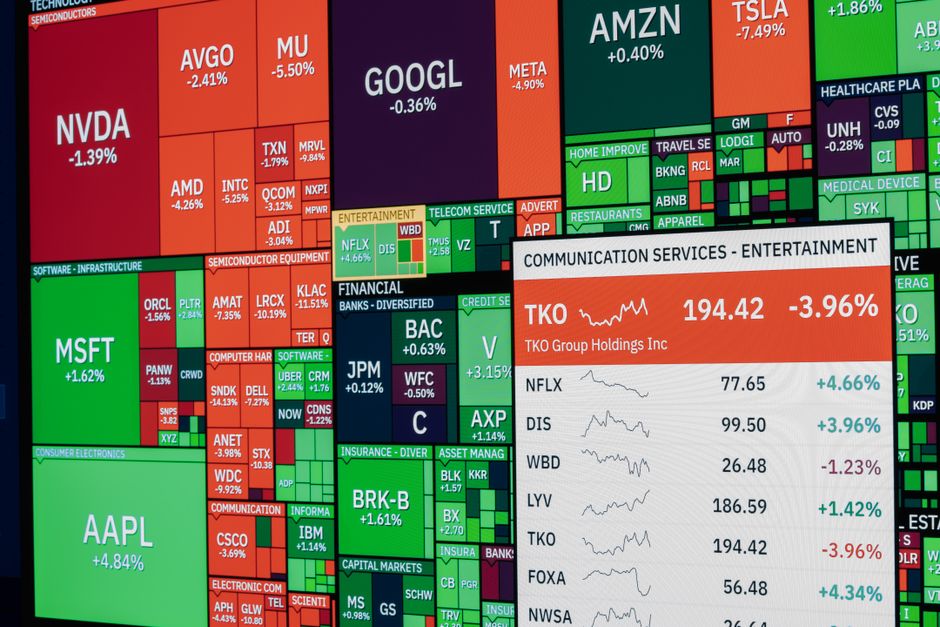
U.S. technology stocks tumbled Thursday, and the losses reached ordinary investors and workers whose jobs depend on the sector's health. The Nasdaq Composite plunged 694 points, or 2.6%, to 26,008.86, its biggest drop since June. Fears that huge investments in artificial intelligence might not pay off fueled the sell-off, and that anxiety didn't stay on Wall Street.
The Sell-Off Spreads
The S&P 500 shed 93.74 points, or 1.21%, to 7,663.43. The Dow Jones Industrial Average, by contrast, gained 11.89 points, or 0.02%, to 52,867.98. That split tells you something: blue-chip companies held steady while stocks most exposed to AI spending took the hardest hits.
Chip stocks led the slide. The iShares Semiconductor ETF dropped nearly 7% in one closing snapshot, after reports put its decline at 3% earlier in the session. The Nasdaq 100, also reported down more than 1% earlier in the day, finished 2.90% lower at 28,958.69. Shares of SK Hynix, Samsung Electronics, SanDisk, AMD and Intel all sank, several by steep single-digit margins.
Tesla topped Wall Street estimates for the third quarter, but its shares fell 2% to 3% as investors focused on lower profitability. Meta beat earnings and revenue estimates and offered strong guidance for the coming quarter. Its shares still lost 7%. The company's annual capital-expenditure estimate barely changed.
What the Spending Means for Workers
Economist David Rosenberg said investors saw signs of tighter spending discipline and warned that those signs could affect supplies across the industry. When companies building the infrastructure pull back, the shock travels to suppliers, contractors and their workers. An AI investment slowdown isn't just a number on a screen. It raises questions about jobs and who shares in the gains.
Goldman Sachs projected in August that global AI investment would exceed $1 trillion this year. That much money goes to a small number of firms, while the public rarely gets a vote on whether they spend it wisely.
Debt Fears and Official Response
CoreWeave, a neocloud company under investor scrutiny over its debt, dropped 4% in one report and plunged 10% in another. One account put its shares down 25% since October 13; the closing snapshot showed a 39% fall from early-October levels. Nvidia CEO Jensen Huang defended CoreWeave and other neocloud companies, saying demand was "off the charts." Whether that demand is real, and whether heavily indebted firms can survive a correction, remains an open question for regulators and investors.
James McCann, senior economist at Edward Jones, said markets "are becoming more demanding around evidence of the payoff from high investment in AI and concerned about the sustainability of this spending amid higher interest rates." Paul Hickey, co-founder at Bespoke Investment, said individual stocks have struggled even as the indices trade much closer to all-time highs. That gap between the headline index and everyday stocks deserves close attention.
Oil, Yields and Geopolitical Risk
Oil climbed on reports that the United States and Israel planned strikes on Iran after the midterm elections. A New York Times report citing U.S. officials described the proposed operation as "short but intensive." Brent crude rose above $112 a barrel in one snapshot and above $113 in another. West Texas Intermediate gained 2% but stayed just below $100.
Investors moved into safer assets, pushing Treasury yields down. The 10-year U.S. Treasury yield fell to about 4.97%, dipping below 5% for the first time in almost a month. JPMorgan strategists said the bullish tone had "reversed overnight" and pointed to "the still fragile narrative around AI financing concerns." Across the Atlantic, France's 10-year OAT yield climbed 7 basis points amid political unrest. Earlier this week, that yield topped 5% for the first time in 24 years during cost-of-living riots.
David Morrison, a senior market analyst at Trade Nation, called the market's response concerning. "Not only does it show that upside momentum has waned significantly, but that intermediate support levels are creaking dangerously," he wrote in a client note.
Why This Matters:
Thursday's sell-off shows how the AI boom relies on corporate budgets, borrowed money and investor patience, all of which have limits. When technology shares sink, pension funds, retirement accounts and index funds take a hit—even for savers who never chose to bet on chips. When heavy spending slows, suppliers and workers far from the headlines can suffer. Higher oil prices and a potential strike on Iran add another layer of risk, one that hits hardest for households already squeezed by costs. Those pressures make public oversight of finance, debt and energy markets more than an abstract debate. The facts point to an economy where a few firms and a few bets carry outsized weight, while the people paying the price aren't the ones who made the decisions.
- technology stocks
- artificial intelligence
- nasdaq composite
- tesla
- meta
- semiconductor stocks
- treasury yields
- oil prices