
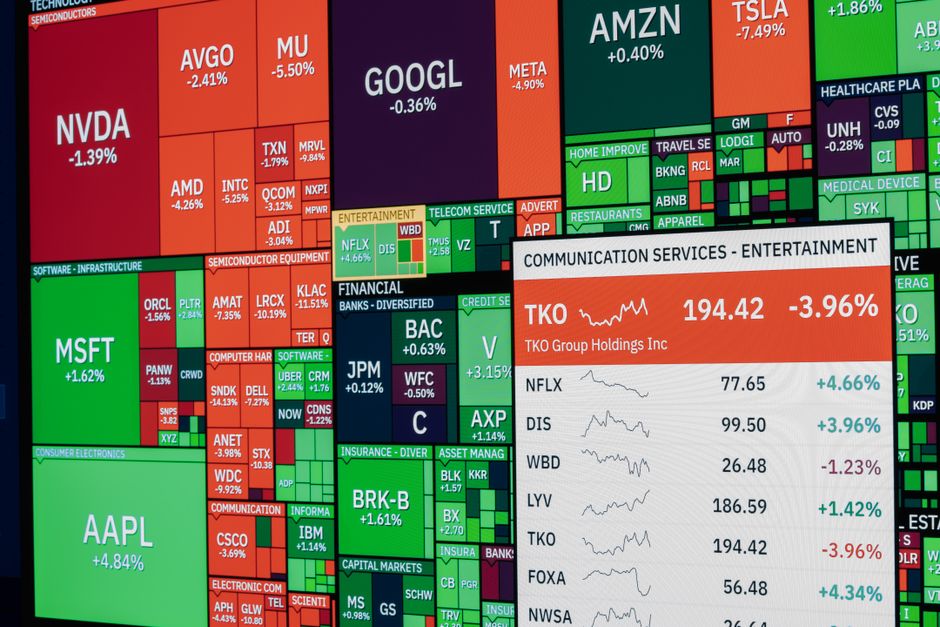
U.S. technology stocks plunged Thursday as investors questioned whether companies can keep up heavy artificial-intelligence spending. The Nasdaq Composite dropped 694 points, or 2.6%, to 26,008.86, its biggest decline since June. The S&P 500 shed 93.74 points, or 1.21%, to 7,663.43, while the Dow Jones Industrial Average edged up 11.89 points, or 0.02%, to 52,867.98.
A separate closing snapshot put the Nasdaq 100 at 28,958.69, down 2.90%. The S&P 500 stood at 7,663.39, down 1.21%, and the Dow at 52,866.85, up 10.76 points, or 0.02%. Those different figures reflect separate snapshots of the session.
Investors question AI spending
Semiconductor stocks led the slide. The iShares Semiconductor ETF fell nearly 7% in the closing snapshot, after an earlier report put its decline at 3%. Earlier in the day, reports also showed the Nasdaq 100 down more than 1%.
Investors compared Tesla and Meta’s results with their spending plans. Tesla beat Wall Street’s third-quarter estimates, but its shares fell 3% in one session snapshot and 2% in another as investors reacted to lower profitability. The company lowered its capital-expenditure estimate for the year to $20 billion from $25 billion.
Meta beat earnings and revenue estimates and issued strong guidance for the coming quarter. Yet its shares dropped 7% in the closing snapshot and by as much as 7% in the other report. Meta’s annual capital-expenditure estimate barely changed. Economist David Rosenberg said investors viewed signs of greater spending discipline as a possible indication that the AI investment boom could slow, with consequences for supplies across the industry.
Goldman Sachs projected in August that global AI investment would top $1 trillion this year. “Following an extraordinary run in technology stocks, markets are becoming more demanding around evidence of the payoff from high investment in AI and concerned about the sustainability of this spending amid higher interest rates,” said James McCann, senior economist at Edward Jones.
Oil, bonds and geopolitical risk
Oil climbed after a New York Times report, citing U.S. officials, said the United States and Israel were planning strikes on Iran after the midterm elections. The proposed operation was described as “short but intensive.” Brent crude, the international benchmark, rose more than 3% to above $112 a barrel in one snapshot and 4% to above $113 in another. West Texas Intermediate gained 2% but stayed just below $100 a barrel in the earlier snapshot. The increase renewed worries about pressure on supplies.
Treasury yields dropped as investors shifted toward assets viewed as safer. The 10-year U.S. Treasury yield fell 11 basis points Thursday, reaching its lowest level in about a month. Another closing snapshot showed an 18-basis-point decline to about 4.97%, below 5% for the first time in almost a month. JPMorgan’s markets intelligence desk said the bullish market tone had “reversed overnight” and described a “flight-to-quality trade.” The bank pointed to “the still fragile narrative around AI financing concerns and the lack of conviction / re-grossing from the recent tech reversal.” It also said hyperscalers’ corporate bond spreads had widened to levels last seen in July.
France’s 10-year OAT yield climbed 7 basis points amid political unrest. That week, the yield topped 5% for the first time in 24 years amid cost-of-living riots.
Volatility spreads across technology shares
David Morrison, a senior market analyst at Trade Nation, said both companies had delivered solid results, which made the market’s response concerning. “Not only does it show that upside momentum has waned significantly, but that intermediate support levels are creaking dangerously,” he wrote in a client note. Paul Hickey, co-founder at Bespoke Investment, said investors’ mood seemed to track individual stocks, “plenty of which have been struggling even as the indices trade much closer to all-time highs.”
CoreWeave, a neocloud company facing investor scrutiny over its debt, dropped 4% in one report and 10% in another. Its shares had fallen 25% since Oct. 13 in the earlier account and 39% from early-October levels in the closing snapshot. Nvidia CEO Jensen Huang defended CoreWeave and other neocloud companies, saying demand was “off the charts.” Reports described several volatile weeks for traders as the midterm elections approached. Treasury bonds were again serving as safe havens after a long stretch of selling tied to inflation and fiscal-instability concerns.
- technology stocks
- artificial intelligence
- nasdaq composite
- tesla
- meta
- semiconductor stocks
- treasury yields
- oil prices