
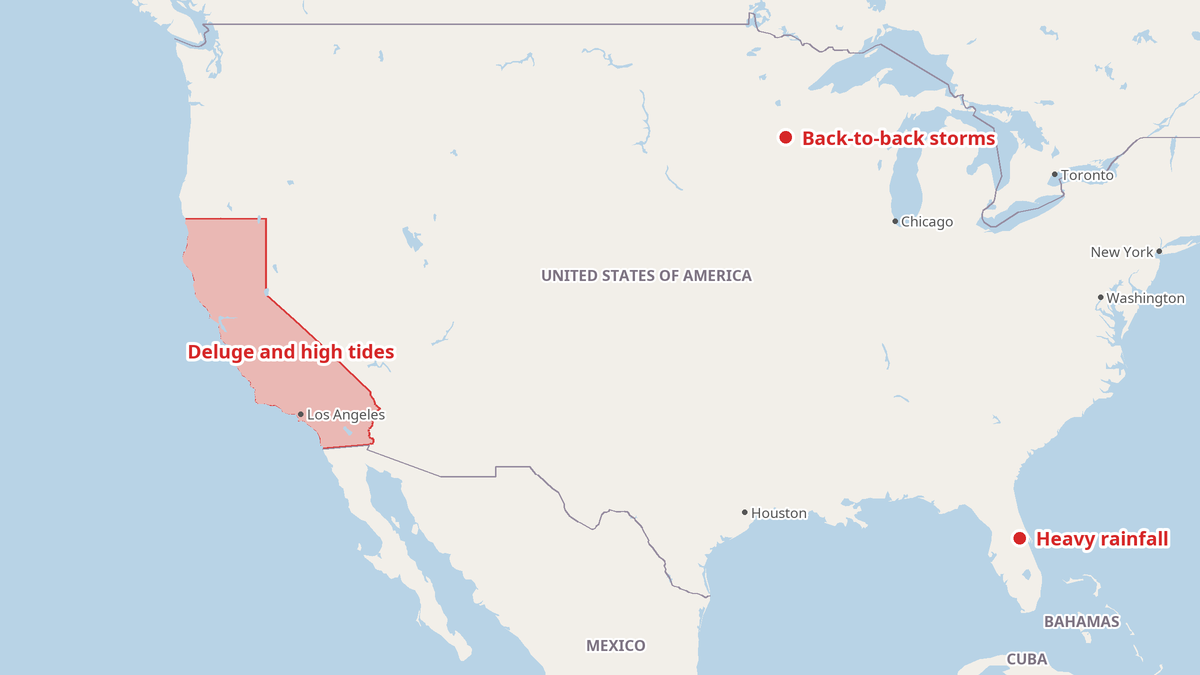
Florida’s St. Johns River rose above a record set in 1953 on Thursday as floodwaters and incoming storms threatened residents and holiday travelers in Florida, California and the Northeast. Officials warned of coastal flooding and possible travel disruptions during the Thanksgiving rush. People who must use exposed roads and transit systems face hazards, while emergency crews prepare to protect residents and small businesses.
Who Pays
Historic flooding continued across central Florida on Saturday, Nov. 21. Heavy rain earlier in the week submerged large areas of the Atlantic coast and trapped people in floodwaters in the state’s northeast. Scattered rain worsened flooding across central Florida. The National Weather Service warned boaters along Florida’s Atlantic coast that thunderstorms could produce destabilizing waterspouts. It also warned beachgoers about rough surf and dangerous rip currents.
Near Cocoa, the St. Johns River rose above the record set in 1953 on Thursday. National Weather Service meteorologist Melissa Watson, based in Melbourne, Florida, said the heaviest rain had passed, but lighter showers were expected to keep water levels rising along Florida’s longest river. “Regardless of any additional rainfall, we are expecting these river floods to continue for an extended period of time,” Watson said.
In Northern California, officials prepared for an unprecedented deluge expected to coincide with high tides during the heavy Thanksgiving travel week. Forecasters predicted the year’s highest tides, known as king tides, alongside the storm. They said up to 2 feet (0.6 meters) of flooding was likely in low-lying areas near shorelines and tidal waterways through 6 a.m. Monday, and through 4 p.m. Thursday along other parts of the Pacific coast.
San Francisco Mayor Daniel Lurie cited forecasts from the National Oceanic and Atmospheric Administration and National Weather Service, calling the coming conditions “extremely serious.” He urged residents to consider staying home for the holiday. “We are expecting tides that the National Weather Service told us they have never seen before in recorded history here in San Francisco,” Lurie said on X. “Take this weekend to get yourself ready, please stock up on supplies, get your shopping done, and know that the city will be out all weekend doing everything possible to protect our residents and our small businesses.”
The State’s Role
El Niño, the natural warming of the Pacific near the equator that alters weather patterns worldwide, spawned the storm systems affecting Florida and California. Florida typically has its dry season from October to May. This week’s heavy rain submerged coastal areas, and flooding remained even after the heaviest rainfall passed.
A separate sequence of storms was forecast for the Northeast ahead of Thanksgiving. A system off Georgia and the Carolinas on Saturday was expected to intensify as it moved north, reaching the Northeast by Sunday evening and bringing rain and wind from New Jersey to Maine into Monday. Dry weather was expected Tuesday from New York City to Boston. Stormy conditions could return as early as Wednesday, when a second system was expected to cross the region, potentially disrupting travel and bringing a chance of flooding through Thanksgiving Day.
The first system was expected to bring heavy rain, with up to 2 inches likely from Savannah, Georgia, to Wilmington, North Carolina, where flooding was possible. Frank Pereira, a meteorologist with the Weather Prediction Center, said the system was developing into a nor’easter and “continues to strengthen as it moves along the coast.”
Travel Under Strain
Pereira said the second system could prove stronger. “It looks like it could potentially be a stronger system than this first one,” he said. “It will bring impacts on Thanksgiving across the Mid-Atlantic and then into the Northeast.”
The Thanksgiving travel rush began over the weekend, a week after what NBC News described as the Federal Aviation Administration’s unprecedented nationwide ground stop had thrown air travel into chaos. NBC News correspondent Valerie Castro reported on what travelers could expect. The base article gives no figures for airline losses, worker impacts, emergency spending or resources available to travelers facing flooding and delays. It describes the hazards and officials’ warnings instead.
Across these regions, residents facing floodwaters, holiday travelers and small businesses exposed to coastal flooding bear the immediate costs. Officials have urged preparation and warned against some travel, while forecasts point to more rain, wind and high water. The account describes no organized labor response or travel-specific relief proposal.
- thanksgiving travel
- weather
- flooding
- california
- florida
- northeast
- national weather service
- el niño