
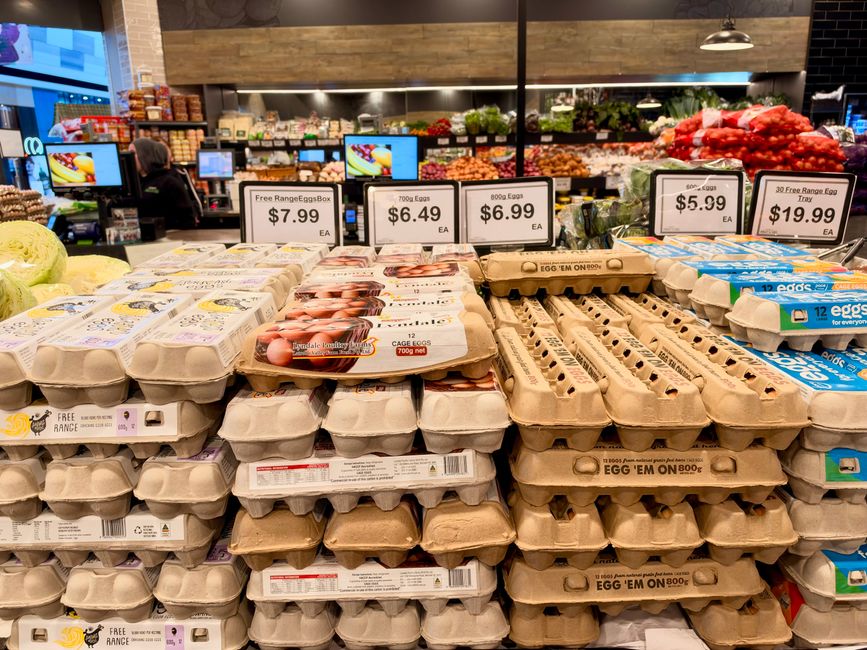
In 2022, bird flu killed 43 million egg-laying hens as supermarket egg prices began a sharp climb. Federal investigators alleged three major producers coordinated bids while prices rose. A proposed Justice Department settlement would require the companies to pay about $3 million and provide 53 million eggs to food banks, without admitting wrongdoing. The settlement hasn’t received court approval.
Who Pays for Prices
The average U.S. supermarket price for a dozen eggs jumped from $1.93 in January 2022 to $4.82 a year later. Bird flu killed 43 million egg-laying hens in 2022; supply-chain disruptions, the war in Ukraine and “Bidenflation” were also cited as reasons for higher prices.
Federal investigators said Hickman's Egg Ranch, Cal-Maine and Versova coordinated bids through Egg Clearinghouse, Inc., a surplus-inventory exchange whose bids feed into Urner Barry price quotes used in contracts with Walmart and other large retailers. Court records showed that the companies submitted dozens of bids—more than all other buyers combined—and allegedly never intended to complete them.
A Cal-Maine executive allegedly texted, “Let's hold it today.” Executives from the three companies allegedly held weekly calls to “bid up” prices. One message read, “As a group, we need to bid like they vote in Chicago, early and often.” The companies didn't respond to requests for comment.
According to a report commissioned by Farm Action, the top four egg companies held 33% of the shell-egg market, while the top 10 held 57%. Angela Huffman, the group’s head, said egg production had fallen by less than the size of the flock decline and questioned whether bird flu alone could explain a 138% price increase.
Huffman called the spike “a collusive scheme among industry leaders to turn inflationary conditions and an avian flu outbreak into an opportunity to extract egregious profits reaching as high as 40%.” Sen. Jack Reed called for a federal investigation. Two class-action lawsuits alleging that the egg industry, including Urner Barry, conspired to raise prices remained pending in federal court.
The State’s Response
The Justice Department opened its investigation in 2023, then intensified it in fall 2024. On June 29, it filed a 29-page complaint and proposed settlement. The companies would provide eggs to food banks in states involved in the case, accept an independent monitor for five years and pay a fine of about $3 million. They would avoid trial and admit no wrongdoing.
U.S. Associate Attorney General Stanley Woodward Jr. said the department intervened because “The manipulation of prices in the commodities market is not a novel concept anymore.” He said the case didn't go to trial because “the conduct had already been resolved” as prices declined. The three companies agreed to provide the eggs when prices stood at $2.14 a dozen.
Huffman condemned the proposed terms: “If you steal a truck, for example, you're going to jail. But then these executives were accused of taking millions of dollars out of the pockets of the American public over a period of years, and the result was just a slap on the wrist.” Austin Frerick, author of a book about corporate agricultural companies, called the settlement “such a joke.”
The affordability debate also encompasses wages and household assets. In August, six in 10 people surveyed said government should focus on reducing grocery, electricity and gas costs rather than raising household incomes. Repeated surveys found Americans identified rising costs, rather than stagnant wages, as the central affordability problem by a two-to-one margin.
More than 70% said the federal government should do more about affordability but was choosing not to. About 55% said their area's cost of living was the worst they could remember. Nearly two-thirds said moving up the socioeconomic ladder was harder or impossible compared with the past.
Relief and Its Limits
Jennifer Jones Austin, co-chair of the National True Cost of Living Coalition, said lower prices seemed “an easier fix because the government has not demonstrated that they're going to change the wage structure.” She said government should address both prices and wages: “if your resources are depressed, you will never be able to build assets, which in America is essential for economic security.”
The bottom 90% of households held less than one-third of U.S. wealth, a share that had barely changed since early 2011. The top 10% were believed to account for roughly half of spending. Real wage growth reversed in recent months amid inflation linked to the Iran war, while serious delinquencies on auto loans and credit cards returned to levels last seen after the 2008 recession.
Proposals include capping federal student loan interest at 2%, compared with roughly 6.5% to 9% for many borrowers, and expanding publicly owned social housing. Seattle's public housing authority acquired the 150-unit Elara in 2026. Rents there ranged from $665 for a low-income studio to $3,767 for a market-rate two-bedroom. A 5% tax on employers paying individual workers more than $1 million a year funds the authority.
Other relief efforts rely on charities. The One Big Beautiful Bill cut food aid and subsidized health care while extending a charity-specific deduction for taxpayers and corporations. During last year's government shutdown, SNAP benefits were cut off to millions of people, and food banks faced long lines. Claire Neal, CEO of MANNA FoodBank, said, “We're seeing lots of folks who have never struggled before and never anticipated to be standing in line at a food pantry.”
- affordability
- cost of living
- united states
- tariffs
- inflation
- federal deficit
- housing
- student loans